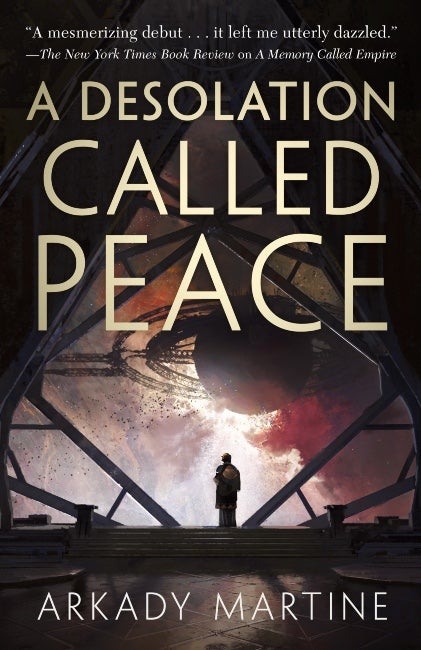
A Desolation Called Peace, by Arkady Martine

Arkady Martine has written another excellent book. A Desolation Called Peace branches out from the space covered in A Memory Called Empire, and while I know there’s more that could be squeezed from the first book’s subject matter I think this evolution serves the story (and the reader) well. And don’t worry, Martine doesn’t abandon anything she built before. Instead, she calls forward elements which had been waiting in the wings; it’s more of a shift of focus than a dismissal of the old.

Specifically, where the first book asked “what does it mean to be human, or a person? Who draws the line, and where?” as a running background theme, this book puts that front and center. And I love that. Those questions are important at any time, but they’re integral elements of a totalizing imperial worldview, and as such they’re critical to this story and setting. Honestly, those questions are part of what I love about science fiction in general, and they’re a big part of what I love about this series in particular.

Now, this book felt a little slower to me, more gradual or less heart-in-throat until nearer to the end. But it’s no less fraught. In many ways, the excruciatingly complicated fusion of the personal and political feels more poignant here, even as the book and that fusion explore new themes. And yes, Martine is still good at digging into the ways hegemony wraps itself around everything, strangling like a ligature until conformity (or death) is achieved.

Now, about this book feeling slower… I wasn’t sucked in head first the same way that I was for the first book, not until further into the book than last time. I’ve had a hard time telling how much of that comes from different reading circumstances, like changes in the time I set aside for reading, versus how much comes from differences between the two books. Either way, I’m pretty sure it took me much longer to read A Desolation Called Peace than it took me to read A Memory Called Empire

But the magic that Martine conjures in the first book is still present. A Desolation Called Peace is still full of heartfelt complicatedness, and confusing wants and desires and struggles, and its *really good*. The conflicts brought to the surface here are wonderful. I like seeing them on the page. I haven’t seen them in other books any time recently, and it feels really good to see Martine explore the ways in which hegemony and empire worm their fingers into everything, no matter how intimate or pedestrian.

Unlike with some other series (e.g. Becky Chambers’ books), order matters here; you should absolutely read A Memory Called Empire before you read this one. If the first book wasn’t to your liking, I’m afraid this one probably won’t be either. But if you’re not a light reader, and if you want good intrigue, ethical dilemmas, questions of humanity, interestingly alien aliens, and the baggage of empire… this is your deal.
Facing grief and trauma in genre fiction

I’m a fan of adventure stories and genre fiction. Genre fiction covers a lot of ground, but you can probably guess what I’m talking about: fantasy adventures, intrigue, sci-fi thrillers, that sort of thing. Not, generally, the stories that literary critics make happy noises about and call “art” or “good literature.”

I don’t think genre writers should mould themselves to the expectations of literary critics. The personal tastes of many of those critics don’t match mine very well. They have too little appreciation for plot, for things happening, to really fit my tastes. But there are a few places where I think the general approach of genre fiction feels… emotionally dishonest, stunted, or like it (sometimes) does us as readers a disservice.

This puts me at risk of agreeing with those literary critics on a few points, which makes me (as a long-time ardent genre fiction fan) a little nervous. 

As you might guess from the title, my quibble revolves around characters’ experiences of grief and trauma in genre fiction. The pattern I see is that genre fiction doesn’t deal deeply or honestly with the impact of the traumatic experiences it puts its characters through. It prioritizes the excitement, the adrenaline rush, the problem solving… and leaves healing from one’s wounds—or picking up the pieces of one’s emotional and social life, or facing one’s lasting pain—entirely out of the picture. Facing trauma and grief, to put too-small a name to it.

A general caveat: I think the patterns I’m discussing here have changed somewhat since I was a kid. It is easier now to find exceptions to the pattern I talk about here, and the pattern may be shifting. But the pattern is still visible, and will probably be recognizable to anyone who’s read certain sub-genres (mil-fic is an easy example).

Where this kind of genre fiction does deal with that trauma and grief, it frequently responds with the blaring one-note horn of limited (toxic) masculinity: anger, revenge, and action, with no time set aside for reflection or any other emotional experience (generally regardless of the gender of the characters involved). I’m not surprised, really: I see in this the parallel discomfort modern American society has had with any discussion of emotional experience, or any need for psychological aid, spiritual counseling, meditative practice, or anything else meant to soothe and heal (maybe excepting the use of drugs or sex as an escape).

I don’t want all of my adventure stories to fixate on the main characters’ desperate need for therapy. That’s not the solution I’m looking for. But it would be nice for more of our genre fiction to, as I’ve seen more examples of recently, deal honestly with the impact of going through all of these exciting, interesting times. How is it that our heroes learn to cope? How are they breaking under the pressure of being heroic? Who’s supporting them, and how? Where are the quiet little moments of Frodo leaning on Sam in the face of terrible odds and endless danger?

I want to read stories where the heroes’ struggles in the face of unyielding badness are more palpably human, less opaquely stoic. And if our heroes are stoic, I want to see the work they put into maintaining that stoicism, holding that balance, despite the exceptional lives they live. It’s the failure to show this side of our heroes that feels like a disservice to us as readers.

That’s especially true in anything that isn’t epic or mythological. What I mean by that is, the further from the banalities of life the focus of the story falls, the more leeway I give it—if you’re writing about characters who are more-than-human or even forces of nature, I don’t have beef. But I’ll add that exploring the emotional depth of those characters (even off-handedly, I don’t need whole chapters about someone’s anguish unless that’s what the book is about) nearly always builds more connection for me and gives me a better sense of the character as a person. And I like that. The more I know what characters care about, and the more ways I have of exploring that, the better as far as I’m concerned. Especially if it’s done with a deft hand and subtly incorporated.

I hope that this old pattern will change. I can see ways that it already has, in the books I’ve enjoyed most recently. You can probably see me writing about those books, those stories, elsewhere on here. Let’s see more of that change.

A Memory Called Empire, by Arkady Martine

Arkady Martine absolutely knocks this one out of the park. 

A Memory Called Empire is a lot of things, but at its heart is a bittersweet tension of love, admiration, and despair for a culture and civilization which will destroy one’s own. It’s about being caught on the outside, stuck as an outsider despite so much work done to fit in. And it’s a thriller about loyalty and betrayal, both expected and not, from without and within.

It’s an excellent book, as I said when I mentioned it a couple weeks ago.

I’ve struggled to write anything more here, and thrown out a few hundred words that might spoil the book for you. Exploring what Arkady Martine does so well without giving away her story is… challenging for me.

She’s managed to write a compelling culture, one in which I can see traces of several historical imperial courts and practices, and held it up for us the readers as a deep and multi-layered thing tantalizingly out of reach of our own comprehension. The fraught weight of meaning is present and palpable, but just enough is lost in translation for us to experience it mostly as our narrator does, unable to be a full part of it as anything but barbarians.

Speaking as someone who studied linguistics, and specialized in the production of ideology and ideological identity through political speech, this book is a delight. Speaking as someone who loves studying political science, international relations, history, and the rise, fall, and gradual mutations of empire, this book is marvelous. And as someone who deeply appreciates heartfelt stories juxtaposed with intrigue and danger—wow.

I’m trying not to ruin anything for you. Please just go ahead and read the book. It’s really good.

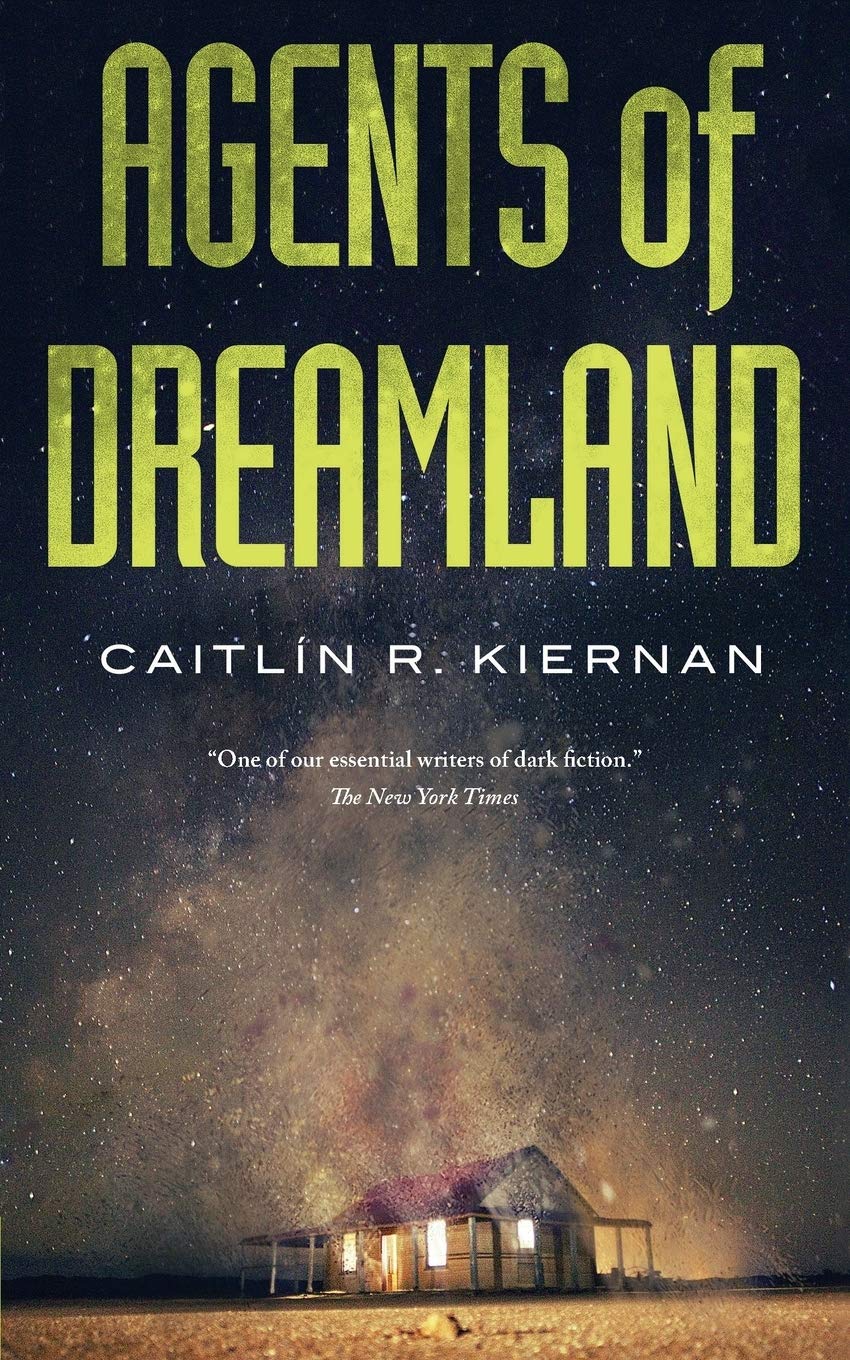
Agents of Dreamland, by Caitlin R. Kiernan

The fourth and final member of Tor’s Reimagining Lovecraft novella collection, Agents of Dreamland by Caitlin R. Kiernan, brings the weird and the uncomfortable home to roost.

Of the four stories, this is the one that felt least complete to me. It left obvious spaces open for the story to continue, implications that want some kind of follow-up… but I think I can see why the story stopped where it did. The novella contained its own neat little arc, even though the completion of the arc didn’t resolve the larger story lines this piece opened. Worth noting: there are sequels to this story, though I haven’t yet read any.

Each of the four novellas in this collection builds on a different part of the Cthulhu Mythos, and I’ve found aspects to appreciate about every one of these reinterpretations. They all draw out facets of Lovecraft’s stories—sometimes things he wrote explicitly, sometimes things he implied but failed to recognize—and I’ve enjoyed them as a return to cosmic horror, a way to engage more with stories that I’ve put aside in distaste but which still hold some good core of fright.

And that good core of fright is precisely what I think CRK captures so well here; its presence is the reason that I don’t feel at all cheated by this story. Despite leaving me wanting more resolution, more progress, Agents of Dreamland absolutely satisfied my desire for the Mythos’ pressing discomfort; Kiernan pulls from multiple pieces of Lovecraft’s work—the sometimes goofy and poorly written bizarre monsters, the fairytale otherness of (mis)understood dreaming—and delivers a horror story that holds together as whole cloth. It’s a reimagining, like it says on the novella collection, that improves on the material it draws from. Just like the other pieces in here do, but in its own distinct way (like, again, the other pieces in here do).

In many ways, I think Agents of Dreamland is the most Lovecraft-ish reimagining of the four novellas. Kiernan improves on the original content in a way that feels most comparable to the source material. Maybe that’s why I kept thinking about Call of Cthulhu and Delta Green games while reading it.

Anyway, yes, it’s another good piece in a good collection. If you like Cthulhu Mythos stories but are tired of / disgusted by Lovecraft, or could never get into those stories because of Lovecraft, I suggest these. They vary a lot from one novella to the next, but I’ve enjoyed them all a great deal.

Hammers on Bone, by Cassandra Khaw

I’ve finished two good books recently, A Memory Called Empire and Hammers on Bone. They both deserve more than a passing mention, but I’m only going to talk about Hammers on Bone right now—I’ve struggled to find good ways to cover A Memory Called Empire without spoiling things, and I’m taking the easier way out.

I read Cassandra Khaw’s Hammers on Bone through the same bundle of four novellas that brought me to The Ballad of Black Tom and The Dream-Quest of Vellitt Boe. I’m glad to say that this book deserves its company. Reading this has inspired me to tell my own investigative horror stories again, through its good example and obvious love for the material; for comparison, these days Lovecraft only evokes that kind of reaction for me by way of spite and a fierce desire to do better than he did.

Perhaps that’s what drove Cassandra Khaw. Whatever the case, they succeeded.

Evocative, punchy, and more full of body-horror and gore than I’d expected, this book wears its love for the stylings of noir on its nicotine-stained sleeve. Seriously, I haven’t read about this much smoking in years. But it’s a story that comes with all the scummy details and twists I expect from old PI noir, alongside the horror of the Cthulhu mythos and a grasp of descriptive language that leaves me reeling in envy and admiration. Not everyone should try this style of evocative, nearly synesthetic detail, but DAMN does Khaw make it work for me. Their prose lays on atmosphere so thick it’s like drowning, mashed face first into the yellowed pages of cheap detective pulp.

And it works. The quasi-hallucinatory perspective, with its depth of detail, goes beyond merely fleshing out a character voice; it rapidly told me more than I’d realized about who our narrator was… and how Mr. Persons was not at all what I’d first thought.

It’s not a big book, not a long story. It’s a quick and potent read, much faster for me than most of the other pieces in the Tor.com novella collection. If you like horror and noir it’s practically a must. I definitely recommend it. Get it here. Or buy the whole bundle (which I’ve enjoyed so far) here.

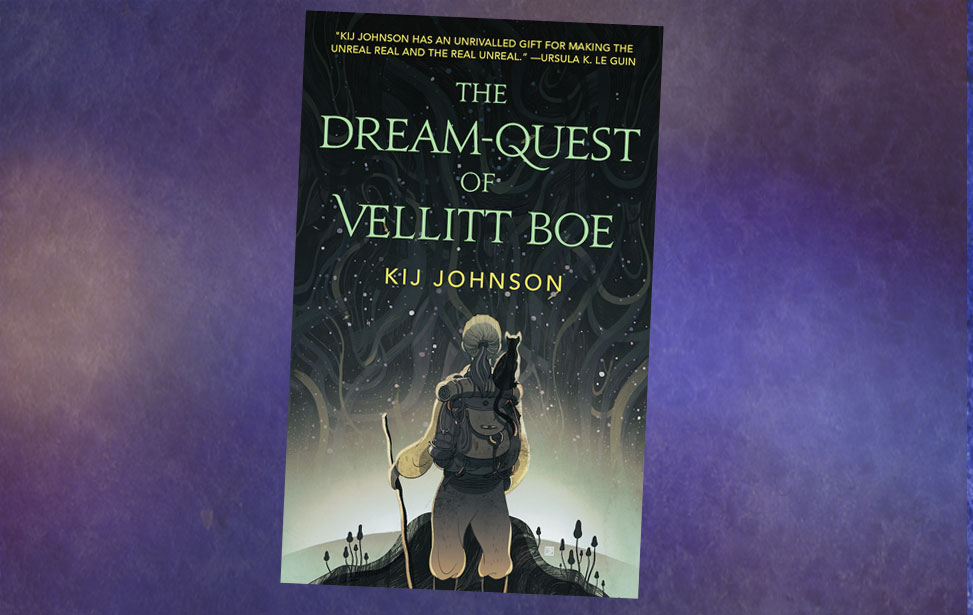
The Dream-Quest of Vellitt Boe, by Kij Johnson

Kij Johnson’s The Dream-Quest of Vellitt Boe was a slow burn, and a good one.

I admit that it lost its compulsive hold on me part way through. I was distracted. My reading wandered, and I consumed several other tasty books. But when I returned to it after some time away, I finished it in one sitting. And while my hair did not stand on end (much harder now with its covid-length), this story does an excellent job of peeling back the skin and exposing fresh, homemade, very human discomfort.

Another friend of mine absolutely adored this book and inhaled it in one go, unable to put it down. In talking about it, we speculated that my distraction in the middle may have come from gendered differences. Perhaps, we thought, I was less caught up in it because it felt less intimately personal. Your mileage may vary.

Whatever the source of that difference, I absolutely agree with her (and with whomever decided to bundle these books at Tor) that like The Ballad of Black Tom (my review, Goodreads), this book does a beautiful job of reimagining abysmal source material with vibrance, reality, and truth. The Dream-Quest of Vellitt Boe captures the same strange wonder and eeriness of Dreaming that I remember enjoying from Lovecraft’s work, while shedding Lovecraft’s awful baggage. I firmly believe that this story, like The Ballad of Black Tom, is superior to HPL’s work.

Read the originals only if you must, and only if you’re ready for how much worse Lovecraft was.

Speaking of ‘must,’ this story is an adventure of musts and mustn’ts. It’s about being pushed, pressured by society and those with more power. And this story is more concerned with wily survival against the wishes of malignant potentates than with any fulfillment of internal, personal dreams and desires. In fact, it’s about quashing one’s own hopes in order to conform, in hopes that conforming will offer some protection. That is part of what sets this story up so well as a piece of slow horror, but it’s also foundational to why it feels so honest. Our protagonist, Vellitt Boe, struggles against constraints even as she tries to uphold them; she’s caught in a vise, doing her best to protect the little island of home she’s found, the little space for broadening life’s horizons she’s been able to settle into… but to do so, she must drag another woman back from those broadened horizons, back into a constrained life, lest many more lives be lost.

Horrible. Perfect.

Now, some very light, very generalized *SPOILERS*…

The late-in-the-story turnaround leading to the story’s final resolution seems obvious when I think about it now, but it caught me by surprise in the best way. And throughout the story, I loved that Vellitt Boe accomplished more through her own previous experience—and the relationships she’d forged over her well-traveled life—rather than through any personal skill mastery or super-ability. Being experienced in the ways of the world, having old allies, and knowing how to convince people to do what she wanted all did more for her… and that felt perfect. In so many ways, Vellitt Boe is the opposite of the heroes or narrators chosen by Lovecraft, or his contemporary Robert E. Howard. And the fact that Vellitt Boe’s connections to other people are so fundamentally instrumental to her success… it feels to me like a beautiful refusal of the ideologies of the source material.

End *SPOILERS*.

Look, I like this book. I definitely recommend it. More deliberate than fast-paced, The Dream-Quest of Vellitt Boe is full of subdued horror, is uncomfortable but rewarding, and is very good.

Rewrites, Dying, and Seeing Beauty

I wrote a scene in my Protectors setting soon after New Years, one that resonated really strongly with me. It felt good. It was obviously either the emotional climax of a story, or one of two emotional climaxes. That scene just as obviously needed more material to support it. It was, in some ways, like finding out that I’d built the middle of a bridge’s span and still needed to build the rest.

As I wrote the rest of the story, I discovered that—to remain honest to the characters and story—I either needed to write something that felt depressing and which I didn’t want, or I had to find a very different way of reaching the conclusion I’d hoped for. My first attempts at this didn’t go well. I tried forcing the conclusion I’d hoped for, and it felt dishonest, jammed into place. Then I mapped out what would happen in the depressing version, and just felt sad.

So, rewrites. Rewrites and talking with my mom (and crit group) about my narrative struggles.

My crit group agreed that I probably had to write out both versions and see what happened. They also noted that writing the depressing version might be more in keeping with the setting. My mom, on the other hand, offered up some observations from a book she’d read recently about mortality and the experience of approaching death and dying (Advice for Future Corpses (And Those Who Love Them): A Practical Perspective on Death and Dying, by Sallie Tisdale).

A little context: my mom has done a lot of work with the elderly (and is now reaching elderly herself). When I was a kid she did a good deal of work with patients in hospice—palliative end-of-life care. Her second husband, my stepfather, was a good deal older than she was, and the two of them met because they were both working in hospice. They read many books together, especially about philosophy, meditation, and the experience of growing old and dying. My stepfather died last fall. What I’m trying to say is, it’s hardly new for my mom to share something from her readings about mortality.

If you’ve read any of my stories in my Protectors setting, you’ll understand what I mean when I say those stories are rarely about growing old but often about the experience of encroaching death. My mom’s contribution was pretty on point.

The bit she mentioned was an experience which is sometimes shared by those who are dying, one she said my stepfather had spoken of: the heightening of one’s appreciation for the everyday, and for beauty in the everyday world. Not that the world is itself different, but that—in the process of dying, faced with imminent death—the world’s vibrancy and glory are more evident, more accessible.

And that felt like the missing key.

Thinking on it now, this feels like part of the gratitude and joy, or the quiet meditation on beauty, which I see in some Buddhist meditative tradition. And that experience of beauty, gratitude, and joy was the second step I needed to follow the first emotional climax. The transformative nature of those feelings, the fundamental shift from despair and depression to wonder and awe, is at the heart of the emotional shift I needed.

I still have to write it and make it stick, of course. I’m part way through that. I’ve got to put together another few scenes, replace a few others with new ones, and then print it up and see whether it makes any sense. I don’t expect it to work on the first (second?) attempt, but maybe it will at least look a bit more like a finished bridge… something I can work with.

Thanks Mom.

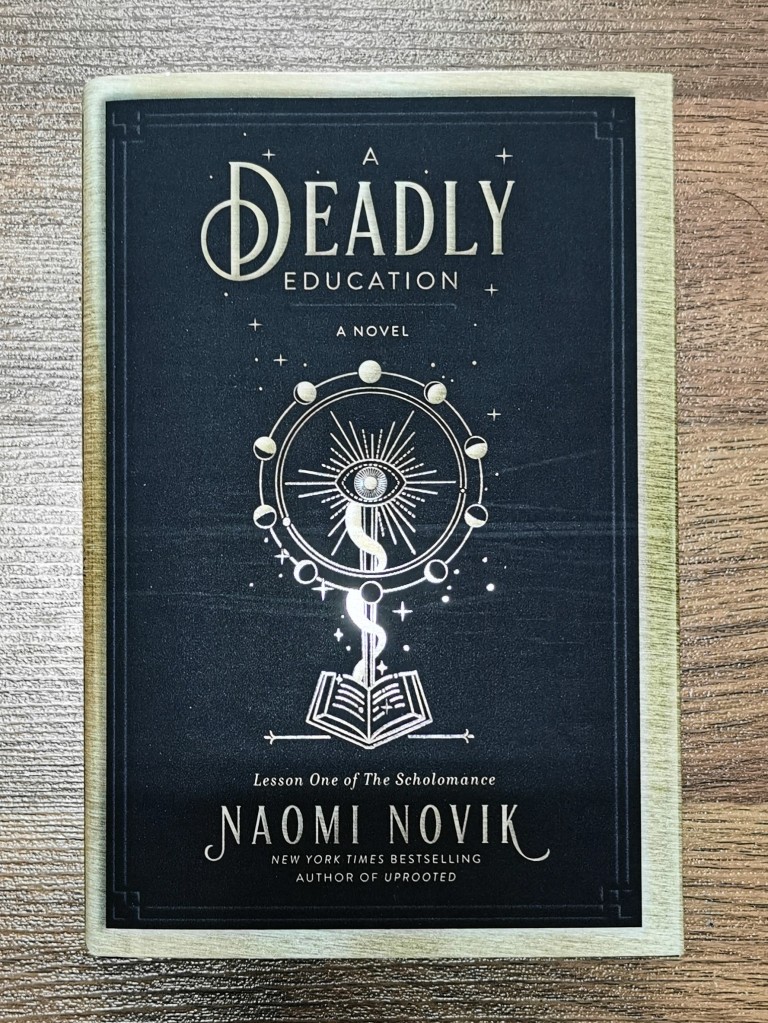
A Deadly Education, by Naomi Novik

This book reads like fanfic grown wild and untamed, the sturdy and feral descendant of stories past. That, in my mind, is a good thing.

I tried to sum up the novel’s concept, as practice for making pitches and loglines, and came up with something like… “what if Harry Potter, but the school is *literally* a death trap full of monsters and there aren’t any adults around to ‘help?’” Add some socioeconomic inequality, teen drama, a pinch of prophecy, and an antisocial and justifiably angry teen girl for a narrator, and you’ll have a pretty good idea of what Naomi Novik’s A Deadly Education is like.

I enjoyed the hell out of this book.

I did not, apparently, read the first released edition. Before posting this, I read a little bit of other commentary on A Deadly Education, to doublecheck my own impressions, and found some critiques of what seemed like racist content that I had entirely missed. It turns out that I wasn’t oblivious (this time): Naomi Novik acknowledged those critiques after receiving them last fall, said the language was unintentional, undesired, and unnecessary, and removed it from later versions of the text (including the version I read).

Honestly, the only thing that seemed off to me was the lack of more queer folks. As someone who works with kids and teens, I’m kind of surprised that there was so little overt inclusion of characters who weren’t cis and het, even in the background. Yes, it’s easy to read one or two characters as queer, but “plausibly deniable” inclusion just isn’t the same thing. I know that Novik has included queer people in her Temeraire books (only as side characters sadly, but important and beloved ones), and—given the change in context from Napoleonic-era historical fantasy to modern teen fantasy—the general lack seems like an avoidable oversight.

Now, of course, dating and romance necessarily take a back seat to simply surviving in this story. Certainly it could be argued that our protagonist, outcast that she is, is paying more attention to other things than the sexualities and genders of those around her. But she’s also an astute social observer, and I would expect her to pay attention to who was dating whom (or who was crushing on whom) if only for the way that those relationships would change power dynamics in the Scholomance. Surely someone in that hell-pit of a school is openly queer.

That said, the lack of more queer rep was not a dealbreaker for me. I was still stuck in this book, pulled back in repeatedly. I’d open it while my computer turned on, and then keep reading while the machine patiently waited for my password. I’d open it when I sat down for lunch, and lose an afternoon. I’d open it as I lay in bed, and then struggle to put it down and sleep. This book grabbed me, and I want the sequel.

Putting those issues aside, I rather liked the book’s commentary and focus on inequality, and the way that inequality is baked into the setting as a driving force. It’s poignantly, painfully honest—and reminds me in a good way of later themes in the Temeraire series. The resources available to any wizard are a vital concern, and they’re literally life or death for students in the Scholomance. People will do nearly anything to get an edge, or keep one, and that desperation is the lifeblood of this book. I’m so glad that it’s brought to the forefront here.

Yes, I recommend this book. If you wanted more teen wizards, awful and dangerous schools, teenage drama in terrible circumstances, or delightfully and justifiably angry female narrators, this book will make you very happy. Indulge yourself.

Also, if you want another perspective on the book, check out this naga’s thoughts. I used the image at top from that site.

Novelizations Panel Schedule, Arisia 2021

Come hear me (and other people) talk about Movie Novelizations!

1pm EST, Saturday Jan. 16th, this coming weekend.

I’m only on the one panel this year. This is a far lighter load than I had last year, when I was on seven panels and modded four of them—one of those by surprise (the Harassment one).

Part of me is a little sad about doing less this year. I really do enjoy being on and moderating panels, for all that I was worn out by it last year. But another part of me is fine with it; I have a weekend that I can use to do other life-things. I won’t come out of this weekend feeling run down from running around constantly and talking non-stop for hours on end.

And yet.

I enjoy nerding out about a hodge-podge of topics, and I enjoy listening to other people speak knowledgeably about their areas of expertise, and I *really* enjoy shepherding panels through their explorations. I’ve made some good friends, people I value reconnecting with, over the years that I’ve been at Arisia. I’ll miss seeing and talking with them this year. I’ll miss being on panels with them.

There were fewer panels offered this year that called to me, fewer panels for which I thought “oh that one fits me to a T” or “I could really add something there.” I don’t think that lack is beyond normal variation, especially given the trying circumstances for any convention this year. And I don’t mean that there aren’t good panels on offer, merely that there weren’t as many that felt correct for me.

If you’d like to hear about movie novelizations, or the struggles involved in translating any given story across media, come check out this panel on Saturday. I hope you’ll see me there.

Movie Novelizations at Arisia 2021

I’ve had a writing break. I’m still on break, as it were, at least for another day or two. Working at home so much even before the pandemic means that I’m used to the struggle of easing myself back into my work schedule. Doesn’t make it easier. Reading about people’s struggles adjusting to working at home last March and April was vindicating, and offered guilty nourishment for my schadenfreude.

This year I will be attending Arisia virtually, and will only be on one panel. Organizing Arisia for 2021 seems like a particularly difficult and thankless task, so I am glad that a) someone else is doing it, and b) they’re still doing their best to run a convention despite COVID-19. After working digital LARP camps this summer, I really didn’t want to be on more than one or two panels in a weekend, so this is perfect for me.

The panel I’m on this year will focus on movie novelizations. I hope to include some exploration of other translations of story across media (from pure-text to text with illustration, animation, or live action… and vice versa). I’m fascinated by the ways in which stories (and the story-telling arts) change as the medium shifts, and the ways that story elements become more or less accessible for audiences across different media.

I don’t think that any particular narrative tricks are *impossible* to translate from one medium to another, but they’re certainly not all equally easy to alter.

Take, for example, the ability to convey internal emotional state. A story told purely via text can be first person, granting the reader direct access to the character’s emotional and physical state. In live action form, on a screen, that character’s emotional state is only accessible through the viewer’s interpretation of the actor… with as much (or more) variation in interpretation due to a viewer’s personal response to an actor.

Or perhaps I should compare the ease with which text can dilate and contract time, glossing over the details of a battle in a few sweeping sentences (Lloyd Alexander does this neatly a number of times in his Chronicles of Prydain series) while giving tight focus to an emotional conversation. Live action film can do these things, but I think the audience’s perception of time (and how time works on the screen) is different than the assumptions of a reader. Meanwhile, film can convey a myriad of elements in one shot, encompassing more details (and background clues) in a single frame than is feasible by text; Knives Out is a glowing example of this.

All of which is to say, I’m very excited to nerd out about this with other similarly excited people. I think there’s a lot of good material to explore.

I’ll post more details about when this panel will be when I know more myself.