Monday’s post gave a taste of the game that I’m preparing, but didn’t go into any details about what would follow. That was intentional. If there’s any chance that I’ll run this game for you, I strongly suggest that you don’t read what comes after the break. If you want to see some of what I’ve come up with, and maybe a bit of how I came up with it, read on.
Category Archives: GMing
New D&D Sneakily Poaches Inclusivity, Narrative
I grew up playing AD&D, as my brothers introduced me to RPGs before I was 7. I’ve since moved away from the various D&D systems, flirting with them occasionally in passing while I instead focus on other systems that I find more interesting; I’ve come to prefer more narrativist games for the most part, though my friend Zach’s super-old-school D&D certainly calls to me at times. But with the release of the newest edition of D&D (5th ed? Next? Whatever we’re supposed to call it) I thought I’d give it a look. I’d examined some of the playtest documents and made appreciative noises, so I thought I should take a chance. I’m glad I did. It seems like the new D&D has learned a few tricks from the games that pulled me away from it in the first place.
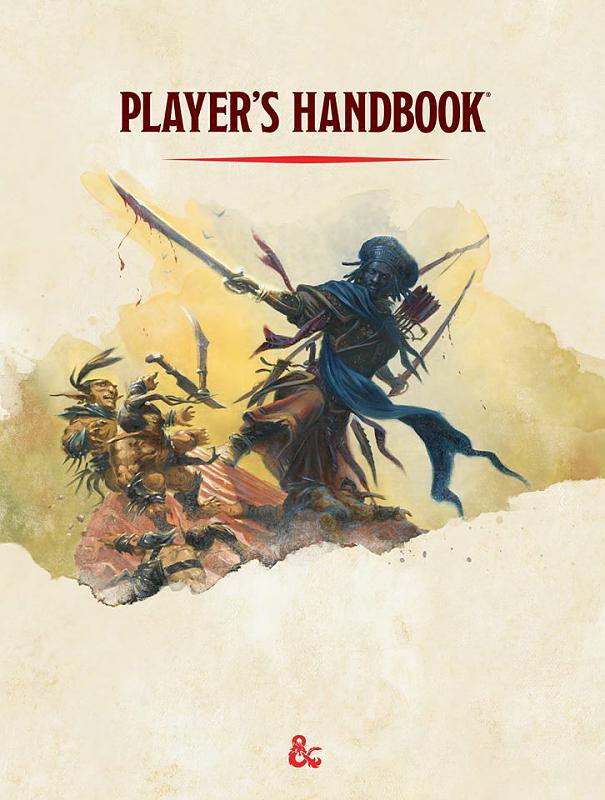
There have been a few things that have really stood out to me while I’ve been reading the new Player’s Handbook (PHB), two quite good and one that I’m not sure how to qualify. These have nothing to do with the rules, I’ll talk about those later. The first item is one which I understand has already been discussed elsewhere, namely the game’s specific mention of a player’s ability to construct their character’s gender- or sexual-identity, and statement that that’s a perfectly fine thing to explore in this game; the second item is D&D’s incorporation of distinct backgrounds, personalities, and motivations into character creation, including something called “bonds” which I can only presume has come from Dungeon World; the third item is the art chosen for the book, and its depictions of a diverse group of characters. I’ll talk more about all of these, but let’s tackle that last one first.
What Flavor Is Your Game?
I like vanilla ice cream. I have for a very long time. Before I knew my alphabet, much less how to read, I knew that hearing my older brother spell out “I-C-E-C-R-E-A-M” meant that I should start asking Mom for ice cream too. Better yet, as I got older and discovered the joys of living in Vermont (home of Ben & Jerry’s before it was bought out by Unilever), I learned that there were far more flavors of ice cream available, and that many of them were exceedingly tasty as well.
When I was little, I played make-believe all the time. A number of my friends simply couldn’t understand the appeal, and stopped playing with me, but at the tender age of seven my older siblings harnessed my ambitions and introduced me to 2nd Edition AD&D. My introduction might actually have been earlier, but that year was the first time I can remember staying up until midnight to play RPGs with them. Over the next few years, I was introduced to Vampire: The Masquerade (along with a bundle of other White Wolf games), D&D’s 3rd Edition, In Nomine, and GURPS. More other games followed. Just like with ice cream, I had discovered a whole new world of flavors to choose from. I was very nearly overwhelmed by my enthusiasm. These days, some people refer to me as an RPG snob. I much prefer the term ‘connoisseur’: through dedicated consumption, I have built an appreciation for the inherent flavors of different game systems.
But what the heck do I mean by “flavor”? And how do you figure out what a game’s flavor is?
Dungeon-Starter: The Duke’s Men
Happy New Year!
Here’s an abbreviated dungeon-starter for Dungeon World, building somewhat on the material that I came up with for The Duke’s Men. Agenda, Goals, and Dungeon Moves are at the top as per usual. This is mostly focused on cultists and such, as the game itself was, but the basic storyline offered in my previous post could easily be altered to deal with any number of different kinds of threats.
The Duke’s Men: A DungeonWorld Adventure
A few days ago, I ran a game of DungeonWorld for two of my friends. It went so well, and ended up feeling so much like a classic Dungeons & Dragons adventure, that I thought I would share the basics of the game with you. It’s somewhere between an actual play and a scenario description. I’ll put up an honest-to-goodness Dungeon-starter soon, and with a little creativity you should have an easy time converting it into your own single- or double-episode game.
We didn’t look too closely at the backstories of our heroes, but please allow me to introduce you to the adventures of Kate the thief and Jonah the ranger (and Jonah’s wolfhound, Erasmus), the loyal representatives of Duke Blackforest. What follows should allow you to live out their adventures for yourself, or change things slightly and experience the adventure anew with other people.
And Then You Die: A Good (Character) Death
Bye bye Boromir.
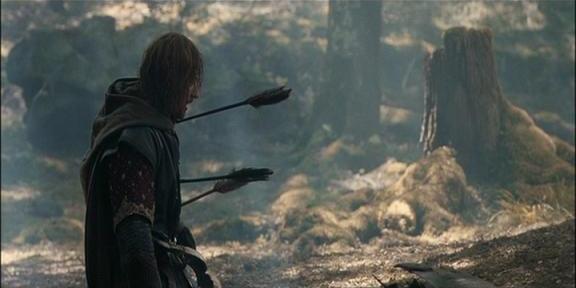
I love Boromir. I know I’m not the only one who does. And however much I like Boromir when he’s alive, there’s something that’s almost even more (tragically) appealing about him dead. This is less because I like his ruggedly handsome corpse, and more because of what Homer touched on thousands of years ago: in his death, because of how he died, Boromir becomes something more than he was in life. Boromir had what we might call a good death. Key to this, Boromir dies before he truly succumbs to the power of the Ring, and in his death he tries to make up for some of the mistakes that he has made previously. His act of self-sacrifice protecting the Ring-bearer is a fairly hefty weight in his favor on the scales of Judgement, making up for some of his earlier errors. Interestingly enough for such a perilous setting, he is also the only member of the Fellowship to die and stay dead.
It turns out that that single heroic death is pretty standard. Most stories, like most role-playing games, don’t have lots of character death. In reality, people engaging in the same activities that most adventurers and main characters pursue with wild abandon have a fairly high casualty rate. People are killed while fighting, they’re permanently injured, they get sick… and in many cases, their deaths and debilities feel meaningless. For every handful of people that die doing something we would idolize as heroic, far more are killed or injured in an almost banal fashion. Would we feel the same way about Boromir’s death if he had, I don’t know, been killed without having a chance to fight back? Stepped on a landmine? Slipped in the shower and broken his neck?
Define Your Terms! Talking about RPGs
Let’s start with the title. When I say RPG, I (usually) don’t mean rocket-propelled grenade. Usually.
No, this post is meant to unpack the terminology surrounding role-playing games, and to be used as a future point of reference. I’m also going to refer back to Mattias’ excellent post about role-playing, because he did such a damn fine job of describing what role-playing is.
All three of us have written about role-playing games (check out the GMing category, and look at the older articles). Yet for the most part our posts have assumed a certain level of familiarity with RPGs and their terminology. I’ve certainly presumed that other people know what I’m talking about; but what the heck does it mean when I call a system “sparsely elegant“?
In an effort to minimize confusion, here’s a quick primer that will begin to bring you up to speed. I’ll do my best not to cover things that were done better elsewhere (see Mattias’ article, really), but there may be a little bit of overlap.
The terminology and topics that I plan to cover…
Temple in the Sands: A Musical Teaser
I’ve been working on a module for Call of Cthulhu for several years now, and I’ve finally found a model I like for organizing my written content. It’s not fancy, and I’ll have to alter a few things eventually when I get around to posting maps and pictures alongside the text, but it will mean that other people can play the game that I’ve made without me running it for them. But the module isn’t done yet, and is already far longer than most of our posts. So with that in mind…
Fleshing out the Details
So now that we have a setting, let’s add in some details! One thing that can derail a campaign most are details. Why? Well, because details are at once meaningful and arbitrary. That is, details have to be consistent with your universe, and they shouldn’t establish any themes which your universe/story isn’t tackling, but they also aren’t always important. I once had to name a tavern at random. So I decided on a color and an animal/cooking object. After all, Black Bull, and the White Swan, or the Red Ladle, are all perfectly good tavern names. And this is how I ended up with the Red Bull Tavern, something Henry was so nice as to tease me about it here, and I’ll probably never hear the end of how I named the Mayor ‘Hamer’, which was intended to be pronounced “ha-Mare”, but ended up being called “Mayor ha-Mayor”. So it is important to make sure to make sure that your random details are unobstructive. But how do you craft important details that are meaningful?
Gamer Typology a la Robin Laws
We’ve been talking a lot about improvisation and working with your players, but we haven’t given you nearly enough background for the topic. There’s a book that I found years ago called Robin’s Laws of Good Game Mastering, and I lend or recommend it to every one of my friends who asks me for tips on how to be a good storyteller. I like it so much that when I started looking through my old copy again while I was starting this article, I had to stop myself from simply quoting the book word for word. It’s more than just a good place to start; the book has an impressively down-to-earth approach that will give you a basis for campaign and adventure design, for preparing easy improvisation, and for reading and managing your gaming group’s social (and problem solving) dynamics. It also offers a very simple gamer typology that should allow you to identify what drives you and your players and what rewards them most in the realm of RPGs. If you’re interested in gaming or in group dynamics, I couldn’t recommend a better read.