Sword & Sworcery

firstlook

The Scythian.

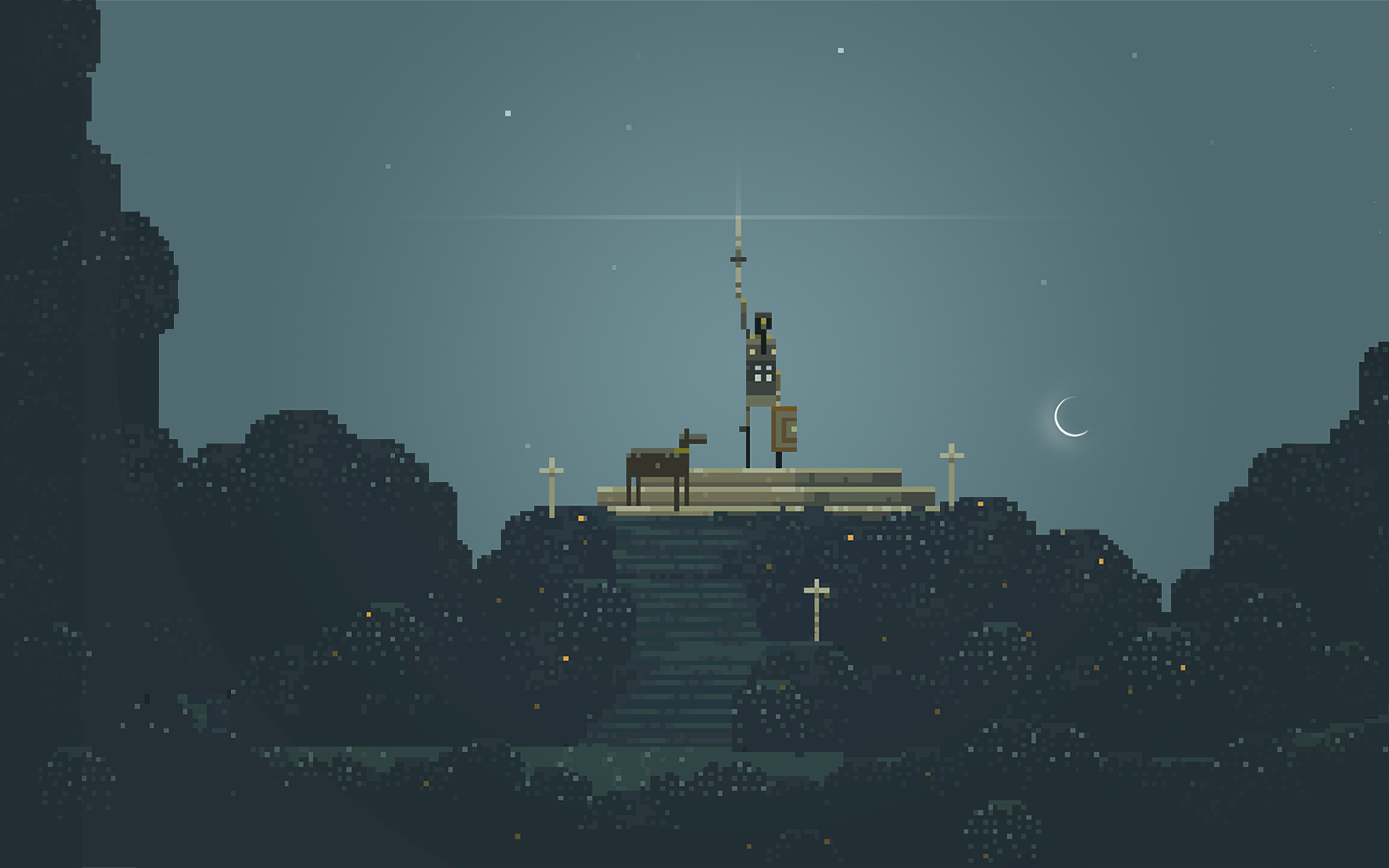
I finally finished the magnificent Sword & Sworcery.  This game is a sumptuously designed experience.  Sword & Sworcery shattered my expectations by providing such a beautiful and completely enveloping story that I almost want to call it a story before I call it a game.  And don’t get me started about the sound design.  Or rather, do, because the music is simply a delight and the sound design creates a beautifully ethereal and dreamlike space that lends an air of enchantment to the entire piece.  I’m listening to the music right now, just because I can.

This game is wrapped up in a bizarre shell of self-awareness, with the other characters completely cognizant of the duality of the game and maybe even aware of how everything will end.  And yet it still has an emotional pull that I haven’t found in any other games I’ve played recently.  Stories I’ve read, movies I’ve watched, yes.  Games?  No.  Despite a one year hiatus part way through completing the game, I’m still exceedingly excited about it.  I want to play it again all in one sitting just to get the full and immediate impact.

This is a game worth discovering.  It is an adventure that is glorious and sad and perfectly appropriate, all in one.  Let me tell you more…

Continue reading

Impossible vs Improbable vs Hard

I don’t like to call anything impossible. Why? Because I don’t think it’s a meaningful word. People set up limits as to what they can and can’t do all the time with this word: that’s impossible! But most things aren’t impossible. Sure, some things are just a priori unattainable (you can’t be in two distant places at once, you can’t violate fundamental laws of physics, etc.), but many achievements we’ve labeled ‘impossible’ have later been made into playthings by scientists and innovators. Every time I get on a plane, I have to marvel at the fact that the combined weight of this giant metal tube — its cargo, passengers, and fuel included — is not quite a MILLION pounds. And it flies. If you ask me, that sounds like a load of impossible. I’m not saying flight is magic, I understand the physics behind it. But if you’ve never seen an airplane or any of the technology that goes into it, and I say ‘I can make a MILLION pounds fly’? You can bet that claim is met with skepticism. And maybe rightfully so. If it isn’t a part of your daily society, that’s impossible.

Continue reading

RPG Character Progression

Zeeblee

Reading the title you may be thinking that I am going to talk about how characters evolve in a narrative in roleplaying games, but if you remember last week’s article you may note the subtle queue in my use of RPG instead of “roleplaying game.”  That’s right; today I am going to talk about different styles of stat/ability progression in RPGs along with minor discussion on the role of progression in narrative.

Continue reading

“Roleplaying” Games and the Misused RPG Label

Zeeblee

I have written a few reviews for digital roleplaying games (RPGs), but in many cases I find the label is completely inappropriate.  When I think of a “roleplaying” game, I think of a game in which I take control and can make important narrative choices.  But most digital RPGs don’t let you make narrative choices at all.  For that reason I would say that the label of RPG has come to be associated with a mechanic which is common to most RPGs, but isn’t the attribute that makes them RPGs.  The mechanic in question is that of leveling up, and I hate it*.

Continue reading

Giving Players More: Strategies for Padding Your Game

Zeeblee

Today we are going to play pretend.  We will pretend to be in the process of developing a game with the goal of being worth a particular price tag.  Since we are ambitious, we want to be just like the AAAs and charge a hefty $60 for our game.  But we are also familiar with the hours-to-dollars assessment people use to judge if the game provided enough entertainment to be worth the pricetag.  If we use the price of a new DVD as a measuring stick we can guess that our players will want their entertainment on a 10:1 ratio ($20 = 2 hours of entertainment), so for our $60 price we’ll need to provide six hours of game time.  That can be a lofty task for a single player game, so today’s article will be delving into the wonderful world of design mechanics/strategies to extend game time (for better or for worse).

Continue reading

In Response to Romero’s Musings on Tidiness Theory

Zeeblee

John Romero recently posted an article in which he discussed the strength of Tidiness Theory in game design, the human desire to build, and the potential ramifications these behaviors in games have for evolution.  While I think his closing paragraph is rather misinformed (evolution just don’t work that way), the rest of his article paints a good outline of how Tidiness Theory rears its head across multiple genres.  I find I both agree and disagree with Romero’s assessment that Tidiness Theory is why players continue to play certain games.

Continue reading

Computer Game Gossip! Blackbird’s new game will be in the Homeworld universe

image-3922921

SPAAAAAAAAAACE

So, this is not what I usually write about.  But I was given some really great news and I thought I should share it with the rest of you.  You know how Gearbox acquired the rights to that totally sweet game Homeworld?  I know, I know, it came out in 1999 which is practically forever ago, but it was still pretty incredible… rather than review it right now, I’ll just say that I loved playing that game, loved watching that game, and loved listening to that game.  Anyway, Gearbox just signed a deal to allow Blackbird, a company founded in part by people involved in making the original Homeworld, to publish their new game Hardware: Shipbreakers as a part of the Homeworld universe.

I also haven’t mentioned how excited I am by how Hardware looks, so I forgive you if you are confused.  Check it out:

Continue reading

Sir, You Are Being Alpha’d

9b14d97b5daf6e966c440a05bdf73e6f_large

Your merciless foes

Jim Rossignol of Rock Paper Shotgun also runs a game company, called Big Robot.  For one month last year, Big Robot ran a kickstarter project to fund their game Sir, You Are Being Hunted (now available both directly from Big Robot and through Steam).  I backed that project.  This summer, just a few days ago in fact, Big Robot released an alpha of their game to their backers.  Can you see where I’m going with this?  Good.

What follows is a collection of my first impressions of Sir, You Are Being Hunted, a game about traipsing across faux-British countryside in search of important MacGuffins while being mercilessly pursued by a very large number of robots with guns.

Continue reading

Types of Competition In-Game

Games are a broad category, something immediately apparent from any attempt to define them. When I was younger, I used to criticize sports like golf and running for ‘not being real sports’. My critique? You were competing against somebody only inasmuch as you were being compared to them. To use mild jargon, there is no way to interfere with your opponents. Now, of course, I know better, but it leads me to the thought of the number of different types of competition you can have in a game, and how that sets the tone.

Continue reading

Define Your Terms! Talking about RPGs

Let’s start with the title.  When I say RPG, I (usually) don’t mean rocket-propelled grenade.  Usually.

No, this post is meant to unpack the terminology surrounding role-playing games, and to be used as a future point of reference.  I’m also going to refer back to Mattias’ excellent post about role-playing, because he did such a damn fine job of describing what role-playing is.

All three of us have written about role-playing games (check out the GMing category, and look at the older articles).  Yet for the most part our posts have assumed a certain level of familiarity with RPGs and their terminology.  I’ve certainly presumed that other people know what I’m talking about; but what the heck does it mean when I call a system “sparsely elegant“?

In an effort to minimize confusion, here’s a quick primer that will begin to bring you up to speed.  I’ll do my best not to cover things that were done better elsewhere (see Mattias’ article, really), but there may be a little bit of overlap.

The terminology and topics that I plan to cover…

Continue reading