World Building: Making The Outer Planes Better

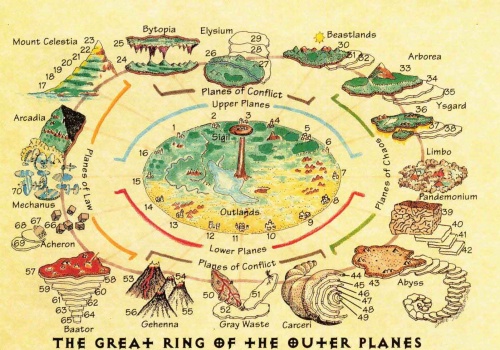
500px-Outer_planes

Once again, I find myself investigating the cosmological background of the setting I’ve most recently created.  I was reading through the Dungeon Master’s Guide again, reading the section on planes near the beginning, and I’m in that usual place: somewhere between excited and miffed.  Fortunately, it’s easy enough to change the things that haven’t excited me.

I’m comfortable, for the most part, with the material the DMG offers on things like the Astral and Ethereal planes.  I’m more okay with the DMG’s ideas for the Shadowfell, the Feywild, and the various elemental planes.  I’m not very happy about their ideas for the Outer Planes.  I have some rewriting to do; let me tell you why.

Continue reading

Shenani-games: Random Character Generation is GREAT

This weekend was a good one for gaming.  On Saturday I ran a last minute seat-of-the-pants adventure involving a great deal of bullshitting, and on Sunday I continued to run a standing campaign based on the material I started posting about last fall, in the setting I’ve been writing about this spring.  I had a great time with both sessions.

I’m not going to tell you much about the campaign, since that would potentially expose spoilers, but I absolutely have to share the basic setup of the Saturday game with you.  You remember whothefuckismydndcharacter, right?

Because we had very little time to set up and run the game, I decided that the players should roll down the line, which is to say that they had to roll their ability scores in order without being able to shift them around and spend too much time thinking about what they were going to be.  Then Spaige whipped out whothefuckismydndcharacter and got “a fucking sentimental Human Warlock from a cavern without echoes who is a recovering cannibal.”  I immediately decided that people could rearrange their ability scores as long as they shifted them to match a randomly generated character from that site.  Two of our players (Thom and Whitney) were hardcore / lucky and both rolled down the line AND used the random character generator.

The party ended up with an elven wizard, two warlocks (one human, one half-elven), a rock gnome rock bard, and a dragonborn barbarian.  The party’s wisdom scores were (I believe) 6, 6, 7, 8, and 12, with the barbarian as the wisest party member.  The lowest charisma score for the party was 14, and most people had 16 or higher.  Marvellor the Shit had a 20.  How did he end up with a name like that?  Well…

As the first few people figured out who their characters were, everyone decided that the PCs should start at 3rd level and that everyone would need an epithet of some sort.  We made a joke about the gnomish bard rocking out, and so he quickly became Duane the Rock, rock gnome rock bard.  The dragonborn barbarian, who had once survived a cookpot (it said so in his backstory), was described as having proportions like unto a Red Delicious; he’s bigger up top than down low, but he’s all around larger than he really should be.  He came to be known as Horgrin the Vast.  Spaige’s human warlock took the Great Old One pact, and was thus able to communicate telepathically (Spaige, seriously, I still want the fluff you came up with for that demon-tainted cave of the cannibalistic thought-collective, it was great), so she became Chathi, the Last Disciple of Silent Whispers, or Chathi the Last for short.

Whitney still needed an epithet and was randomly generating her character name (she got extra bonus points, because she randomly generated everything including wizard her spell list), but she quickly realized that her name was her epithet.  She ended up playing The Gart, which was perfect because it continued the tradition of four letter epithets.

By this point people were starting to get a little cracked out and/or drunk.  Thom showed up late and generated his character as quickly as he could, randomly generating the name Marvellor for his half-elf warlock, but was stumped for what to call himself until we pointed out that he needed a four-letter epithet.  Thus was born Marvellor the Shit, and his less impressive imp familiar Bixby the Crap.

Together these hooligans decided to search out a treasure as yet untouched by the adventuring group which had touched (more like scarred) all of their lives.  There’s so much that I’m skipping over, like the beautiful way in which they connected the fragments of backstory given to them all through the random character generator, but suffice to say that they had reason to despise and outdo the people who had ruined the lives that they once led.  As such, they journeyed into the land of Kraskya, the ancient and ruined city, and promptly fought a large number of things that they were hilariously ill prepared to face.  And despite the fact that high charisma types and people with enchantment and deception spells rarely do that well against the undead, they triumphed.

Of course, we left off while they were still stuck underground, more or less trapped by a very very large number of skeletons, but I’m sure that will be a good story for another time.

What I Usually Write, or, Responsibilities to One’s Audience

Annex - Rathbone, Basil (Adventures of Robin Hood, The)_02

More or less what I grew up with.

I love adventure fiction.  It’s makes up a large portion of what I write, probably because it’s what I grew up reading in books and creating in role-playing games.  When I don’t write adventures, I still generally use the climactic structure to resolve the primary tensions of the piece.  Unless I feel like experimenting, I don’t usually do the “unfinished story” thing and leave such tension unresolved.  But you probably already know this, so why the hell am I telling you?

Continue reading

World Building: The Hells of Errant Souls

Botticellismapofdantesinferno

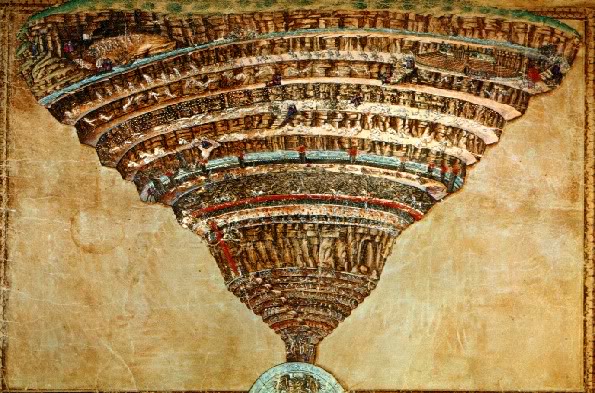
Hell, courtesy of Dante.

Last time I kept mentioning someone that I decided to call the Most Powerful Devil (MPD), without ever going any further into who or what that was.  But I’ve come up with more background for them since then, and in so doing I’ve also come up with more details for the game-world as a whole.

So, today I have a stupidly simple calendar (though I haven’t yet bothered to give the months names), I have a better idea of what the afterlife looks like (I’ve totally tossed out the basic alignment-based fare in favor of something a bit more complex), and I have a name and backstory for the Most Powerful Devil.  I think you’ll like this stuff. Continue reading

World Building: Magic, Demons, Angels, and Devils

Back in November I wrote about a new RPG campaign that I had cooked up, a game that I’ll refer to as For The King! for lack of a better name.  If you are currently playing in or are going to play in my 5th edition D&D campaign, you might want to be careful with reading this post.  If not, feel free to read this early-concept campaign overview.  I’ll avoid saying things here that could be too spoiler-y, but I plan to explore the nature of magic, demons, devils, and other such inimical forces.  Your character might or might not have access to this information.

Based on the first few sessions that I ran for my brothers, I already know that the setting allows for angels and fallen angels, though the latter are more like Remnants from In Nomine, powerful supernatural beings from other planes who have had some part of their greater nature stripped from them by intent or by accident.

Angels and their derivatives are all essentially moderately self-willed fragments of the god they serve, and might be thought of as something like having a god let its fingernail clippings (or maybe severed finger?) go off and do its bidding in the world.  A bit like some kind of overpowered intelligent celestial dandruff, I suppose.  But I don’t know off the top of my head how to make demons and devils work, and I don’t just want to sign on to the metaphysics presented in the 5th ed. Monster Manual without some editorial input.  I’d much rather doodle in the margins and make their setting fluff more thoroughly my own.  So read on for sweet lore! Continue reading

A Red and Pleasant Land: Old School RPGs through a Looking Glass

Processed with VSCOcam with f2 preset

My itinerant laser-show friend arrived unexpectedly this week, and as such it was immediately time to play RPGs.  He brought a copy of A Red and Pleasant Land, a Lewis Carroll inspired setting and rules supplement for the system Lamentations of the Flame Princess, and we all thought that this was so cool that we totally had to play it.  We got somewhat distracted by character creation because we’re a bunch of nerds and it’s fun coming up with details about our fictional selves, but I’m really looking forward to playing with these characters.

I can’t tell you that much about the game yet, since I haven’t really gotten much of a chance to play, but I can tell you this: Lamentations of the Flame Princess is a little bit like a more metal version of original DnD, and A Red and Pleasant Land is a far more metal version of Carroll’s visions, chock full of murder, bloodthirsty vampires, and wars.

If you like the idea of playing a stripped down and often lethal version of old-school Dungeons and Dragons, something that will force you to think your way out of your various predicaments (because your stat line and the game systems surely won’t save you), you should check out Lamentations.  If you like the idea of doing that in a fabulously lethal Wonderland, and possibly wandering the world as an Alice (yes, “the Alice” is a class, and from what I’ve seen she’s totally amazing), then you should check out A Red and Pleasant Land.

Ok, that’s enough for now, I’m afraid the time has come for me to go back to seeing my visiting friend before he disappears onto the road once more.

Behind the scenes of the new campaign…

Monday’s post gave a taste of the game that I’m preparing, but didn’t go into any details about what would follow.  That was intentional.  If there’s any chance that I’ll run this game for you, I strongly suggest that you don’t read what comes after the break.  If you want to see some of what I’ve come up with, and maybe a bit of how I came up with it, read on.

Continue reading

A new campaign in the works…

This post is only going to include non-spoiler material, appropriate for the opening of the game.

You (the players) are the King’s officials, expected to enforce his decisions, act in his interest, and carry out his wishes in the wider Kingdom.  Mostly drawn from the wealthy and noble classes, the King’s officers are expected to outfit themselves out of their own pocket and see to their own expenses.  There are always a few exceptions to the norm of “wealth and privilege,” since an individual’s skills and qualifications for this particular job are far more important than their bloodline, but exceptions are likely to have an interesting story for how they became one of the King’s officers without the usual entrée.  In many ways, you might think of the King’s officers as Musketeers with a little less in the way of Alexandre Dumas.

The game is set in the Kingdom of Duval, and begins with the players being sent from the capitol city of Duval to the backwater county of Mont Mondal.  Count Xavier of Mont Mondal was recently imprisoned for treason against the throne, when he broke his oath of fealty.  He was executed along with many of his closest companions, and the executions have created quite a disturbance at court.  One of his companions, the wizard Castanedra, fled back to Mont Mondal on the same night that Xavier was taken prisoner: you and your compatriots have been tasked with capturing her and returning with her in your custody.  You have also been instructed to raise the county’s levies and send them to the capitol, to join with King Mander’s other forces already mustering for war against the Kingdom of Meius to the east.

While thoughts of war on the nearby eastern border weigh heavy in everyone’s mind, how are you and your companions going to run this powerful wizard to ground and bring her back to Duval?

Other things that people from the Kingdom of Duval would know:

-Meius and Duval share a border that runs through an agriculturally rich valley.  North and south of the valley the terrain becomes increasingly hilly and mountainous, leaving only one clear passage between the two kingdoms.  While the kingdoms have a long history of trade with each other they’ve recently suffered through a series of trade disputes and feuds, and there are now frequent border raids which have further angered each side.

-Count Xavier (that’s pronounced “Sh-avier,” more or less) had a meteoric rise to match his catastrophic fall.  He was ennobled and granted County Mont Mondal a little more than ten years ago, and he and his companions were widely recognized as having done a great deal to make Mont Mondal actually livable for Duvalians.  Xavier and his companions drove out a large clutch of magical aberrations which had claimed the land as their own, and then kept the local bandits in check.  While his breaking of his vow of fealty clearly put him in the wrong, some people have even gone so far as to say that they wish the king hadn’t had Xavier and his companions executed for their treason.  Not that they’re likely to have said as much to the king.  The king, after all, is known to have a bit of a temper.

-The city of Duval is slowly being surrounded by the many thousands of soldiers who have answered their liege-lords’ calls.  The various levies have been joined by a few mercenary companies looking for work, and their spirits are high as they prepare to fight against Meius.  The king’s armies only wait for a few more levies (like those of Mont Mondal) to join them before marching against Meius in the east.

New D&D Sneakily Poaches Inclusivity, Narrative

10325260_10152496571526071_8983892837449015744_n

I grew up playing AD&D, as my brothers introduced me to RPGs before I was 7.  I’ve since moved away from the various D&D systems, flirting with them occasionally in passing while I instead focus on other systems that I find more interesting; I’ve come to prefer more narrativist games for the most part, though my friend Zach’s super-old-school D&D certainly calls to me at times.  But with the release of the newest edition of D&D (5th ed? Next? Whatever we’re supposed to call it) I thought I’d give it a look.  I’d examined some of the playtest documents and made appreciative noises, so I thought I should take a chance.  I’m glad I did.  It seems like the new D&D has learned a few tricks from the games that pulled me away from it in the first place.

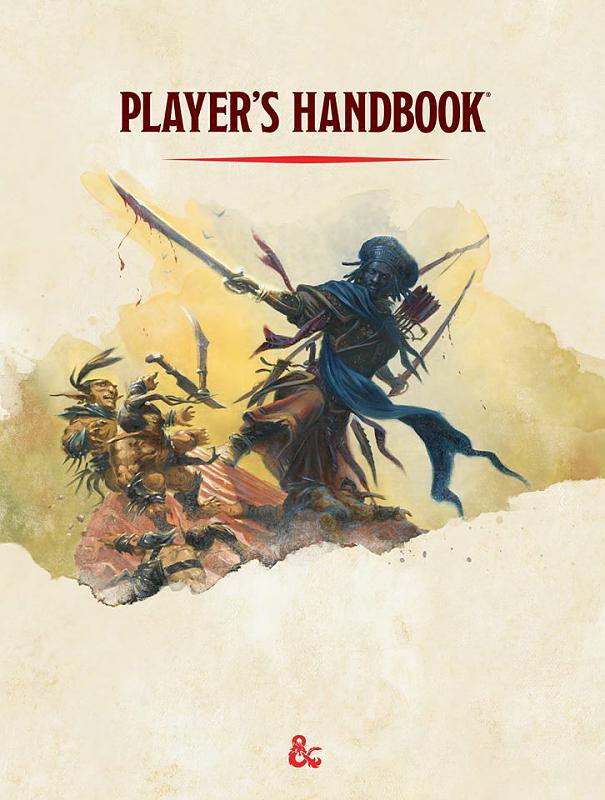
There have been a few things that have really stood out to me while I’ve been reading the new Player’s Handbook (PHB), two quite good and one that I’m not sure how to qualify.  These have nothing to do with the rules, I’ll talk about those later.  The first item is one which I understand has already been discussed elsewhere, namely the game’s specific mention of a player’s ability to construct their character’s gender- or sexual-identity, and statement that that’s a perfectly fine thing to explore in this game; the second item is D&D’s incorporation of distinct backgrounds, personalities, and motivations into character creation, including something called “bonds” which I can only presume has come from Dungeon World; the third item is the art chosen for the book, and its depictions of a diverse group of characters.  I’ll talk more about all of these, but let’s tackle that last one first.

Continue reading

“Roleplaying” Games and the Misused RPG Label

Zeeblee

I have written a few reviews for digital roleplaying games (RPGs), but in many cases I find the label is completely inappropriate.  When I think of a “roleplaying” game, I think of a game in which I take control and can make important narrative choices.  But most digital RPGs don’t let you make narrative choices at all.  For that reason I would say that the label of RPG has come to be associated with a mechanic which is common to most RPGs, but isn’t the attribute that makes them RPGs.  The mechanic in question is that of leveling up, and I hate it*.

Continue reading