New D&D Sneakily Poaches Inclusivity, Narrative

10325260_10152496571526071_8983892837449015744_n

I grew up playing AD&D, as my brothers introduced me to RPGs before I was 7.  I’ve since moved away from the various D&D systems, flirting with them occasionally in passing while I instead focus on other systems that I find more interesting; I’ve come to prefer more narrativist games for the most part, though my friend Zach’s super-old-school D&D certainly calls to me at times.  But with the release of the newest edition of D&D (5th ed? Next? Whatever we’re supposed to call it) I thought I’d give it a look.  I’d examined some of the playtest documents and made appreciative noises, so I thought I should take a chance.  I’m glad I did.  It seems like the new D&D has learned a few tricks from the games that pulled me away from it in the first place.

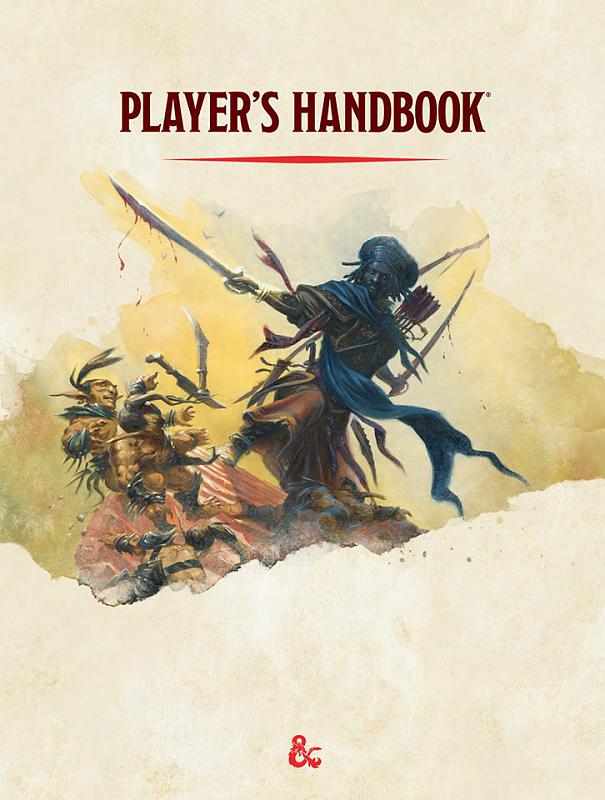
There have been a few things that have really stood out to me while I’ve been reading the new Player’s Handbook (PHB), two quite good and one that I’m not sure how to qualify.  These have nothing to do with the rules, I’ll talk about those later.  The first item is one which I understand has already been discussed elsewhere, namely the game’s specific mention of a player’s ability to construct their character’s gender- or sexual-identity, and statement that that’s a perfectly fine thing to explore in this game; the second item is D&D’s incorporation of distinct backgrounds, personalities, and motivations into character creation, including something called “bonds” which I can only presume has come from Dungeon World; the third item is the art chosen for the book, and its depictions of a diverse group of characters.  I’ll talk more about all of these, but let’s tackle that last one first.

Continue reading →

“Roleplaying” Games and the Misused RPG Label

Zeeblee

I have written a few reviews for digital roleplaying games (RPGs), but in many cases I find the label is completely inappropriate.  When I think of a “roleplaying” game, I think of a game in which I take control and can make important narrative choices.  But most digital RPGs don’t let you make narrative choices at all.  For that reason I would say that the label of RPG has come to be associated with a mechanic which is common to most RPGs, but isn’t the attribute that makes them RPGs.  The mechanic in question is that of leveling up, and I hate it*.

Continue reading →

Types of Games

gentleman-gustaf-figure

In my last post, I talked a lot about what roleplaying is, and – surprise! – it wasn’t just one thing! That is part of the beauty of roleplaying, it’s full of options. What are these options?

Well, first, we have the three qualities talked about before:

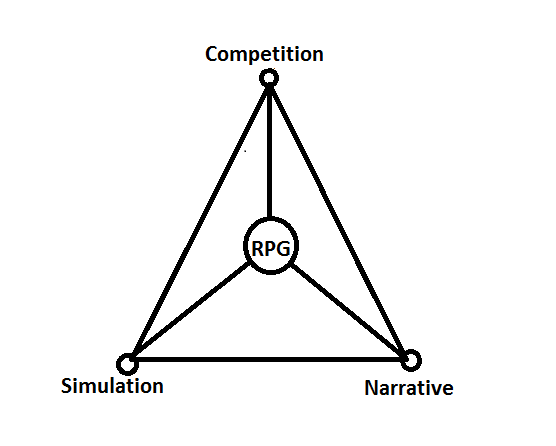
Roleplaying, Storytelling, Mechanics. To keep in line with the existing literature on Gaming Theory, I have slightly renamed the categories I used in the previous post. I have renamed ‘Mechanics’ as ‘Competition’ (it goes by ‘gaming’ in GNS Theory, but I find that to be a bit ambiguous of a term); it essentially refers to how much of the experience of the game is rooted in competition. Storytelling will be referred to as ‘Narrative’, and Roleplaying will be expanded slightly to ‘Simulation’. Simulation refers to how much of the setting goes to recreating system-internal realism. Note that this realism does NOT have to be actual realism. For example, many unrealistic things happen in Star Wars, but there is an assumed set of rules which governs things like lightsabers. Any given game will have a balance of the three, like so:

Game-Qualities

Continue reading →