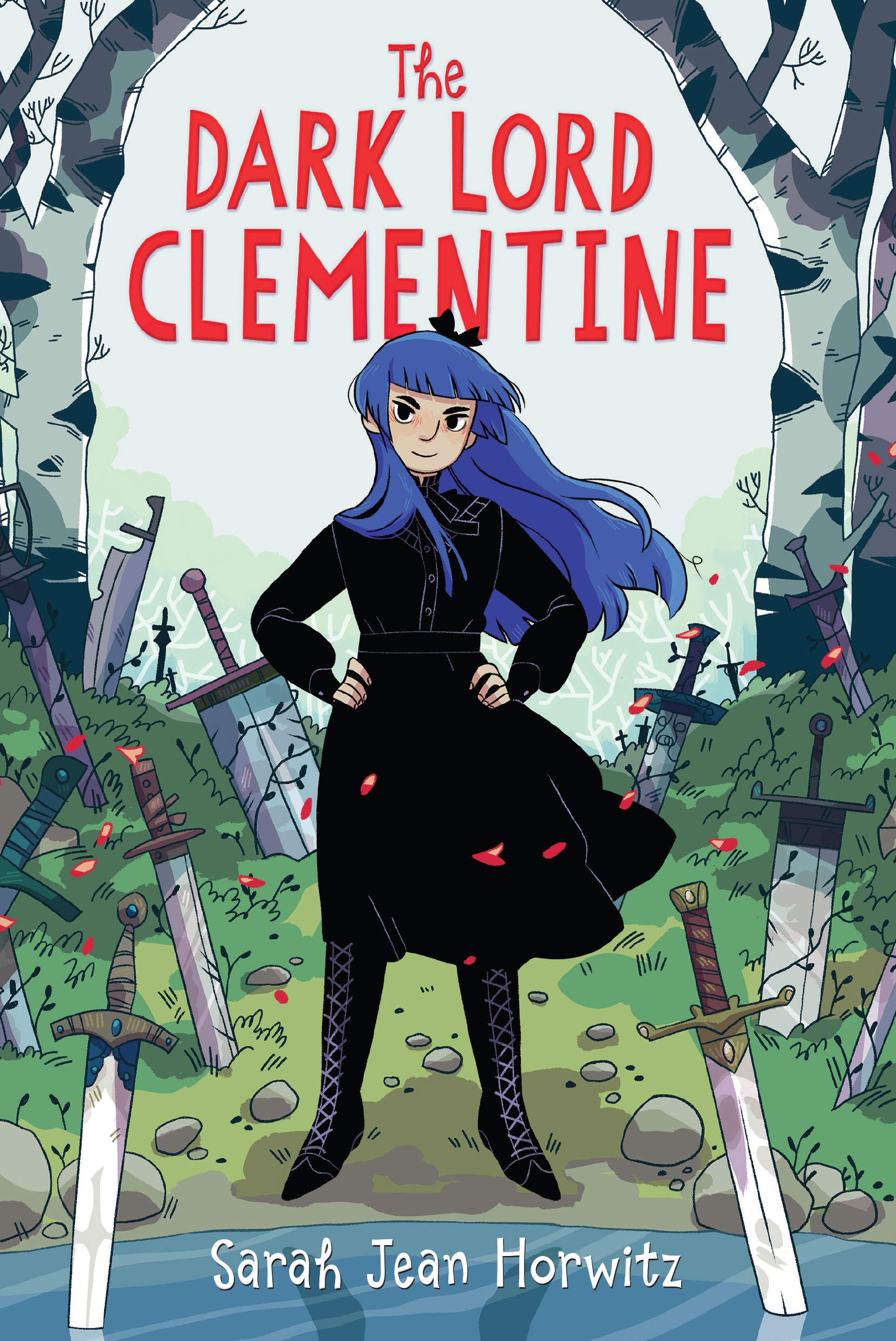
The Dark Lord Clementine, by Sarah Jean Horwitz

I’ve been meaning to read Sarah Jean Horwitz’s The Dark Lord Clementine for years, and I’m glad I finally did. It’s charming. Extremely charming.

I have complicated feelings about how the main character is constrained by forces outside her control, and how that creates what I felt was a gendered portrayal of empowerment, but… that’s what the story is all about. And on reflection, the feelings I had about the gendered story conventions were both correct and missed the point. The story beats which evoked those conventions are crucial to the course of the story, and crucial to the way its conclusion works so well and feels so good.

I don’t think the story could create the same excellence without them.

The Dark Lord Clementine is about Clementine, sole child of Dark Lord Elithor and heir to the family’s title and responsibilities: crushing witches and competitors, vying with other Dark Lords while maintaining evil status, and making the local peasants’ lives miserable. It’s about Clementine’s need to live up to her father’s expectations—as well as her own expectations, and those of her society. And it’s about her need to save her father from the terrible curses of his enemies, when he’s struggling to save himself.

It’s about more than that too, about relationships and manipulation and abuse, and friendship and betrayal. It’s about growing into yourself, and finding your way in the world on your own terms. It’s full of classic upper middle grade goodness.

I recommend it heartily. That goes double if you like middle grade fantasy at all, and it’s still true even if you don’t.

Now I’m going to pontificate about gender and genre fiction for a minute, before segueing into potential spoilers. Don’t worry, I’ll mark them clearly.

I should note, the Folding Ideas video on empowerment in Jupiter Ascending was very helpful to me in reflecting on this. The key question asked there is “do the characters take action within the story, on their own terms? Or are they solely acted upon by the story?” That was a useful framing device for me.

Classic adventure stories, the genre that I’m used to thinking of as my measuring stick for empowerment, don’t do a good job of encompassing social expectations and the way they impinge on characters’ lives. Protagonists in those adventure stories rarely have to explicitly juggle others’ perceptions of them (or their perceptions of themselves). More often, they’re forging new paths outside the traditional bounds of society, or casting off their expected roles—but doing so in a way that is expected by the genre, and by cultural expectations of (usu. male) heroes. They’re nearly always archetypically “manly,” and certainly not “weak.” Whatever that means.

Yes, those stories—presented as being ungendered—are culturally extremely male-gendered.

So when reading adventure stories, or genre fiction in general, I have several constantly running questions in the back of my mind: what social pressures are exerted on the protagonists? How aware is the protagonist of the social pressures they’re under? And do they question or act against or (usually in the academic sense) queer those pressures? 

Slight digression: in my anecdotal experience, the less aware the protagonists are of these pressures, and the less aware the story is of these pressures, the more likely the story is to regurgitate and not question those old gender conventions. Relatedly, those stories are also more likely to be written by a man who hasn’t spent much time examining gender roles and their social impact, and generally hasn’t had a good critical think about how gender roles constrict people (of all sorts) in negative ways. For that matter, those authors are also more likely to be white or to have some other kind of unexamined privilege. Basically, it’s a solid clue that the author hasn’t had a good think about feminism, and the way in which cultural expectations constrain everyone—which is painfully obvious when those authors’ male characters are seemingly unaware of the constraints of the system while knowing deep in their gut that they must be “manly” at all times.

Moving on.

This (the unexamined-ness, or a story’s lack of awareness of gender roles) isn’t universally a sign of the author being unaware. Sometimes people write stories where those pressures aren’t as present explicitly because they want to imagine a different world, or don’t want to spend their brain power on our world’s conventions. It’s just a tendency I’ve noted, and which I continue to keep tabs on.

Tying that back into the previous thread…

When stories deeply invest lots of attention in social pressures and expectations, and constrain their characters with those things, they also often read to me—with my assumptions trained by old (male-centric) adventure genre fiction—as being gendered (gendered female, that is). And the empowerment that I see in those (”female“) stories often feels less empowering to me than the empowerment in old adventure fiction. It’s a whole noodle-y mess of ingrained cultural assumptions. And my narrative palate was well trained; for a long time, I appreciated stories that empowered characters by allowing them to do all those typically-gendered-male things far more than I appreciated the ones that showed protagonists working carefully within their social constraints. It’s been long slow work to counteract: expanding my narrative palate has taken time.

What’s more, expanding my palate hasn’t changed my fundamental issues with these gendered expectations around different flavors of genre stories. I’m still wrestling with how to write genre fiction that feels appealing and empowering, and which queers those gendered conventions of empowerment. I want to be able to write good stories that play with all sides of those gendered narrative expectations, and then go new places too.

Maybe that’s part of what I love about Clementine’s story.

Okay, now we risk some *SPOILERS*. I’ll keep things general, but… I’m giving away the narrative arc without giving precise details.

See, Clementine is extremely aware of her responsibilities, and feels the constraints on her life quite keenly (though she doesn’t question them much at first). She acts, taking initiative as best she can, but flounders in the process. And who can blame her? She’s trying to do the work of an adult (several adults, really) and is balancing far too many duties all at once.

All of these constraints wrap Clementine up tight. They felt suffocating to read. It was both awful and extremely effective storytelling.

And unlike the adventure stories I read when I was young, this story is less about our protagonist going out and forging some brilliant new path or performing acts of derring-do, and more about our protagonist finding the wherewithal to escape those constraints and reach the freedom to forge her own new path. Those oppressive constraints are key to her emotional journey. Without them, her struggle and growth would feel less meaningful and consequential. This is why my internal judgements—about how the story wasn’t empowering Clementine enough—withered by the time the story finished.

Clementine doesn’t go out and “do adventures” in the same classic (male-gendered) genre fiction way. She isn’t empowered in the same ways. But she absolutely is an empowered character. She’s able to choose and make decisions, and isn’t simply shuffled around by the plot without an opportunity to make her own decisions and try to act as she sees fit. Others have power over her at times, and she’s certainly not in control of everything, but she can steer herself and ultimately arrives at a place that feels more empowered because of her own choices, more able to engage with the world and its expectations on her own terms.

In some ways, this story feels like an exploration of the edge between two classically gendered narrative structures, moving from one to the other. It’s great.

I recommend it.
Hero’s Hour (pre-release version 1.8.2)

Hero’s Hour is so clearly an homage to Heroes of Might and Magic (HoMM), especially HoMM3, that it’s impossible for me to play it without comparing the two. That’s both a strength and a weakness.

I love HoMM 3. I played so many hours of HoMM3 that it’s been etched into my brain in a way that few other games have matched since. I also played a number of other HoMM games—the first two, as well as HoMM4 & 5—and all of that trained me pretty well in the genre those games pioneered (and which few games have matched before or since). Heck, New World Computing, the makers of the original HoMM games, may have actually trained their audience too well given the mixed reception to their changes to the game for HoMM 4.

What I’m trying to say here is that making a sequel to the Heroes of Might and Magic series, even making an homage to the series, isn’t easy. A number of studios have struggled to do just that, most often creating new games that were mediocre imitators rather than improvements to the genre.

A little history, and maybe some perspective.

After New World Computing disbanded, Ubisoft continued publishing sequels from other developers, with a new developer for each subsequent game. Sometimes they even found a new developer for an expansion. I have no idea what that was like for the teams involved, but from an outside perspective that doesn’t seem like a good sign.

I played a little bit of some of those sequels. They were… fine? None of the ones I played went beyond simply feeling okay, none of them delivered quite the same flavor that pulled me into HoMM 3 and kept me playing it for over a decade. Some of them shared similar points of failure with Hero’s Hour.

This isn’t a struggle unique to those trying to recapture the appeal of HoMM. It’s happened with a number of different attempts to recreate the feeling of other 90s classics (like Master of Magic or Master of Orion). The best sequels and homages to those games that I’ve played all rely on finding some way to distinguish themselves, to be new and different and give themselves a way to excel, while still obviously following in the same vein as their predecessors. That seems like a universal rule for sequels, not only with sequels to these games.

But for whatever reason, most games I’ve seen that have tried to follow in HoMM 3’s footsteps haven’t managed to both recapture the feel and distinguish themselves well.

Sadly, I’m not sure that Hero’s Hour does either. Yet.

First, a caveat: I’m writing about an early version of the game (v.1.8.2). It’s available on itch.io, but isn’t out on Steam or GOG yet. I don’t know what will change with the wider release. Presumably some of the issues I mention here will be resolved. 

Now. Why do I have to compare Hero’s Hour to HoMM?

The game very obviously wants to be recognized by fans of HoMM. The hero attributes are the same, many mechanics are the same, a number of the factions (and the factions’ units) are either the same or within spitting distance of each other. Tromping around the map and upgrading your town is eerily similar to HoMM3 (more on that later), right down to the names, functions, and visual designs of many map locations. It’s all close enough—until you get to combat—that it’s achingly familiar. Familiar enough that I wouldn’t be surprised by an intellectual property lawsuit (though I don’t know who’d win that).

Combat, and the way in which those familiar hero attributes are used in combat, is where things are totally different. Hero’s Hour uses a real-time-with-pause auto-battle system, one that allows you to give commands to your various units, sling spells, etc. That’s a considerable departure from the hex-grid turn-based strategy of HoMM. I actually like how this change distinguishes the game from the originals. But it’s not especially clear to me how to learn the auto-battler’s systems, and it’s not clear I’ll be able to master it in the same way I did HoMM3’s battles. Like HoMM3, the underlying mechanics are a bit opaque; but 23 years have passed since HoMM3 came out, and I have higher expectations for system design and the presentation of information. Also, I want to feel a little less clumsy in the game’s battles. Maybe that expectation of mine, the idea that I might have finer control of the battle, is the problem here: nothing about the game’s battle aesthetics suggests much fine control would be available, as lots of little units hop around cartoonishly and bump into each other in bloody combat.

It’s cute, really. I wish I felt like I understood it better.

It also is unstable. I expect this to be patched out, but the game has crashed several times for me near the start of a battle. More rarely, it’s crashed at other points during the turn. This is a big problem. The game is informal and straightforward enough to keep me playing for a while, but it’s not addictive enough to pull me back in after a crash (let alone several). The game does have a reliable autosave feature, so I’ve never lost too much progress in one go, but I hope the instability is fixed quickly.

Now, back to the map.

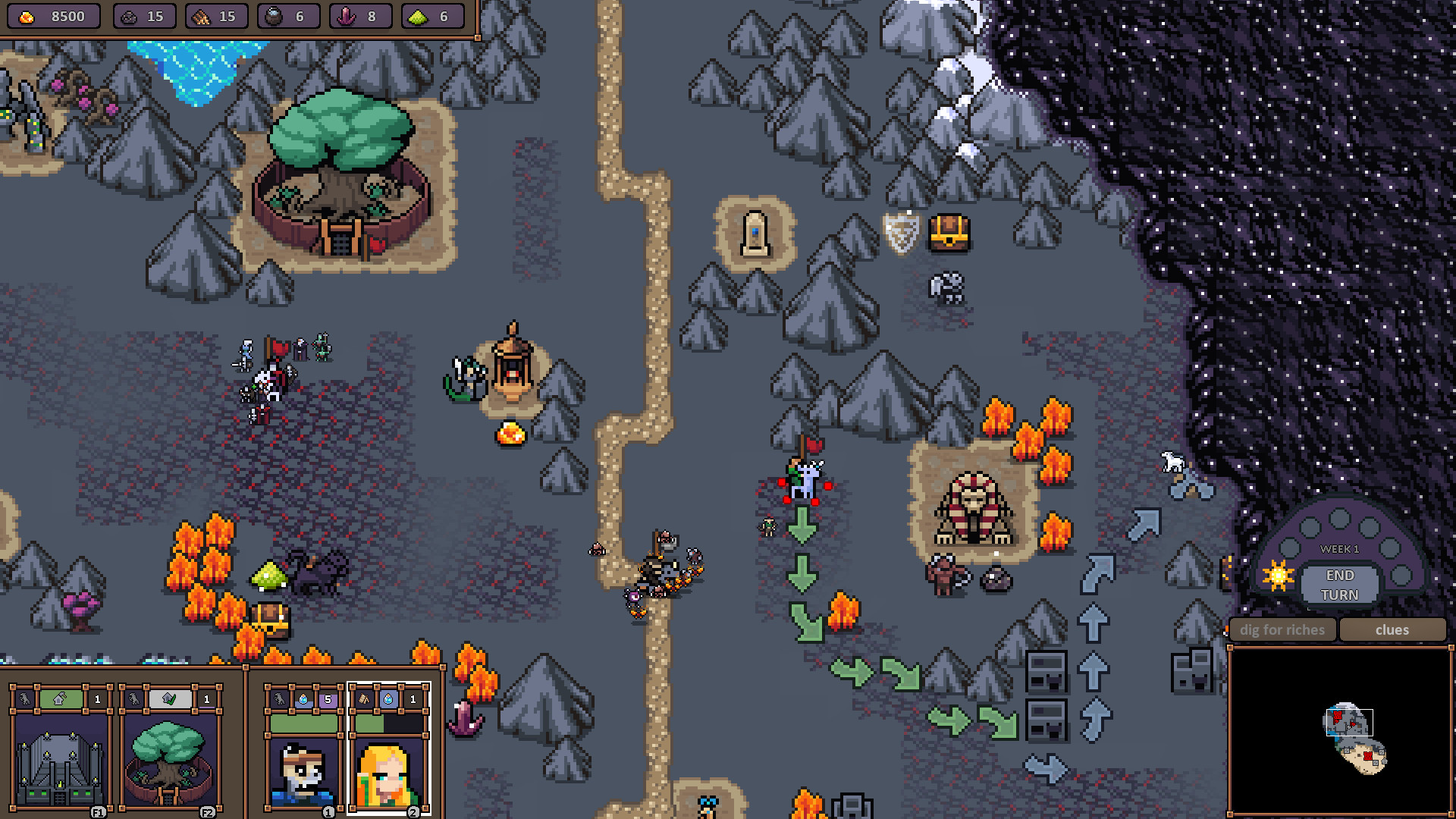
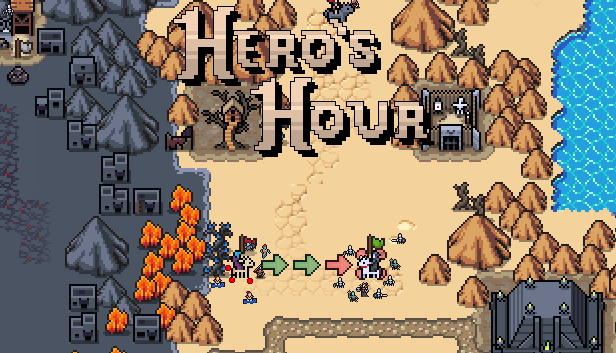
Hero’s Hour’s visual design for its maps is fine, but compare it to the rich textures of the games it’s imitating.

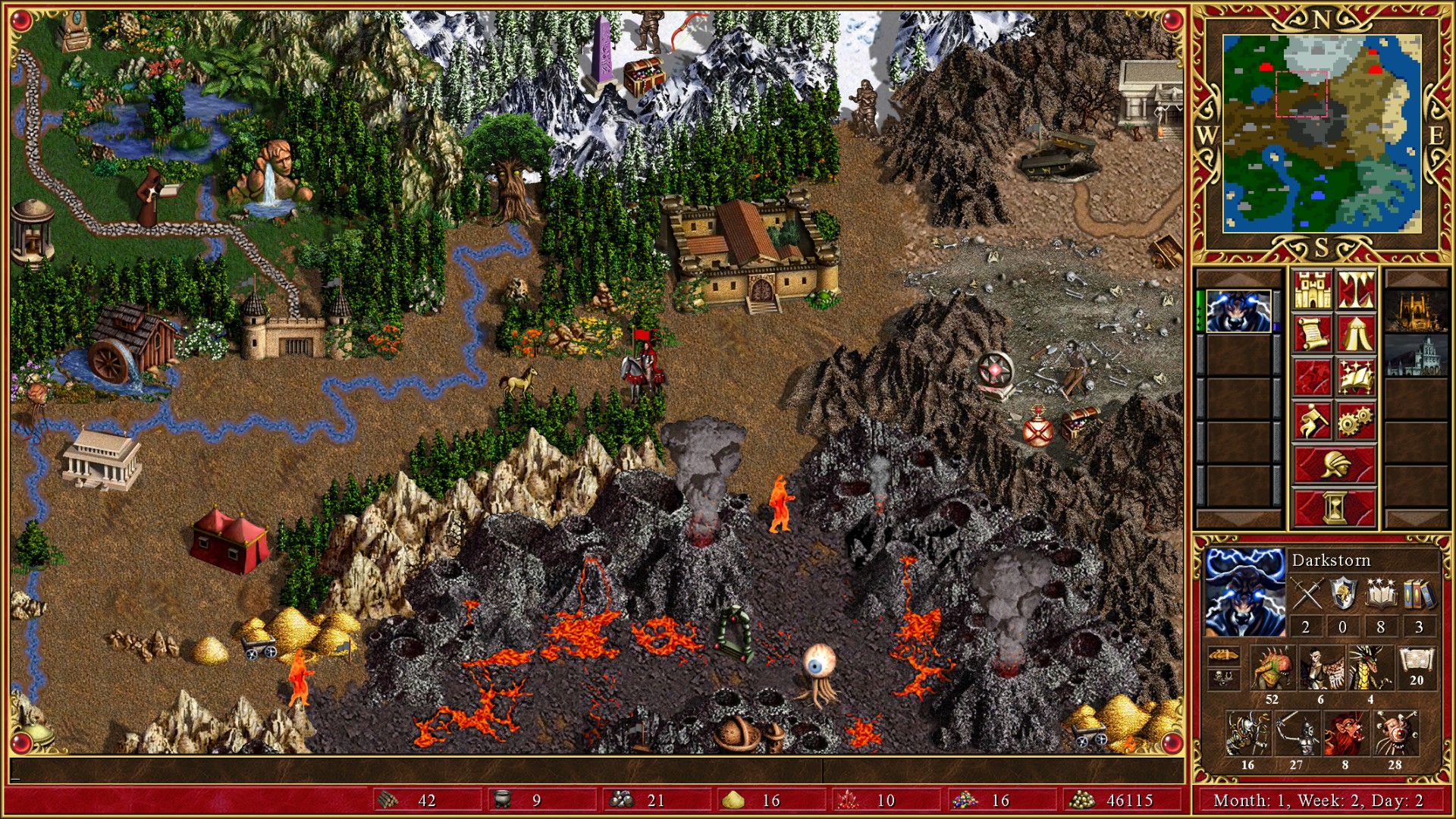
This critique in some ways feels unfair to me, but: the visual design for the map feels lackluster. It’s bland. This is made worse by how obviously this game has been built in the image of the old HoMM games, and how it looks when I compare a screenshot of it with a screen from one of the old games. Hero’s Hour wants to remind players of those games (and does!) but its visual design doesn’t stand up to the visual design (or map design) of HoMM 2&3. HoMM2 had vibrant and inviting color, lots of texture, and map features that engaged the viewer. HoMM3 toned down the color palette very slightly—but it instead added more color variety, and paid even more attention to detail, making the various locations on the map pop. Both titles managed to make very full screens overflowing with tiny details that were still legible to the eye. Hero’s Hour has obviously put time into designing the map locations that players will look for and visit, and has ensured that all the various interactable locations and items are legible as such, but by comparison the background (which takes up most of the screen, and which players spend almost all their time looking at) feels neglected.

HoMM 2 looks lush and vibrant by comparison
And compare HoMM 3’s richly textured volcanic terrain to the detail available in Hero’s Hour

That critique feels unfair to me because I know there’s a solo developer (presumably with limited support from contractors) behind this project. For comparison, even at its smallest I believe New World Computing had three people. Yet while I know it’s a stretch to ask for more and better art—and better overall visual design—I do want more. I want varied texture for the backgrounds. I want the edges of the current texture swatches to be less blocky and more organic. I suspect that if this game’s map backgrounds received a little more attention—got a little more texture, more saturated colors, more places for the eye to explore—that would go a long way. I don’t expect this solo developer to outdo (or even match) HoMM 3’s visuals, but I really want a little more visual appeal.

And it’s clear that the dev knows how to do this! The Town screen is an excellent example. It’s detailed, colorful, and has lots of changing elements that develop as you build new structures (all hallmarks of the HoMM games). It’s obviously received plenty of attention. But this means that the dramatic difference in visual appeal between those Town screens and the map that I spend almost all my time looking at is even harder to ignore.

There’s another side to the maps which feels odd: area layout, map design, and initial expansion. This feels especially odd given how closely the “riding around on the map gathering resources and visiting locations” experience matches the old HoMM experience. Maybe this would feel different to me if I had better mastery of the battles, but early expansion in Hero’s Hour (with default settings) is harder and slower than I remember it being in HoMM3. The neutral armies guarding the ever-vital elements of the resource economy are a hair tougher, more wall than speed bump. And those guarded mines are spread further apart… indeed, it feels like the whole map is stretched just a bit wider than the old games. If this felt more deliberate, and if the game gave me more opportunities to *do* things while building up my army to conquer basic resource generators, I think it might feel different. As it is, I feel like I’ve spent more time wandering back and forth picking up minor collectibles and twiddling my thumbs than I did in the old games—which is saying something.

I suspect this comes down to random map generation.

Random map generation is neither easy nor simple. I’m not surprised that Hero’s Hour’s map generator is creating maps that feel less well-tuned than the custom made maps of HoMM3. That seems unavoidable, without a preposterously long development time. And playing Hero’s Hour gave me newfound appreciation for how finely the old HoMM team had honed their map-making skills. But it also makes me wonder whether this game would be better off with hand-made maps, at least at first. So much of the game is spent roaming around them, it matters when they don’t feel rewarding.

Unfortunately, the combination of visual design, less well-tuned maps, and slightly-clumsy battles leaves this game feeling a little more like an idle game and a little less like a deep and engaging strategy game. I think that’s misleading, because I suspect that approaching it more like an idle game will make it very hard to win. What’s more, I can see that there *are* deeper strategic options available, even if I haven’t yet learned how to really shine in the game’s battles so that I can reach them.

And I want to reach them. I love the genre, and I do still enjoy the game. I’ll probably play more again today, and will no doubt check in again as it is updated. But as the game stands right now, it’s not going to pull me in and feel rewarding for hours upon hours, unlike the games it’s so obviously trying to imitate. I want Hero’s Hour to do better, because I love those old games and I want more people to see how good they could be. And I want Hero’s Hour to do better because it’s already so close, it’s almost there. Good luck, dev(s).

Paladin’s Hope, by T. Kingfisher

Paladin’s Hope is the queer continuation of Ursula Vernon’s paladin romances (written as T. Kingfisher). It does finally deliver the gay romance I’d asked for previously, and now I’m wondering what other stories we’ll get next given that I know there are a few paladins remaining without books about them.

For personal reasons, I enjoyed reading this one less than I enjoyed the others (Paladin’s Grace and Paladin’s Strength). I’ll try to dig into that, but I should add: if you liked the previous books in the series and still want “paladin romance,” this will still give you that and do it well. My personal discomfort has more to do with my own history than with some bigger critique of the book or series.

These books are all about paladins (often along with their potential romantic partners) being—in the words of friends who also read and enjoy these books—“total goobers.” The paladins these books revolve around all have lots of reasons for telling themselves why they’re not good enough for a romantic partner, or telling themselves that they’re doing everyone a favor by not pursuing or committing to a relationship, or etc. They are, in short, goobers. This goober-ness almost always drives the core of the relationship drama at the heart of each novel’s romance plot. There’s always other plot too, good fun stuff, often with intrigue and murder playing off the romantic tension to draw the story out and let everything feel right, narrative-wise. It’s well-written and does the expected romance novel thing, and it’s all fun.

But with Paladin’s Hope, Vernon very evocatively wrote some goober-ness that reminded me—painfully, powerfully—of my own previous episodes of goober-ness. And that hurt a lot. It hurt enough, was evocative enough, that I had to stop reading for a while and just meditate to keep myself from spiraling.

That’s the reason I liked reading this one less.

It’s still a good fantasy romance with murder and intrigue, like the others in the series. It’s certainly got some solid characterization and a good portrayal of relationship dynamics (healthy and unhealthy).

It wasn’t comfortable for me, and that’s okay. With any luck, you won’t have the same issues that I did.

The book also establishes the next step for the larger story world’s plot. I’m quite excited about that. I think the next few books in the setting and series will be fun, and big, and open up bigger overarching plot elements again. Those felt a little lacking with this novel, though I can’t say I noticed the lack until I reflected on it after the fact. Anyway, I’m looking forward to the next one.

A Marvellous Light, by Freya Marske

Freya Marske’s A Marvellous Light is magic society intrigue set in early 1900s Britain, with a heaping serving of gay romance on top.

I knew I was reading something very gay before I started, given what little I’d heard about the book beforehand. I *hadn’t* realized I was going to be reading lurid sex scenes. Fortunately, I was able to avoid reading those scenes in public (something I’ve tried to be cautious about since a few awkward experiences in high school—Covid has actually been helpful there), and I was able to just relax and enjoy the book.

If you read the things I had to say about Ursula Vernon’s books, you’ll understand what I mean when I say that this book delivered all the gay romance I’d felt was lacking in the first two Saint of Steel books. Also, I just realized that I read the newest one (Paladin’s Hope) and didn’t write about it here. I’ll try to rectify that.

But I’m distracting myself. This book is good stuff. And it opens with an excellent dramatic scene that sets the stakes for all that is to follow.

In fact, thinking about it from a composition perspective, I wonder when Marske decided to use that as the opening scene; it’s the right choice, I think, and does a marvelous job of creating tension for the reader, but it doesn’t seem like the obvious jumping off point for the next set of scenes. It feels like the teaser intro used to open a spy movie and showcase the future badness our heroes will face. That’s not the wrong choice or the wrong genre for the rest of the story, it’s just not the surface genre for the next step of the story. And I really want to know what inspired Marske to thread these pieces together this way.

Backing up…

Freya Marske has combined several genres here, as I mentioned up top. There’s gay romance, there’s magical fantasy, there’s historical society intrigue and drama (subgenre: British, early 1900s), and there’s the related spy genre. I tie those last two together because, in many ways, spy stories (more le Carré, less Fleming) feel like a reduction of society intrigue: concentrated, cooked down over some higher stakes to something more piquant, seasoned with a dash of paranoia and murderousness. The ultimate dish here is less twisty than an actual le Carré story, but with some of the same flavors and machinations.

So. Back to the novel (heh) genre blending of the book’s first chapters…

When the first scene of the book feels like the opening to a spy story, turning up the pressure and letting us know that something dire is afoot, that’s great. Then the story segues into something that feels more like society drama and leaves the threat lurking under the surface, like a shark too deep to show the reader its fin. And that works too. But, as a tonal shift, I don’t think the choice to do things that way is immediately self-evident. Or, it wasn’t an obvious option to me until I read this.

By the end of the story, it’s clear that all those elements work well together. What’s more, the genres feel well-blended; I’m really looking forward to the (clearly intended) sequel(s) and how they play with this mixture, because I suspect this story’s continuation will give me even more of the magical intrigue and spy fiction that I desperately want. If there’s more queer romance in it, all the better.

All of which is to say, if this blend of genres sounds like your cup of tea then you should hop to and find yourself a copy. It’s good stuff.

A Psalm for the Wild-Built, by Becky Chambers

Becky Chambers’ work, as I think I’ve written about before here, feels like a different kind of science fiction (and indeed genre fiction) than the stuff that I grew up reading as a kid. Her work is… emotionally textured, small in physical-plot scale, entirely about the characters in the story and their emotional journeys rather than about the big dramatic large-scale events which might be happening around them.

Her stories are about people before they’re about events. Sometimes big things happen, yes, but it’s the characters and their emotional lives that get our focus.

And this story, A Psalm for the Wild-Built (is it a novella? It’s certainly brief) feels even more character focused than the other books of hers I’ve read (the Wayfarer series).

That’s not a weakness.

I mean, none of this is a weakness, it’s what she does so well. It’s what sets her apart from so much other genre fiction (so much other fiction, period). I love this aspect of her work. What I mean to say is… the fact that this story feels even more character focused than her other books is a strength. It’s a delight.

The story is meditative, it’s charming, it’s sweet. It’s not without a hint of bitterness and sadness. But only enough to feel honest, only the amount that leaves me thinking “yes, this is precisely the way that would feel, this is just right as a representation of this very human emotional experience.” I often feel that way about things that Becky Chambers has written. Her skill at finding the emotional heart of an experience, and then expressing it in a way that resonates and sings, is one of the things I love about her work.

And that, no doubt, is why I love this story.

Well, it’s part of why I love the story.

There’s another large part, which is unique to me and a few of my friends; we’ve been playing a game of D&D for the past several years (yikes, we might be coming up on seven years at this point) and in many ways this entire book feels like the core of my (robot-plant) character. Reading a story that feels like it fully understands my character’s slightly-askew perspective on life—right down to the questions about purpose and… everything, really—is a joy. I feel like I’ve briefly shared brainspace with Becky Chambers herself. It’s fun, and it’s flattering: a writer I deeply respect reached similar thoughts when exploring this character’s emotional and psychological interior.

And all of this has left me wondering: where are the feeder-stories, the tributaries that lead new genre readers (or readers who love other parts of the genre) to this book? Is it happenstance? Does it rely on word of mouth?

I would not have found her work if I’d kept reading the adventure stories of my youth. I had read so many different high-plot high-action genre stories, with lots of exciting action going on and significantly less time given over to emotional depth. Had I continued reading “similar works” I suspect that I would never have picked up The Long Way to a Small, Angry Planet. In fact, I only read Chambers because a friend suggested that first Wayfarer book to me.

I hadn’t known that Becky Chambers’ stories were something I would love.

Anyways.

This is a good book. I recommend it, especially if you already know you like Chambers’ stories. If you haven’t tried her work before, this might be a little slow as an introduction (even if it is also quite short). But if you want good gentle science fiction all about very human emotions and philosophical struggles, this is a great piece for you.

Oh, yeah, this story also leaves me feeling better about the world, humanity, and myself. Other reviewers have called it optimistic, I’d call it heartening. It’s really very good in that way.

EV adventures

I was busy last Thursday. Very busy. I had a bit of an adventure, really.

My sib has finally replaced their ancient car with an EV, and we used it last Thursday to deliver our brother (the eldest) and his kids to the airport. From Burlington, Vermont, to Boston’s Logan Airport.

During the winter.

I, and my sib, learned a great deal.

We delivered our eldest brother and our niblings to the airport only twenty minutes later than planned, but the drive took approximately twice as long as I’d normally expect (seven hours, ish). It turns out that the quality of the charging stations available to you matters a great deal, whether that’s “do they charge quickly” or “do they work at all.”

The EV in question is not a Tesla, no superchargers for us.

This all meant that we stopped several times for recharging, with each stop taking about thirty to fifty minutes. We would stop charging before hitting full capacity because the rate-of-charge decreases significantly as the battery fills, so we tried to time our stops to only charge when we’d actually get faster charging. I can see a future where this becomes more normal, and the dominant “highway refueling” paradigm shifts from gas stations with little quick-to-use convenience stores to charging stations with diners, restaurants, or any place that can hold your attention easily for fifteen to fifty minutes. It’s not a bad feel, really, and if we weren’t under time pressure to deliver our family to the airport, it might have been nice to slow our journey and appreciate those stops. Not having COVID be a thing would help too.

But as best as we can tell, any charger installation needs someone nearby who really cares about whether it works and how well it works. The reliable chargers were near stores that might want them to attract clientele, mostly Whole Foods (though there was a Walmart with mostly-okay chargers). But other chargers, like one hidden behind a hotel, were often simply broken and only registered error codes or offered trickle charges that would take a whole day (or night) to refuel. Even the chargers in Somerville’s Assembly Square garage didn’t work reliably; if my sib and I are right, this comes down to no one establishment caring enough about the chargers to push for their regular maintenance, and no one establishment seeing them as clearly tied to their own reputation.

Having delivered the fam to the airport, we then turned around and headed back north. Well, after stopping to charge again and eat. It probably would have been a better idea to stay the night in Somerville, all things considered.

But we retraced our steps, mostly without excitement (except for a surprise fireworks display), until we were nearly in West Lebanon, New Hampshire. That’s when the temperature dropped into the single digits (6F or so) and we both got real quiet, watching the battery’s gauge plummet.

We had to cycle the defroster, and turn off the car’s heat in general, in order to nurse the battery to the charge station… where we discovered that the charging capacity had been temporarily reduced (from earlier that day) due to an in-progress system update. It felt, in many ways, how I imagine early gasoline car trips might have felt. Remarkably functional, exciting, and just uncertain enough to keep us on the edges of our seats.

So we spent the next hour and a half or so waiting for the battery to charge. We napped (or lay still with eyes shut, in my case), and drank our extra coffee, and generally tried to pass the time as midnight rolled by. After watching the battery drop so quickly in the cold temperatures, we didn’t want to chance going up and over the Green Mountains without a nearly full charge, so we took extra time to be sure. Then, nearly full, we set out again.

The first leg of that trip was nerve-wracking. We kept eyeing the number of miles remaining, comparing it to the percent charge still in our battery. We planned out where we’d pull off the highway and ask for help, if it looked like we were losing charge too quickly. It wasn’t until we could tell that we were definitely getting slightly more than one mile per percent of battery charge that we relaxed—we knew we had another charger in range at that point, which would let us finally return to Burlington about seventeen hours after we’d left.

From there on, it was fun. We talked, listened to music, and generally enjoyed ourselves. Vermont is beautiful, and driving through it at night and watching the snowscapes pass by is still something I love.

It’s not a trip I want to make again in an EV though, not the way we did it.

I think that until the charging infrastructure is a little better—more reliable, faster, more omnipresent—I prefer to make shorter trips. Or I prefer to make long trips like that with more flexible time available on either end. I suspect that the trip would feel quite different in the summer, too, without the battery choking on the frigid temperatures.

But, for all that I have been raised to expect the convenience of a gas engine, I think the more languid rhythm of a long EV trip is quite nice. And I think it’s vital that we build out better charging infrastructure to make those trips easier, because EVs are the only practicable way to move car-culture and long range personal transport past petroleum. I don’t think there’s anything inherently different about what is possible with an EV, I just need to change the way I think about structuring my trips in them: what would be a three and a half hour trip will be longer, and I’ll want to plan for more rests and more layovers, as it were.

This makes me think of rural America, and of small towns.

I actually think there’s a lot to be said for EV charging, and building business offerings around that, as a way to buttress the small communities that are so often simply passed and ignored by people on highways. When you’re nearly guaranteed to spend half an hour in a spot charging your car, you’re far more likely to look around and be tempted to eat or buy something. Gasoline vehicles will pull into a station and be out again three minutes later, there’s no captive audience there. But EV drivers are far more likely to want something to do, see, or eat while their vehicle prepares for the next leg of the trip. If an EV charging network can collaborate with local businesses, or if local businesses can band together to offer a charging station… that would be great.

Despite the harrowing nature of some pieces of my trip last week, I think EVs are great. I think they’re vital to weaning ourselves off petroleum, and I think they could be another way to bring people to the small communities that have withered along the sides of the highway for so long. Maybe we’ll be fortunate enough to see them succeed.

Blood Bowl 2, for socializing with friends

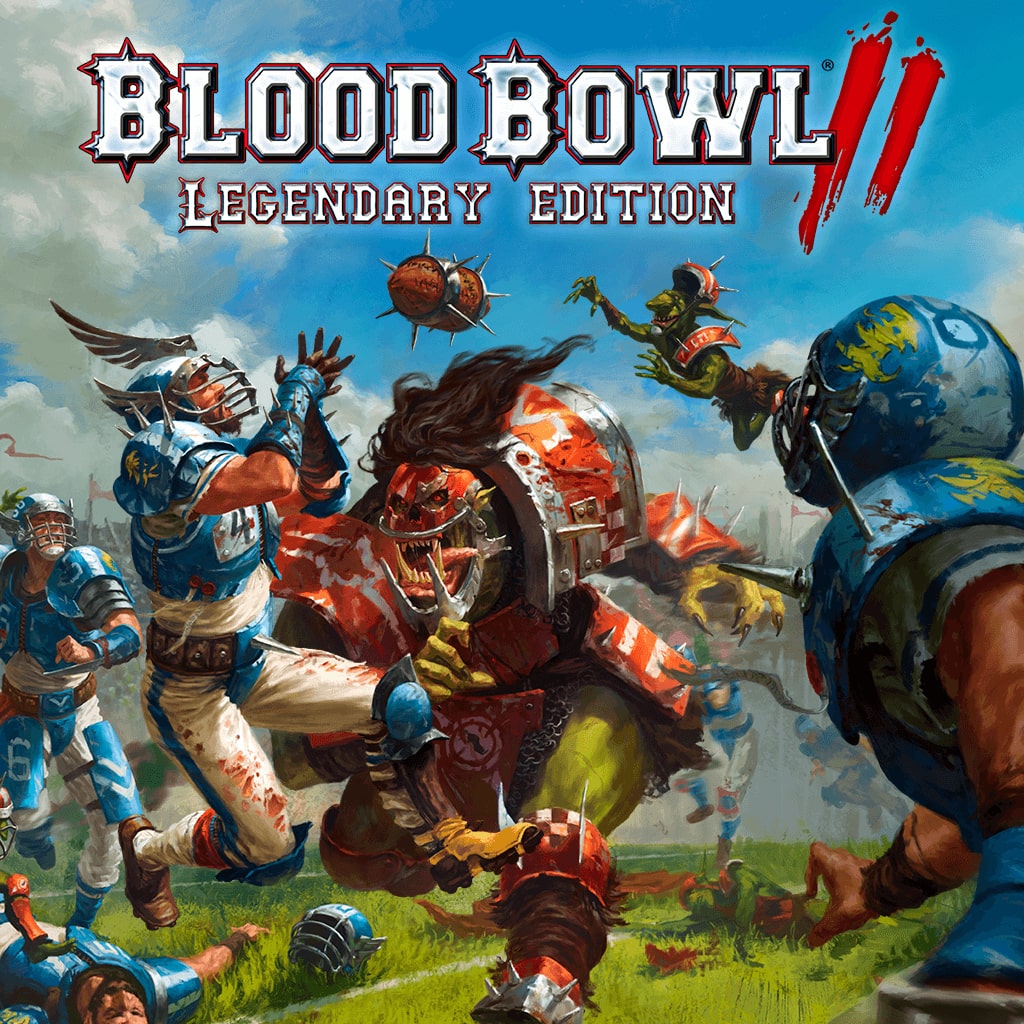
This is not a recommendation, this is just me musing on a game that I’ve been enjoying with my friends for the past… COVID, really. We started playing together in the spring of 2020, when we realized that we weren’t likely to see each other for a long while. I’d never played Blood Bowl before, though I remembered seeing a couple painted minis for it when I was a little kid.

I thought those looked cool, like pretty much everything else that my older sibs touched.

Normally, my friends and I would all see each other in the summer while we worked at LARP camp. We’re also quite close, emotionally speaking; being able to talk to them regularly was (is!) sanative and restorative for me. Given that I’m bad at staying in touch with anyone I don’t see regularly or intentionally schedule time with, playing a semi-weekly fake sports match in a league with my friends was pretty ideal.

The game, however, was not easy to love. Blood Bowl is a satirical mashup of soccer hooliganry, American football, and rugby, and it’s about as violent as it is tongue-in-cheek. It’s also a troublesome beast, full of non-obvious rules and capricious randomness. You can absolutely play an excellent game and still lose because you were sufficiently unlucky with your dice. And you can win a game with a mere tactical victory, while most of your team lies broken and bleeding on the pitch.

In a strange way, I think Blood Bowl was a very appropriate game for me to start playing during the early stages of a pandemic. You have to learn equanimity to play well, or at least learn to recognize when you’ve lost that balance. You can only play your best, try to control what you can, and understand that there’s always something that simply isn’t up to you. In that way, it was quite good at teaching me to let go of trying to control absolutely everything.

Useful, given the world’s circumstances.

For a long time, perhaps over a year of playing the game, I wasn’t even interested in playing with anyone besides my friends. No matter how much fun I had playing, it was often still stressful. And the thought of playing with anyone I wasn’t close friends with—anyone I wasn’t LARP-camp friends with—had very little appeal. A lot of the joy I got from the game came from naming my team and players after good bits, things that I could play to the hilt and which I and my friends could laugh about. It helped that some of my fellow players were into pro-wrestling and convinced us all to indulge in the kayfabe and the creation of faces and heels for our league.

But I think I’ve finally turned a corner. I can’t say I’m likely to start playing games with randoms on the internet, but I’ve finally reached a point where the game feels more rewarding and less stressful. Maybe that’s from growing skill and familiarity, maybe it’s a shift in mental health and brain weather, or maybe it’s something else. Suffice to say, I do actually enjoy the game these days. I don’t only engage with it as a way of maintaining regular contact with my friends (though that is still something I treasure).

For myself, I’m looking forward to more seasons of Blood Bowl to come. And I can’t wait to see whether the Skraghaven Squigbitas can take down that uppity bunch of varsity kids, the Kronar High Neandertals. I plan to watch, and heckle, and root for my friends this Saturday while we find out what wildly improbable inanity will happen this time.

I think I finally understand what people love about rooting for their teams in real life sports. I won’t say that you should try the game, or that you’d enjoy it, but… you might?

Under the right circumstances, you might.

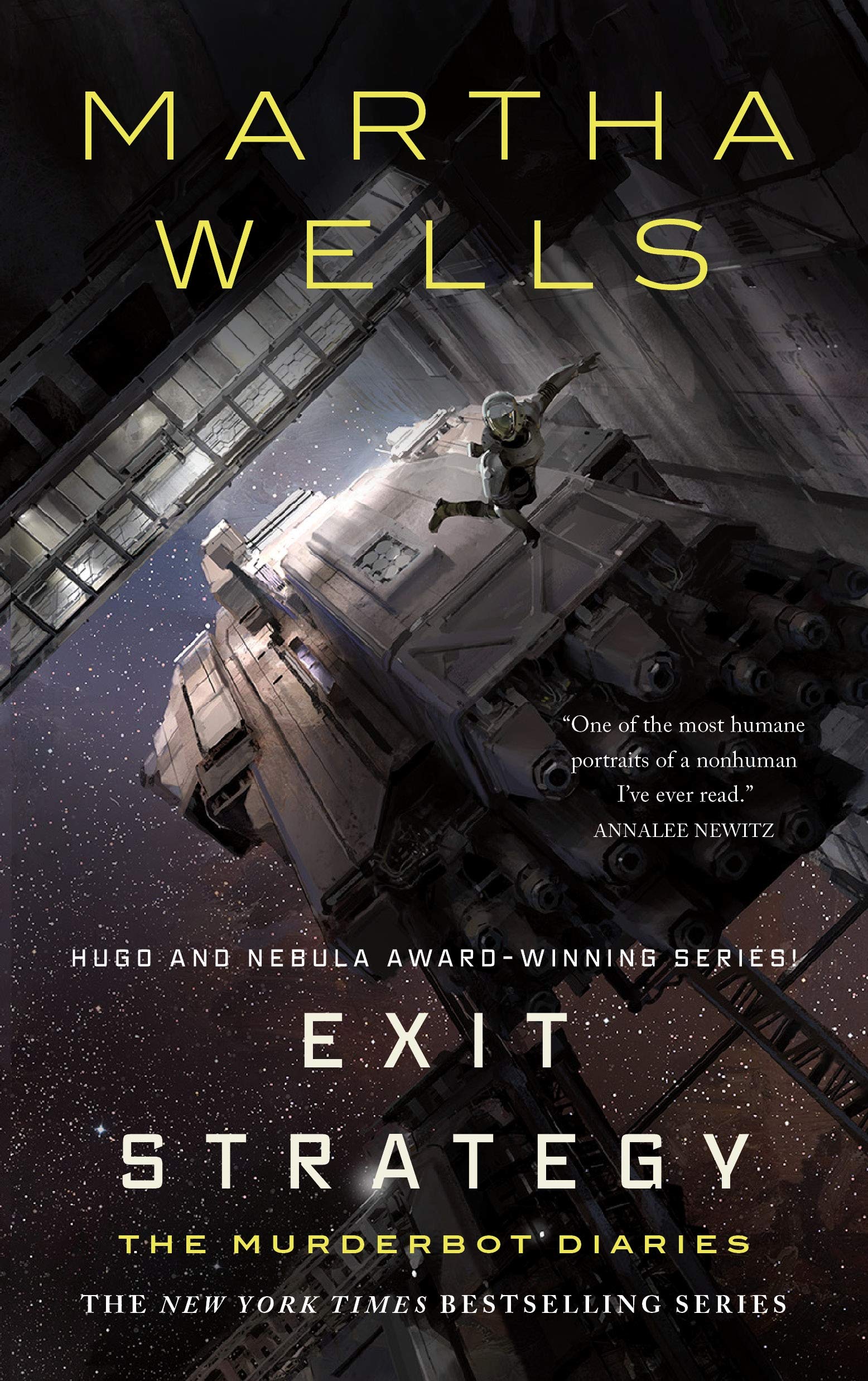
Exit Strategy, and more Murderbot from Martha Wells

Martha Wells does an excellent job of wrapping up her arc in Exit Strategy (Murderbot #4).

Her habit through the first four novellas of layering in emotional struggles alongside but separate from the underlying physical plot—separating the drivers of the physical and emotional plots in ways that are contrary to most current practice—works really well here. That separation allows her to write Murderbot as a proactive character, reaching for goals that it chooses for itself, without requiring Murderbot to be complicit in pushing its own emotional development. That’s important, because Wells has created a character with zero desire to engage in personal emotional content (despite its love of human media), which means that Murderbot starts the series uncooperative in pursuing any emotionally charged plot.

It’s a neat combination of a driven and reluctant protagonist, in one package.

Murderbot’s reluctance to engage in emotionally charged plot only makes the conflicts Wells builds towards in Exit Strategy even more satisfying. And because of all that, because of the character transformation that Wells laid out over the course of the first four Murderbot novellas, I cried as I neared the end of book four. It was that good.

Having now read the rest of the (currently available) series, I think Wells’ use of a multiple-novella arc was ingenious. I think those first four novellas together may even be stronger than the novel-length Murderbot story. This isn’t due to a lack on the novel’s part—rather, I think it’s an outgrowth of how the novellas serve Murderbot’s growth uniquely well.

Some thoughts on this…

Any time that a character needs to experience emotional growth and change, it helps to have your story cover a long enough time period for that change to feel real. It’s also useful to have there be multiple mutually reinforcing circumstances that coincide, over time, to produce the gradual shift. Both of those things are easier to do over the course of multiple novellas, where literary convention allows the story to wander across more spaces, times, and situations without the requirement of tying all the developments into a single cohesive unit of story. An obvious parallel: it’s the same freedom of expanded narrative space that allows a six hour miniseries to offer more character growth than a three hour movie. Spreading that character transformation out, especially when it’s a big and complicated one, gives the character’s growth space to breathe, expand, and feel less forced.

The usual alternative—the approach most similar to a movie’s, and the one favored by action and adventure stories since the 1800s at least—is to have the story produce a high-tension crucible of a climax, where all the preceding character development comes to the fore and shakes out like an earthquake of personal growth. That single big conflict has to encompass, even prove, all of the character’s transformation in the story. That means that if there are multiple points of change, they all need to be set up ahead of time. The groundwork is often elaborate, and a large degree of genre-savviness is simply learning to recognize those story preparations.

Storytelling is all artificial; it’s artifice working as hard as it can to look natural and real. And it’s harder to make something look real when you’re forcing it to go as fast as possible, with nary a moment to breathe. Giving a big character transformation more space therefore helps to smooth everything out and make a tumultuous period of transformation look right.

That’s what Martha Wells does with her first four novellas.

I think her novel length piece, Network Effect, is still good. I enjoyed it a lot, and happily recommend it to anyone who likes the Murderbot series. But it doesn’t do all the same work that the first four novellas do. In some ways, the important emotional journeys of Network Effect belong to people besides Murderbot… and they aren’t as resonant or rewarding for me as the arc Murderbot completed in Exit Strategy.

They’re still good though.

But now I’ve run out of new Murderbot to read, and I’m at a bit of a loss. My next few library books aren’t ready yet. And once I have them I don’t expect them to be as good, or as good in the same ways, as Murderbot.

I’m really looking forward to whatever Martha Wells writes next. I hope it’s more Murderbot, but I’m excited for whatever it is.

Dune (2021)

Dune (2021) reminded me why I like seeing movies in theaters. It was CINEMA, in an incredibly all-caps fashion. It was larger than life: it pulled me out of my socially distanced seat, even made me forget that I was wearing a mask, and caught me up in its vastness.

There are certainly movies that benefit from being seen on the big screen, movies that benefit from having a good sound system. So many MCU blockbusters fit that description. I’m sure I’ve said that of other movies here before.

But it’s rare that I watch a movie that feels designed for that largeness every step of the way. It’s rare to watch something that so welcomes dwarfing its human actors against massive backdrops, that feels ready to swallow up everyone on screen at once. It’s even more rare for these movies to go beyond dazzling spectacle, and to evoke awe.

I really liked watching Dune. I LOVED it.

I’m not yet talking about the story, or the characters, or any of that (though I do have thoughts there). I’m not covering the soundtrack at all, which deserves its own essay. Nor am I talking yet about how Dune is problematic, and one of my problematic faves. I’m just talking about the experience of watching Dune on a big screen, with a proper 7.1 sound system that I could feel in my chest. And part of that, part of the magnificence of the movie and how it drew me in, comes down to a set of decisions they made that (I think) were brilliant.

First of all the camera work, and especially the groundedness of the camera, keeps the viewer in the scene. The camera never moves in ways that feel unreal, even when its location is obviously impossible: the vacuum of space is graced with a slow pan, while an ornithopter in flight is followed either from the ground, or with what feels like remarkably steady helicopter work. Like David Lynch’s 1984 Dune, scale and distance and perspective still play a crucial role as we see just how small the characters are in their setting—a visual cue that parallels the ways in which so many people in this movie, full of hopes and dreams, are rendered insignificant and cast aside.

This movie’s visuals say, loud and clear, that the world is bigger than any human. It’s bigger, and it doesn’t care. Arrakis doesn’t care about you. The Padishah Emperor doesn’t care about you… and if he does, he may simply wish you dead or broken. The story is Shakespearean, as Stephen McKinley Henderson (Thufir Hawat in Dune 2021) points out. I agree, though perhaps a little differently: it’s a vast tragedy, with many people who die on the sidelines without ever achieving what they’d wished. Few people are as large as they might think themselves, few as important. The movie’s visual language hammers this home.

But the visuals also feel incredibly real. That feels unusual for a big genre movie with showy fantastical elements. So often, those big “wow” moments are both impressive and just slightly off. Dune manages to convey a sense of reality and presence that I can only compare to seeing the original Jurassic Park in theaters. As I discovered when I dug deeper, this is because the Dune production team (like the JP team) paid attention to minute detail, working extremely hard to make every little bit fit together—and work together—into a greater whole. It paid off.

For one, Dune paid incredible attention to lighting color and quality. They developed a new background screen which the production team called a “sand screen,” replacing the common blue and green ones. A warm brown, the sand screen better matched the lighting-color of their set locations, and allowed reflected background lighting to paint the proper colors on the actors’ faces, thereby enhancing the visual immersion (at the cost of slightly harder work for the CG artists). This meant that even when working with CG’d-in sets, the actors were still lit more like they were shooting on location.

Speaking of shooting on location: Dune captured their outdoor shots with real sunlight, even when working in front of screens. And when they had explosions in dark scenes, they filmed in darkness and cued pre-positioned lights to illuminate the actors’ faces in time with the explosions. What’s more, they used literal tons of real sand in many of their blowing-sand shots (material that gave their CG artists something to work with while touching up the scenes) and took footage of helicopters blowing up desert dust clouds for additional reference.

Heck, they also weren’t afraid to let those dust clouds obscure their (beautiful, intricate) prop and set designs. There were shots where I could barely make out the vast scenery, only see hints of it by well chosen lighting and inference. The production team understood the value of not showing everything, of letting the viewers fill the gaps. And while they may have covered up some of the gorgeous art they’d created for the film, the effect was magnificently immersive. Watching a lone figure buffeted by wind and rain below the landing lights of an otherwise pitch black ship, or seeing Harkonnen combat vehicles hidden by billowing sand and lit only by the flares of their own missiles, I felt more pulled into the scene. And the movie pulled my focus to the elements it really wanted to show, rather than overwhelming me with too much detail.

They did an excellent job.

Okay, now for some of the other stuff.

First, if you’ve read the book you’ll know what’s happening. If you haven’t, I can’t help you. It’s been so long since I read the book, this story has wormed its way through my brain. I doubt I can judge whether it does a good enough job of including an uninformed audience.

That immediately opens many cans of worms. Dune, the novel, was published in 1965. That age, and the divergence in social assumptions that go with it, is palpable when you think about the book. And despite the little ways they’ve changed things, the movie is pretty faithful to the original text.

But in a lot of ways, the 2021 film does a good job of concealing the cultural temporal disconnect. While it (like the source material) is painted up like science fiction, the movie’s genre feels far more like grim feudal intrigue fantasy, in space. That gives it some cultural leeway I think it might otherwise lack. Like an interstellar Game of Thrones, with some technology that reads like magic (or an excuse to follow Frank Herbert’s personal Rule of Cool), it’s clear that this world has some different cultural conventions than our own. And, of course, we return to it being a Shakespearean story—murderous feudal politicking in space.

Now, I feel the movie made the right choice by leaning into the fantasy intrigue genre, because I think the book was there all along. For me, the book fits far better into the genre conventions of epic fantasy a la grim feudal political intrigue than the genre conventions of science fiction. (I feel similarly about Star Wars: it’s space fantasy, rather than sci fi). It feels like the movie is being even more faithful to the text than I’d realized was possible.

I don’t think this will save them from all the ways in which Dune is problematic. I think it already hasn’t. This movie is less problematic than its source text, but not without issues of its own.

But it does look like they’ve backed off some of the ways the original text was troublesome, and laid some groundwork (that I don’t recall from the books) that builds context for other ways in which the original story was problematic. I have no idea to what extent that will cushion the blow, though, because… this was just Dune: Part One. Time to wait another two years, probably.

I’ve now written enough without a clear outline that I’m losing track of my thoughts. Suffice to say I think this is an awesome movie, in the archaic and classical “awe-inspiring“ sense of the word. It’s absolutely worth watching if you can see it on a big screen with big sound. If you can’t, and you’re a Dune fan, you should still watch it. If you’re not a Dune fan… yeah, I’d still recommend it, provided you know what you’re getting yourself into (I’m not going to write about that here and now, this is already too long). But do try to find a safe way to see it on something large. And ready yourself for taking in visual and auditory spectacle.

Because wow. This movie is a lot.

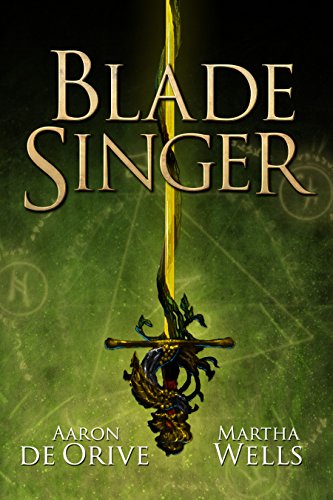
Blade Singer, by Aaron de Orive and Martha Wells

This isn’t Murderbot.

It’s really not fair to compare the two. But because I found this book by looking for other things involving Martha Wells—that felt like Murderbot—I’m afraid it’s doomed to comparison. This was the available book, with Martha Wells’ name attached. It wasn’t what I was looking for.

I did finish it.

Blade Singer isn’t Murderbot. It’s straightforward portal fiction, with a powerful fey three musketeers vibe. All genres I like. Clearly intended for that awkward threshold between middle grade and young adult, where the plot is very middle grade but the writing is a tad more complex, Blade Singer has a mix of genres (and a target audience marketing category) that I have strong opinions about.

Honestly, this book is fine. I enjoyed it. My quibbles with it are perhaps unreasonable.

Leaving aside my desire for more Murderbot, I think this is actually a solid book to give to a younger reader who enjoys fantasy, fey and faeries, swashbuckling and musketeers, or portal fiction. And it’s a solid choice for any younger reader who might like those things and hasn’t gotten deep into books yet. It isn’t as immediately accessible as other simpler reads (it’s no Warrior Cats), but it’s not especially difficult either. On that front, it lands the upper middle grade rating pretty solidly.

However… as someone who’s quite familiar with (and enjoys) all the genres involved, this book also doesn’t offer any big surprises or new takes. It isn’t transforming the genres, or at least not in a way that offers a story more complex and nuanced and to my taste. It doesn’t succeed where other ostensibly-for-children fiction has thrived, with the depth required for cross age-market appeal (think She-Ra and the Princesses of Power, most Pixar movies, or Nnedi Okorafor’s middle grade work like Akata Witch or Shadow Speaker).

Blade Singer’s stumbling blocks for me, I think, were its moral and emotional plots. They were present, all the requisite structure was there, but they felt almost bland. Like I could see the action on the page, and I knew how it would or should play out, but I never felt pulled into it, into feeling it. And I know this book could have done that. All the puzzle pieces were there.

Part of that could have been the close over-the-shoulder third person narration, but I know other close third stories have succeeded for me where this book didn’t. And while adding more filigrees to the moral and emotional plots might have helped make them less straightforward, I don’t think that would have solved the issue for me—I don’t feel pulled in just because something’s complex, I enjoy something being complex when I’ve already been pulled in. I think it came down to something about the characterization, and the fact that I simply bounced off of fully connecting with the narrator, Manny.

Your mileage may vary.

But that emotional bounce, and having a solid physical plot while struggling with the emotional and moral plot, reminds me of my own experience first writing fiction. With most of my preceding storytelling experience coming from running RPGs, I struggled to make stories with emotional connection or character depth. I’ve written about all that on this blog before.

And maybe I’m reading too closely here, but I think Aaron de Orive had a similar starting point (both in terms of games and the fiction he consumed). He’s involved in writing for RPGs and video games, and the authors he mentions on his personal site aren’t known for their excellent depictions of relatable complex emotional people, not like the modern authors I’d compare them to. Many are the same authors I read as a kid.

For me at least, writing linear fiction was a puzzle that I didn’t even realize I wasn’t solving. Most adventure fiction I’d read as a kid didn’t have much emotional depth or nuance. And while I knew how to elicit reactions from my players, that was all about setting up the stage with the right plot pieces and then letting them complete all the robust internal character struggle in their own heads. I didn’t know how to show that on the page. Sometimes, I still don’t.

But I wanted Aaron de Orive (and Martha Wells, she’s credited as a co-author even though this doesn’t feel anything like her other work I’ve read so far) to yank on my heartstrings. I wanted these authors to reel me in deep and leave me really feeling the joys and sorrows of the characters involved. That didn’t happen. And I didn’t feel attached enough (as I did with Murderbot) to complete the loop myself.

But as I said above, my quibbles are probably unreasonable. Blade Singer has more emotional depth than those adventure stories I read as a kid. It’s not a bad book! It’s perfectly fine, and I do recommend it to anyone who likes the relevant genres. And, to really enjoy it, I think you’re best off reading it as a kid who doesn’t have as much experience with these stories.