The carrot is more effective than the stick. That’s especially true when running a game. In fact, failing to give your players enough carrots might cause them to lose interest and stop playing. But what makes a good carrot?
Continue reading
The carrot is more effective than the stick. That’s especially true when running a game. In fact, failing to give your players enough carrots might cause them to lose interest and stop playing. But what makes a good carrot?
Continue reading
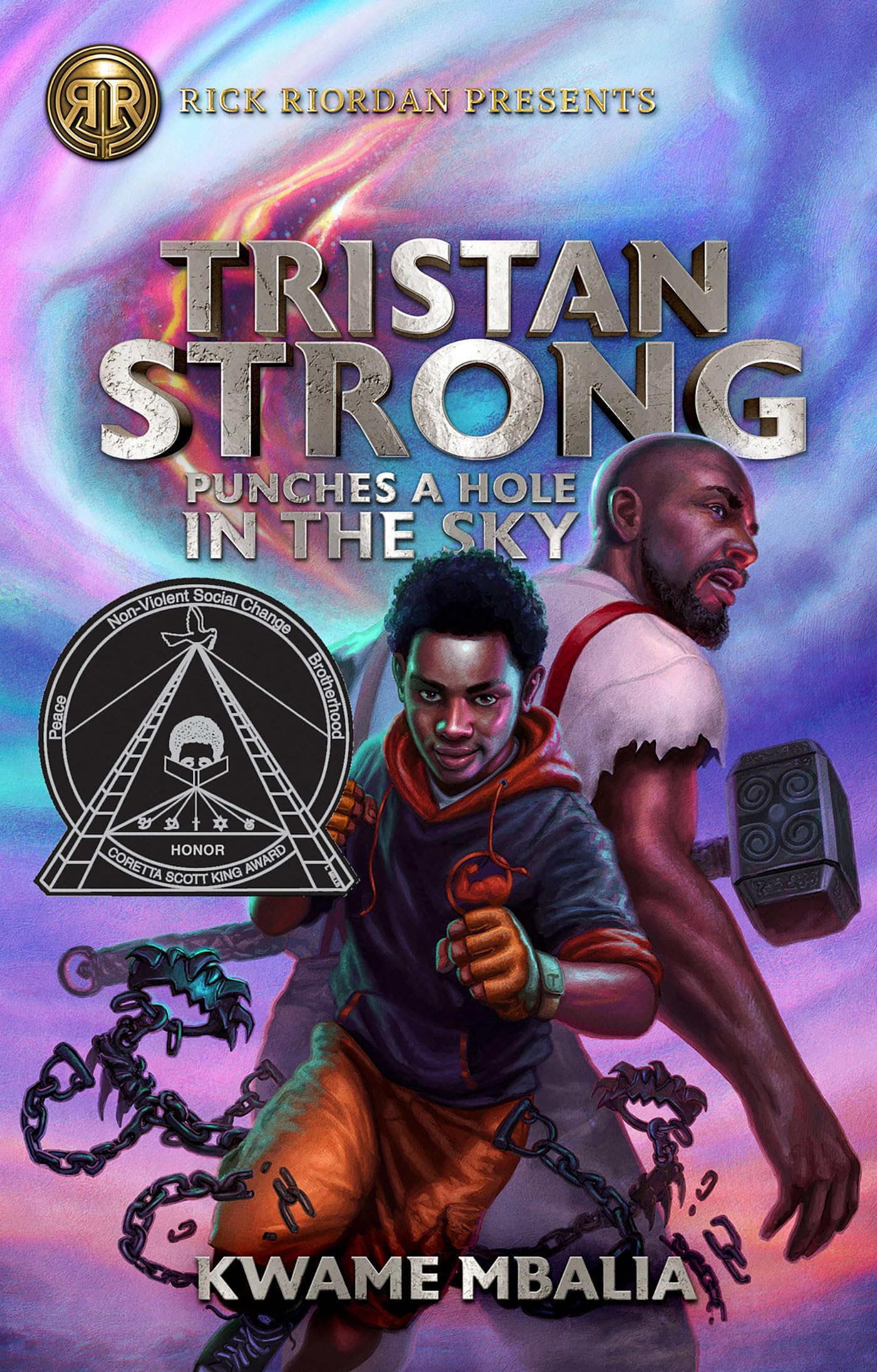
I love a good middle grade adventure story. That’s precisely what this is. As you might expect from something published under Rick Riordan’s imprint, it’s full of mythology and folk tales and legends. Tristan Strong Punches a Hole in the Sky, by Kwame Mbalia, is all about one young boy’s discovery that the stories he’s grown up with (African-American stories with American folk heroes like John Henry, African trickster figures like Anansi, and those who blur the lines like Brer Rabbit) are all far more real than he ever could have believed. It’s fun, it’s pretty fast, it’s (heh) punchy. This is a good book.
I admit, my appreciation for this book is influenced by my desire for more high quality middle grade adventure stories aimed at boys. There’s a lot more to unpack there, some of which can be better understood by reading Of Boys And Men by Richard V Reeves. Read on for some of those details, as well as my few quibbles with Tristan Strong.
Continue readingYou’ve all made your PCs. You’re all ready to dig into a big game. This time, you think, the game will be serious and deep, full of emotional complexity and resonance. And then someone makes a bunch of fart sounds, Boblin the Goblin is the only recurring non-player character and he’s obviously a joke, and your biggest emotional payoff is a PC’s binge-drinking celebration of their big gambling win.
You want a serious game full of big feels. You get a goofy game full of jokes and idiocy. The heartfelt depth and emotional bleed you came here for are nowhere in sight. Why? And how can you change that?
Continue readingAre you tempted to make every NPC in your game a deep and complex character?
Don’t.
I love creating and playing NPCs in my games, and it comes easily to me. Part of this is because I’ve done improv theater—lots of improv theater. But mostly it’s because I use a few basic guidelines when I’m coming up with NPCs.
Since I apparently haven’t written anything about making or running NPCs since that article about naming them from over a decade ago, I figure this post is overdue.
Continue readingThere are many ways to play TTRPGs. As long as you’re all having fun you’re doing it right.
It’s easy, however, to stumble over one’s assumptions. Mismatched assumptions about creative control, who’s taking narrative initiative, and what to expect in play are a quick way to sour your fun.
This is a tangent from the “social skills of storytelling” series, working from two inspirations:
Continue readingI write a lot on this blog about the social skills involved in being a storyteller, because I think many of our RPG books ignore the topic. What’s more, many RPG-related blogs and YouTube channels that I admire share advice about the mechanics and structure of RPG systems… but don’t cover the social dynamics. It seems like a collective blindspot. We assume that people will know what they’re doing, or that they’ll muddle along well enough.
Some of this has changed since I started running TTRPGs about 30 years ago. Many RPG books now include the basics of safety mechanics like lines and veils, the X-card, etc. But there isn’t much on how to find consensus or foster buy-in amongst your players. You have to learn the tricky art of building agreement and engagement in your own gaming group with few pointers and little advice.
On the one hand, I get it. I think the arguments run something like the following:
There’s so much variation in social expectations between gaming groups that no system could truly be one-size-fits-all. Those interpersonal connections are outside the scope of a roleplaying game. People should figure out what works for them, and do that.
But on the other hand, those arguments are an avoidant pile of crap.
Continue readingI was talking with a friend of mine recently about worldbuilding and how to teach the skill, and I realized that I’m not sure where to start.
I think my perspective is warped. I’ve been making up worlds for stories and games for so long, the whole process has become second nature. I haven’t consciously examined the process of worldbuilding in a long time.
Given that I’m planning to run a class for people who want to be DMs (or GMs, or storytellers, or whatever the hell you want to call the person running your roleplaying game), I think I need a clearer approach. I do have some ideas.
Continue reading
Have I tired of Guy Ritchie?
The first episode of Netflix’s The Gentlemen reminds me of Michael Bay’s Pain & Gain without the leavening of self-awareness. Pain & Gain leaves us, the audience, with enough room to see the idiocy and toxic obsession involved. From the movie’s first moments we are offered a perspective that might empathize with the main characters, but doesn’t ask us to sympathize with or believe them. In that way, Pain & Gain feels like a critique of the stupidity and myopic ambition of its characters.
The Gentlemen might critique its characters’ beliefs… maybe. But The Gentlemen doesn’t offer the distance and outside perspective that Pain & Gain does. Even when it showcases the absurd, the first episode of The Gentlemen takes the main characters seriously and takes their perspectives. It believes its own hype. Instead of offering a self-aware critique of people’s unwillingness to admit that they’re stuck swimming laps in a shallow pool, this first episode puts us inside the fishbowl, trying to find a better fishman.
It’s flashy and stylish and dramatic. It also feels a bit stupid.
Continue readingLeave yourself room for later. If there’s anything I’ve learned from doing lots of worldbuilding—for my own linear fiction and for the collaborative fiction of RPGs—it’s that trying to fill every last nook and cranny of a setting is a daunting task. And actually filling up everything is choking, stifling. Don’t fill up everything. It leaves no room for the future, and it leaves no room for anyone else.
Continue readingThis post follows Be Boring and Be Hungry. It’s all about making characters for roleplaying games, and how to think about RPG character creation from the perspective of a writer.
Playing RPGs recently, one friend of mine was struggling with how to make and play her character. It was not her first time playing RPGs, but she felt less experienced than most of the other people at the table and was anxious to make a good impression and make good story contributions. She has a writing background, and is familiar with arcs and storyboards and how to make a good dramatic narrative. But she was foundering as we sat at the table, sinking beneath the weight of making a character who would be interesting enough to the rest of the players, a character who would have a complete story. She couldn’t see a way to do that, couldn’t see a way to tell the stories that seemed right for the character she had, and couldn’t reconcile her knowledge of how to tell stories with the structure of our RPG.
In a darkly funny sort of way, Continue reading