Work In Progress: Last Days of Loneliness

I’ve shared my thoughts on this with you before (here too), but I have some more material.  It turns out that I still haven’t solved some issues I was nattering about back in November:

So, I’m still seeing this big problem looming in front of me.  I’ve got this wonderful ending all set up at the moment, with Amanda and Doug Felber working together to try to burn the eggs in order to destroy them.  I really like the whole idea of the flamethrower, and think it’s pretty awesome.  But WHY THE HELL WOULD THEY KNOW TO USE A FLAMETHROWER?

That’s one big issue: I don’t presently have a reasonable path for them to follow to even discover that fire would be necessary to kill the stupid eggs.  Nor do I have a reason for why anyone would tell them this.  Nor do I have a reason why they would think that the whole town might be destroyed, nor do I have a reason for why they might find out that destroying the eggs would result in destroying the town.

To sum it up:

  • No reason to know to kill the eggs with fire
  • No one with a reason to *tell* them to kill the eggs with fire
  • No reason to know that killing the eggs destroys the town
  • No one with a reason to tell them that killing the eggs destroys (or might destroy) the town.

In some ways, that last one is the easiest to solve.  If one of them tells someone that knows the Mother about the plan to destroy the eggs, that person might wig out and tell them that it’s a stupid idea.  Problem is, anyone who did tell them it’s a stupid idea would also then know that they were thinking about destroying the eggs.

All of that is potentially solved through sufficient idiot-balling, with Amanda fooling Rick/friend into thinking that she’s going to join the cult and getting a tour of the eggs and asking questions (“If they’re so important, why aren’t they better protected?  What would happen if someone broke them?”).  But that feels like it could be more than Amanda would be willing or able to pull off, and it would require the other person not to twig to the very suspicious questions.  Don’t like that idea.  See top for previous intro of this concept, which I’m now mostly dismissing.

Should I just kill my darlings and do away with killing the eggs with fire, and even do away with having the town be destroyed?  What would that look like?

Ditching both schticks

Amanda goes to town on the eggs with a sledgehammer, breaks them open and kills them, the town’s covenant is broken and the cult’s connection to Mother is destroyed (or maybe the cultists were all just crazy to begin with and that was all just them being super fucked in the head).  There’s a big anti-climax in the massive-wreckage department (have to rewrite the beginning again).  Amanda then has to burn down her house or something in order to ensure that her parents don’t try to come home, and flees town.  Another option would be going home and hoping that no one knows that she’s the one who broke the eggs, but that seems really boring because it doesn’t resolve the panic and tension of risking being discovered.  Which has been building since the middle of the book.

Ok, this seems possible, but the only interesting version of this that I can see at the moment is having Amanda burn down her house to force her family to move afterwards, and there’s just not as much horror there (unless, maybe, she murdered some people in the course of breaking the eggs, in which case now she’s also wanted for murder).

Quick question: what’s freakiest?  I think the most horrific option, and the one which best showcases her determination and how far she’s gone in terms of leaving conventional morality, is for Amanda to KNOW that she will (or might) kill everyone in town if she carries through with her plan.  She could find this out at the last minute, which wouldn’t change how bad what she does is, but knowing further ahead of time leaves more of the blame on her.  There’s no argument for the “heat of the moment” defense or whatever.

But “accidentally” destroying the town is pretty bad too, especially if she appears to feel little remorse.  And that opens up some potentially interesting scenes.

So then…

Keeping the “TOWN IS DESTROYED” schtick

I could keep the whole ‘town is destroyed thing’ and instead have it come as a surprise to Amanda.

Maybe she still planned to leave town because she thought she’d be discovered and killed, along with her family, so she sent her parents to NYC for their date, and then planned to burn down the house.  Turns out she didn’t have to burn down the house and tries driving away instead of sticking around for an earthquake that seems like seriously bad news.  Not as horrifying because Amanda doesn’t intentionally kill the whole town, but still pretty good overall.

OR

She thought she could get away with it and didn’t have plans to leave the town, so she just set up a date to distract her parents while she runs around all night.  If the date was in town, she finds them and hustles them into the car or desperately tries to convince them to leave (maybe at gunpoint).  If the date wasn’t in town, she just books it from town?

The ‘parents at gunpoint’ scene sounds pretty good, but the rest of it doesn’t feel like it has as much tension.  This would extend the physical threat of the climax, but (apart from holding her parents or others at gunpoint) wouldn’t do much to heighten the emotional climax.

One thing I definitely *don’t* want is for Doug to know that the town will be destroyed while Amanda does not.  I also don’t want him to know that it could happen and then inform Amanda.  That makes him as much (if not more) a villain as she is, and makes him just as complicit in the destruction of the town.  Besides, if he knows all these things, why hasn’t he acted on them?  If he would destroy the eggs himself, Amanda becomes at worst passive and at best an instigator rather than a decisive actor.

I do like the ‘holding parents at gunpoint thing, and I like the ‘town is destroyed’ thing, and I especially like her knowing ahead of time that the town will be destroyed (though I still would have to solve that stupid problem of it making no sense).  What about killing it with fire?

Pros / Cons of KILLING IT WITH FIRE

First of all, the scene (which has changed a good deal) originally came to me as something that involved a homemade flamethrower.  There was something almost too horrifying about having Amanda kill people with the flamethrower, something that really made the scene stand out in my mind.  Plus, if you’re looking at Cthonian eggs according to the relevant source material (which is fictitious bullshit anyway, so who cares), it’s made pretty clear that fire is definitely the best way to kill them.  Thinking about what you’d have to do in order to break a round, smooth-ish, and occasionally squirming rock… you’d be pretty likely to see your sledgehammer bounce or deflect in some possibly vicious ways.  For all that it requires more work beforehand and is more complicated overall, killing it with fire is definitely a lot simpler in the actual execution.

Are there any real story or scene benefits to having Amanda use a flamethrower vs. Amanda using a sledgehammer or something?

I guess I had an easier time imagining her using a flamethrower just because it would require less active upper body strength, but I already know that she does martial arts and has for quite a while, and I’ve definitely had female friends who are quite capable of and enjoy using sledges.  So using a sledgehammer certainly passes the plausibility test.  It also fits with the whole “Amanda is a hardcore badass” thing I’ve got going.  Fighting people with one is a little more difficult, but she’s still got the same things going for her.

I would be sad to see the flamethrower go, because it’s a fear-weapon as much as anything else.  There’s something especially upsetting about having Amanda kill people with the flamethrower in the course of achieving her goals, and I like that.  It isn’t as easy as using a gun, and feels more personal while still being scary.

Thinking a little further, I was going to mention that a sledgehammer allows for Amanda to use her martial arts in the middle of the fight while the flamethrower doesn’t, but that isn’t quite true.  It would certainly make it easier for someone else to rush her and for her to then get in a physical fight with them, but that’s still possible with the flamethrower; her having a flamethrower just means that the people facing her have to be more desperate, or the situation has to allow them to get next to her without her burning them.

What if Amanda and Doug plan to use the sledge, but bring the flamethrower as a fallback plan?  This is good, and gives an opportunity for Amanda to try breaking the eggs in the mine and fail… but it doesn’t serve tension in any meaningful way (if there’s a flamethrower, the writer will *use* the flamethrower, thank you very much).

This reminds me of a side problem, namely that I’m not sure why Amanda isn’t trying to break the eggs while still in the mine.  My original thought on that involved her taking them elsewhere to kill them in a special way or with a time delay that would let her escape town, but *that* was predicated on knowing that killing them would result in the destruction of the town, which is still a problem that I haven’t solved.
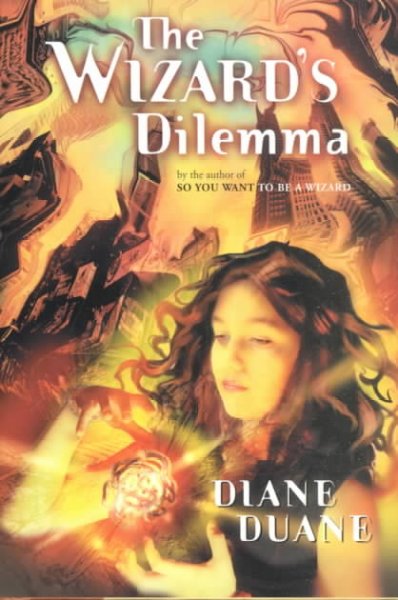
The Wizard’s Dilemma, by Diane Duane

JacketWelp, this one took me a long time to finish.  I’m still not quite sure how that happened.  Part of it was that I started the book while I had far too many things on my plate and thus got distracted.  But part of it was that at a certain point in The Wizard’s Dilemma, I felt like I could see where all of the pieces were, where they needed to go, and had a pretty good idea of how they were going to get there… and I really wanted them to just be there already, instead of making me wait.  I suspect that this is the price I pay for reading so much.  Or perhaps for being impatient.

It turns out that I was right about most of those various story beats, but seeing what Diane Duane did with them was far more satisfying than what I’d imagined.  I probably should have seen that coming, given that I’ve read the earlier books in the series and know how good Duane is at her work.  Once I finally got over my block and moved into the last parts of the book, I didn’t want to put it down.  And then, of course, the climax made me cry.  Whatever the real reasons for my reading delays, I feel quite certain in saying that this was an excellent book, one worth reading, worth recommending, and one that leaves me wanting to read the next one in the series.  Just like the previous books in the series.  I probably could have seen that coming too.

So, why the heck did this book make me cry?
Continue reading

Further Troubleshooting: Last Days of Loneliness

Turkey Day approaches.  I’ll be spending a bunch of time with family around then, and for the week after.  This means that I’m unlikely to post much in the next two weeks, though I’ll see if I can scare up a few more interesting posts for you.  This Wednesday will be largely occupied with travel.

Today’s post is going to be a lot like last Wednesday’s, so spoilers abound.  This time I’ll be working through how exactly Amanda ends up deciding to break the town’s covenant with its deity-figure.  Oglaf illustrates the concept quite admirably here (surprisingly SFW, though the rest of the site isn’t).  Enjoy!

Continue reading

Last Days of Loneliness: Writing the Middle is Terrible

My apologies for the much delayed post, I’ve had a moderately busy day: my visit to the optometrist took a bit longer than I’d anticipated, and I’ve started writing this far later than I’d originally planned.  Today’s topic is all about how frustrating I find writing the middle of Last Days of Loneliness.

If you followed that link (or remember the other earlier posts), you should have a pretty good idea of the shape of the story that I’m writing.  Like those posts, this one is going to be full of spoilers… so if you really want to shield yourself you should probably just stop reading.  If you want to read my thoughts as I try to solve the trouble that I’ve run into while trying to make the middle of the book live up to the promise of the premise, you know what to do.

Continue reading

Last Days of Loneliness, a YA horror story pt. 3

This is yet another post about the YA horror novel I’ve been working on, which I roughly outlined here.  Last time I gave you the very beginning of the story (which I’ve already altered again); this time I’m going to give you the very end of the story.  This ending will undergo further changes: I already know that I need to decide whether it makes sense to have italicized thoughts-of-the-moment within the narrative, and if I like them, decide how to alter other story sections to incorporate them holistically rather than as a last minute deal.

Here’s the action climax:

Continue reading

Last Days of Loneliness, a YA horror story pt. 2

Like I promised, I’ve got some actual text for you today.  I’m a bit late because I’ve just finished pounding through Marcus Sakey’s Brilliance, which I rather liked, but hopefully this material will make up for it.

Keep in mind that this is all still rough.  I’m not even sure that the narrator’s voice is appropriate, so whatever ends up being final may look wildly different.  With that said… I do hope you enjoy it.  Also, please do comment if you think something works particularly well, or really needs to be changed.  The beginning of the story lies after the break…

Continue reading

Last Days of Loneliness, a YA horror story

A number of years ago, one of my writer friends mentioned a story concept that she wanted to share with me.  She wondered what would come of a Lovecraft-inspired horror story in which the protagonist was a high school girl who had just recently moved to a new town.  I immediately latched onto the idea.  We spent a few hours bouncing ideas back and forth, and at the end of our brainstorm session I asked whether she would like to collaborate with me on the project.  She said yes.

I started writing material for the story, occasionally ignoring school work that I really should have been doing at the time.  I soon had a great deal of (questionably valuable) material to share with her, but she’d fallen into a work-hole and been unable to claw her way out.  She ceded the project to me, though we continued to share our thoughts on it.

Fast forward a few years: after finishing my thesis, graduating, and getting back into the swing of writing for a while, I dust off my old drafts of this nascent YA horror novel and get some other people to take a look.  The drafts are, to put it figuratively, mostly made of poo.  I’m now aware of the fact that I have little idea of how to write a teenaged female narrator, which makes looking at my past struggles all the more painful.  But there are some pieces that seem like they still hold some value.  The concept and the basic story beats still seem basically solid, and the story clearly has an excellent ramp up to the climax.  Now the time has come to strip the piece down to its bare bones and tinker with it for a while.  Oh, and write a variety of new attempts at a teenaged female narrator, while reading as many pieces with teenaged female narrators as I can (preferably from the right genres).

In case you’re wondering where this is going, yes, I’ve got some material to share with you today.

Continue reading

When You Reach Me, by Rebecca Stead

whenyoureachme


This book came highly recommended, and it seems only appropriate to pass on the favor to you.  It’s not a long read, nor is it a difficult one, and I can’t say that the ending came as much of a surprise to me… but I simply loved reading it.  It felt both extremely real and wonderfully thought out; it contained a loving homage to another children’s novel which I adore, and yet was clearly its own story, laid out as a puzzle with all of the pieces lying there right before your eyes, waiting for you to put them together.

You know, usually I’m able to talk about a story without giving away any spoilers that I think will unduly influence your understanding of the book.  Or else I’m able to sequester all of the relevant spoilers in a place just for those who’ve already read it or are willing to spoil themselves.  But this time I think I have to leave it be.  I’ll even say that you shouldn’t bother reading the dust jacket’s inner flaps.  Just pick up the book.  I doubt you’ll take more than two days to read it, and you could probably go through it in an afternoon if you had the time.  There’s something too good to spoil about following the narrator’s journey as she slowly tells us how it is that she pieced together the puzzle, and I’m impressed with the narrator’s consistency as she reflects back on the events she describes in the book.  It’s a skillfully told story, and I hope that you’ll take my word for it and pick it up.  Find it here at Rebecca Stead‘s website, or find it at your local library!

Deep Wizardry, by Diane Duane

Deep_Wizardry_NME_2


Yes, that is a truly massive shark.  The cover of the version that I read had something to do with a whale, but I like this one better.  I thought I’d already reviewed this book, and it was only as I was sitting down to write my review of the next one in the series that I checked back through my previous posts and found that I was wrong.  So before I tell you my thoughts on High Wizardry, let me tell you how I felt about Deep Wizardry.

The quick and dirty version is as follows: Diane Duane is good at her job, and she knows how to write books about young children taking on incredible responsibilities and facing overwhelming decisions… Which is a decent description of growing up, when I think about it.  Of course, most of us aren’t given access to powerful magical forces except in a metaphorical sense.  Deep Wizardry, like So You Want To Be A Wizard, is quality children’s literature; I’ll even go further and say that it’s good enough to merit your attention and reflection too, child or not.

With the exception of the “I think I read most of this before” section, my review of Deep Wizardry really is very similar to my review of So You Want To Be A Wizard.  I’m still more than a little bit in awe of Duane, she still writes excellent YA adventure with exceptionally mature themes, and she still does an incredibly good job of not talking down to her audience.  What I hadn’t really appreciated before is just how well her chosen storyline and protagonists map onto the experience of going through puberty and becoming an adult.  Call me stupid, call me slow, but though I noticed it in the first book I took another book or two to finally decide that it was more than just a fortuitous construction of the moment.  This, of course, has simply left me more appreciative of Duane’s writing chops, and her choice of subject material.

As per usual, there’s more after the break.

Continue reading

So You Want To Be A Wizard, by Diane Duane

so-you-want-to-be-a-wizard

I’m more than a little bit in awe of Diane Duane.  It’s been a while since I read something of hers, and I’d forgotten how good she was at her chosen profession.  Though the genre is no longer quite so thinly populated as it was when this book first came out, I still think that Duane outdoes the young wizard competition.  When it comes to books about serious young people dealing with serious (if fantastical) problems, she’s totally on top of it.  Admittedly, I’m not the most experienced judge for this particular sub-genre, but Duane is worth reading if you like YA literature that doesn’t talk down to its readers.

So You Want To Be A Wizard follows two young newly-sworn-in wizards who are facing their very first duties, which include slowing down the entropic death of the universe and generally trying to make the world a better place.  You know, the usual.  As you might expect from a story with protagonists devoted to such expansive duties, they don’t have an easy time of things and quickly end up in way over their heads.  I admire the depth of the goals Duane sets in front of her characters, as it seems as though they never lack for things to do.  This also means that they’re facing things that are profoundly scary and difficult to deal with, which turns out to be the perfect recipe for excitement and wonderfully climactic scenes.

Without spoiling anything, I think I can safely say that this book is an excellent adventure with exceptionally mature themes for a YA story.  The themes are more cosmically oriented than those of many other YA books that I’ve seen recently, with an emphasis on the broad scope of a story that I normally associate with epics; I admire the way in which Duane manages to include an epic scope even as she keeps the story (and its narration) very personal.  It takes considerable skill to see that through, and Duane clearly has it.  If you enjoy epics, YA stories, modern fantasy, or anything similar, I expect that you’ll like this book.

Ok, so I have an odd story about my history with this book…

Continue reading