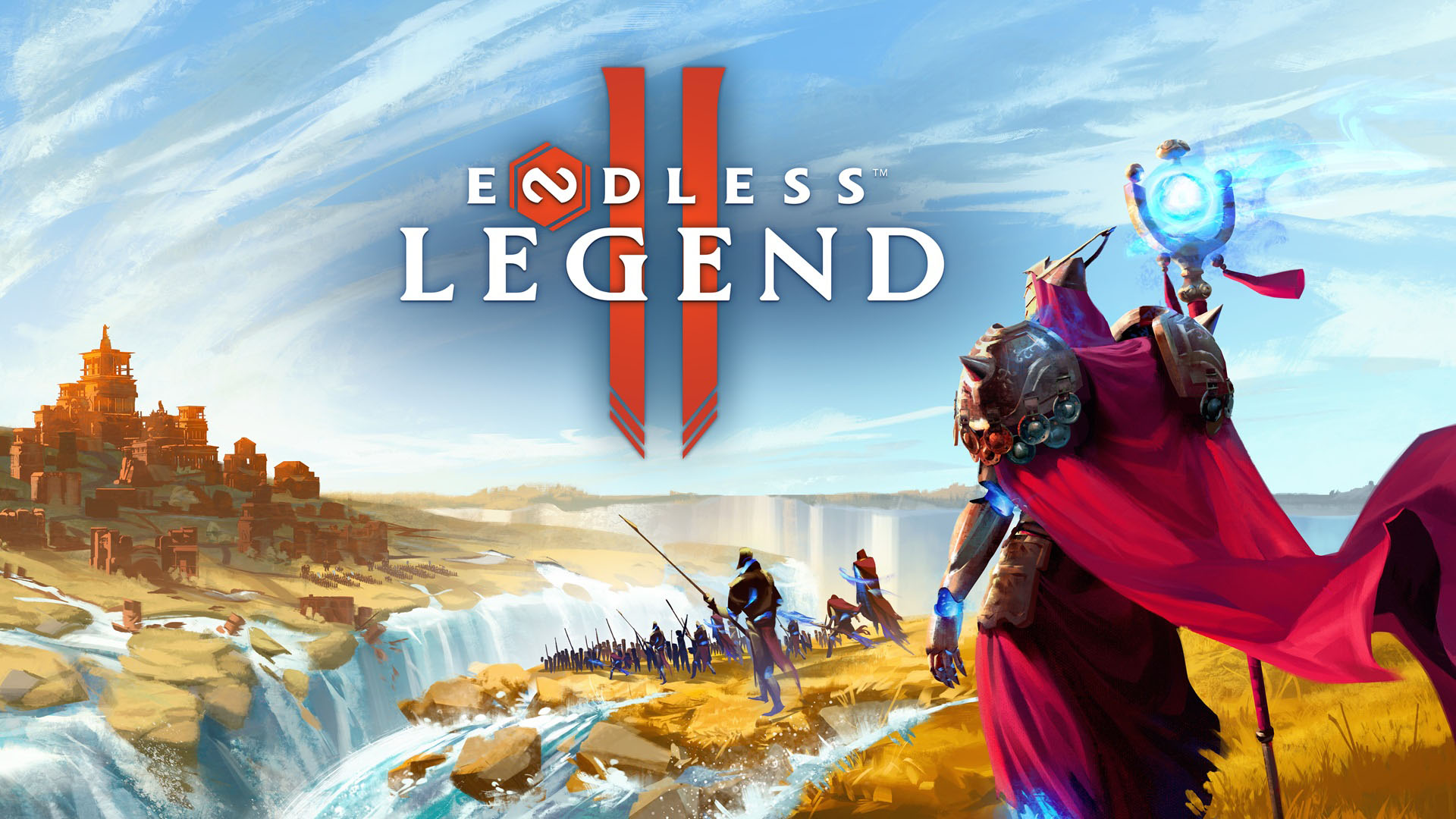
Endless Legend 2 is out.
I’m shocked to realize that I haven’t written anything about the Endless games here. I planned to connect my thoughts today to what I’d previously written about Amplitude’s games, only to discover that there was nothing to connect to. I haven’t ever mentioned Amplitude Studios, let alone their interconnected series of Endless games.
It’s time to rectify that. I’m a huge fan of Amplitude’s work.
I freely admit that Amplitude doesn’t always hit home runs. I admire, however, that they consistently take big swings. They also (to my eyes) create some of the prettiest games, offer incredibly informative and accessible and layered UI, and with their Endless games weave all that into a single sci-fantasy setting that neatly legitimizes many of a 4X game’s mechanical abstractions.
Dust is narratively superior to a classic 4X’s generic abstracted “gold.” I will fight you over this.
I haven’t yet played enough of Endless Legend 2 to give you a thorough review. I’ve struggled to find time for a new 4X while juggling childcare. That’s especially true when my laptop can’t run the game and my desktop is in the baby’s bedroom. I played some of the early access versions, but only in bits and pieces. My knowledge is thus both partial and out of date.
I have however played enough of EL2 and other turn-based 4X games to understand the promise EL2 offers. Amplitude Studios is trying another big experiment. Regardless of how it turns out, I think they’ve once again already improved the genre.
It all comes down to Tidefall.
Tidefall?
Just a moment. If you’re already familiar with turn-based 4X games, and especially if you already know Endless Legend 1, you should skip ahead to the next bold text. If you need an introduction or refresher…
Quick background time.
I’m going to assume that you know the basics of what a turn-based 4X game is (so named for the genre’s core dynamics: eXplore, eXpand, eXploit, eXterminate). I’ve written tangentially about 4X games before, but suffice to say it’s an enduring game genre. Case in point: the Civilization franchise pioneered the genre with its first game’s release in 1991, and Civ7 came out just last year. Many more than seven games connected to the series have been released over those 35 years via other one-offs and experiments.
There are also different core variants of turn-based 4X games, with some changes in fundamental systems and mechanics. The Master of Orion games (and most other space-based 4X games) have different baseline assumptions about how the game’s territory works, for example, because the empty space in between star systems is still present but matters less than the land between terrestrial cities does. Fantasy 4X games like Master of Magic, Age of Wonders, Warlock, and the Fallen Enchantress games (to name only a few) often include the ability to alter or affect things on the strategic map more than “historical” games like Civilization do, because you can throw around world-changing magic.
Thematically, the Endless Legend games (1 & 2) are both on the fantastical end of the Civilization-esque spectrum. Mechanically, they’re closer to Civilization than to Master of Magic or Age of Wonders (you mostly can’t cast big spells). Moreso than most other turn-based strategy games, the Endless series also leans strongly into asymmetric faction design.
Each Endless game usually has one playable faction that feels closest to a “normal” turn-based 4X game’s design. Then, all the other factions ignore or rewrite some important baseline game rules. In EL1 these other factions included a faction that was unable to build more than one city, a faction that could not declare war, a faction that could not make peace, a faction that couldn’t see food and subsisted instead on Dust (that money analogue I mentioned above), a faction that had to terraform the world into a volcanic wasteland, etc. etc. Each faction had significant benefits to make up for its weaknesses (and fun narrative and art design to thematically unite each faction’s mechanics), and so your choice of faction strongly shaped your overall strategy and created a very distinct play experience.
Some people hate this level of asymmetry in faction design. My friend Josh detests it. If you, like Josh, hate this kind of asymmetry then Endless Legend (1 or 2) probably isn’t for you. If that asymmetry sparks your curiosity, definitely check these games out. Endless Legend 1 regularly goes on sale and it’s currently discounted. Heck, Endless Legend 2 is 50% off right now.
Phew, okay. Background done.
Amplitude’s new big experiment is Endless Legend 2’s Tidefall system.
Most turn-based 4X games do not change their map or strategic terrain over the course of a game. Impassable boundaries are common, but you can often bypass those via later technological research (e.g. sailing along a coast, or bigger ships to cross oceans). As a rule though, mountains present at the start of the game don’t disappear on turn 50 and open a new passage to new territory.
Endless Legend 2 does the opposite. Games start with most land covered in impassable oceans. At semi-random intervals the oceans recede, water dries up, and new lands emerge. These lands are rich in valuable resources, natural wonders, and dangerous new opponents. They also connect your existing territories to the lands of new friends and foes. This mechanic of receding water and emerging land is called Tidefall.
This system upsets the usual progression of a 4X game. Normally earlier Xs (eXplore, eXpand) slowly give way to the later ones (eXploit, eXterminate) as a game progresses. By the midpoint of a game of Civ6, there’s little left to eXplore and few uncontested places available for eXpansion. You must eXploit more effectively than your competitors, or else eXterminate them.
Tidefall changes the rhythm of that dynamic.
Because each Tidefall exposes new lands, with each Tidefall players can eXplore again. Each Tidefall also sparks another rush to eXpand and eXploit, and deepens the complexity of your existing diplomacy (unless you’re a bunch of hungry bugs who just want to eat the world bare—those guys don’t really ‘do’ diplomacy). Tidefall extends the experience of novelty and discovery that characterizes an early-game 4X, stretching it much further into the mid-game.
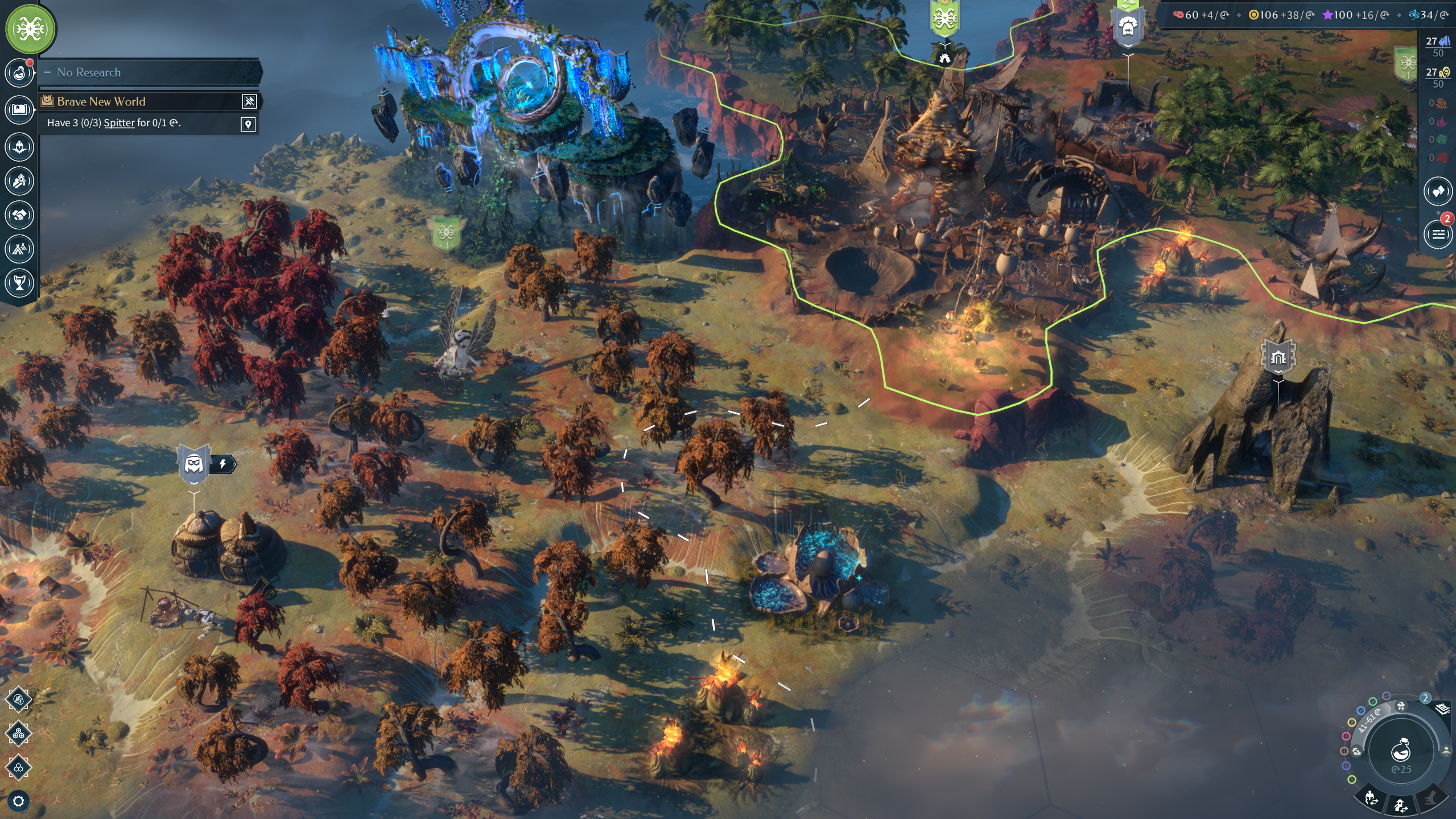
I can’t yet tell you how the Tidefall system feels in the late-game. Regardless, I think Tidefall’s impact on the game is already a huge win.
Now, Amplitude isn’t alone in experimenting with ways to extend that early-game novelty and discovery. Civ7 has played with some changes in this area, via its Distant Lands mechanic. But from what I’ve seen I think EL2’s Tidefall mechanic extends early-game novelty better than Civ7’s Age-connected Distant Lands mechanic does.
Like EL2’s Tidefall, Civ7’s Distant Lands mechanic creates barriers to exploration and expansion that can preserve some novelty further into the game. But because of how gaining access to Distant Lands is tied to Civ7’s more rigid and discrete Age transition system, rather than the semi-random and more frequent Tidefalls, the Distant Lands restrictions feel less fluid and dynamic. Those restrictions also become progressively less meaningful over the course of a game of Civ7, while the Tidefalls continue to offer new doses of novelty and discovery for quite some time.
It helps that EL2’s narrative and design choices smoothly support the restrictions of the Tidefall system: “That land is covered by deep water! Of course you can’t explore it until the water recedes!” Meanwhile Civ7 is stuck with more arbitrary boundaries which their own design choices sometimes conflict with: “Yes you could sail across that narrow strait, and yes we have historical records of people doing something similar in the boats you have, but those lands are ‘Distant.’ You’ll have to wait until you’re a big-kid civilization and all grown up before you can go play over there.” In short, Civ7’s mechanical design is fine, functionally speaking. It’s merely more difficult to justify and support within the game’s narrative logic.
All that is to say: I think Tidefall (within the context of EL2) is a big step forward for improving the experience of turn-based 4X games. I hope that Amplitude’s experiment can improve the genre. I recognize that implementing something comparable would be difficult in other similar games, at least not without some narrative dissonance from the design choices involved. But this is such a neat take on how to design a 4X game, and these experiments and contributions to the genre are part of what I love about Amplitude.
I hope to have more to tell you about Endless Legend 2 in the future. Maybe I’ll have more thoughts for you about other games from Amplitude. With any luck, Amplitude will continue support and develop EL2 for as long as they’ve supported EL1 and Endless Space 2 and we’ll have even more fascinating stories to tell about how their experiments play out.


As a non-gamer, I appreciate the time you took to spell out what 4x is and how it works. I’d have been lost in the post without that.
You’re welcome, I’m glad that helped! What kept you interested and engaged enough to power through? Has this raised other questions for you about 4X games that you’d like to have answered?
I just started following you and want to get a good feel for the “vibe” (as it were) of your blog. I want as good a handle on things before I comment very much :-)
I’ve had enough times of putting my foot in my mouth because of not giving myself time to see what kind of blog it was and so my comment didn’t land. I have learned from those experiences.
Also, just because I’m not a gamer doesn’t mean I don’t want to learn more about the people who DO game. I’m getting a second hand experience that I’d otherwise be totally ignorant of. Seeing how different people think and write helps me get outside of my own head :-D
Hope that wasn’t over explaining!
Not over explaining at all! As a curious non-gamer reading a blog that definitely has material about games & game design, is there anything you’re especially wanting to know or to get a feel for?
I may be able to point you towards something I have already written, or answer a question that’s been eating at you.
Thanks. But I’m good for now. If one post sets off a question, I’ll ask then :-)