All Ornamentation Must Be Load Bearing

Given my druthers, I overwrite.

Overwriting is the only way I can get the words out. If I think about what should or shouldn’t be on the page, everything gets gummed up. So when I’m being productive, words pour out and I don’t bother sorting which ones should stay.

There’s a fitting apocryphal Mark Twain quote: “Writing is easy. All you have to do is cross out the wrong words.”

I get lots of practice crossing out the wrong words.

Rewriting Bury’em Deep was a big step. I cut it (with wonderful help from Story Boyle) from ~70k down to ~45k and then built back up to ~50k. That showed me what was possible, in much the same way that writing my college thesis reassured me that I could write a large text in the first place.

My World Seeds keep my editing in shape. For those, I regularly crop sections running between 1.5k and 2k down to 750 words. I sometimes worry that I’m losing a little of the magic I want, stripping something special out of my World Seeds in the process. Mostly I feel accomplished.

Plus, if I want to fit my text in my template I need to make those cuts.

All this practice does have some side effects, of course. I now regularly want to strike out chunks of text from the fiction or RPG books I read. I want to strip them down, reshape them, clarify them. I know that I’m enjoying a book when I stop thinking about editing it. I know a book is really good when I feel like every piece of text is doing important work.

That comes back to a phrase I came up with while working with my friend Story: “All ornamentation must be load bearing.” Shit, I guess that’s the title of this post now. The phrase came out mid-crit session, and stuck with me clearly enough that I inked it onto my clipboard. I refresh it every time it fades.

All this cutting and shaping is trickier when editing other people’s work. It takes time to learn their voice—my editing is harmful if I homogenize their style, or replace it with my own. Sometimes pieces are meant to be wordier—but that’s usually period pieces, or something mimicking a specific style. If you want to stay wordy, you need good reasons.

Why am I writing about this now?

Easy: I did it again this week, paring 1.6k down to 860 words in one pass. I’ll cut around 100 words more before I’m finished with that section. I have another chunk, about the same length, that I’m about to start trimming down to roughly 750 words. I’ve got editing on the brain.

The flip side is that it’s difficult for me to switch quickly from editing to writing and back again. I need to separate the activities. With enough of a break, I can do both in the same day. More often, I hyperfixate on one and don’t look up until I’m bleary-eyed and hours have disappeared.

Let’s see if I can get back to editing.

Portals and the hero’s journey

I figured out what I like about isekai and portal fiction—and why some of it feels so bad.

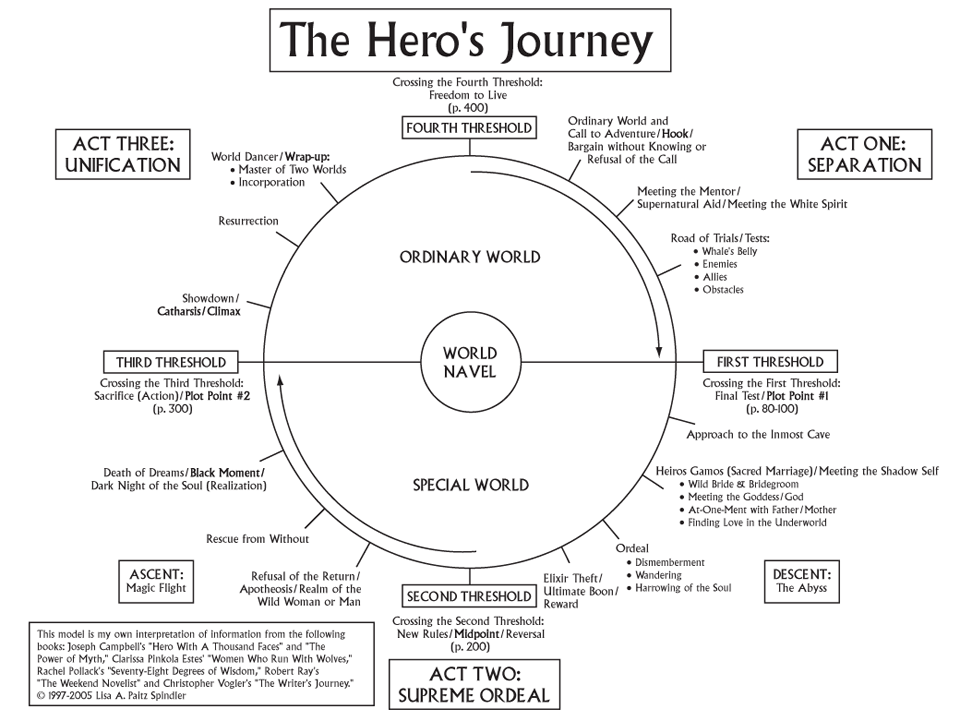
The portal fiction I love most plays with the hero’s journey. It is, at its core, about characters traveling into the unknown and experiencing growth through trials and tribulations. It’s the same pattern that so much adventure fiction I love adheres to.

The hero’s journey puts a big emphasis on coming home to confront the ways one has grown (in the image above, the Act Three segment saying “Master of Two Worlds” & “Incorporation”). But it’s confronting that growth which is the important part; what home you’re coming home to doesn’t particularly matter, as long as the recognition, confrontation, and resolution with past-self happens. The hero could literally return to their home world, or recognize any space within their new world as sufficiently home-like to be their new home—as long as they have that final confrontation and resolution.

And that’s the thought I had when everything clicked.

Continue reading

City of Bones by Martha Wells, and the evolution of character archetypes

I am such a sucker for this art style.

It’s odd, reflecting on the ways in which an author I love has grown (and stayed the same) over the years.

I’m specifically thinking about Martha Wells. I recently read City of Bones, which was originally published in 1995. I’m in the middle of reviewing City of Bones, because it’s being rereleased this year in trade paperback by Tor. I’ll have my review of that up on GeeklyInc in the not-too-distant future.

City of Bones is intrigue, archaeology, lost civilizations and past apocalypses. It’s a thriller, a mystery, it’s got political machinations and murder… you know, the good stuff. What stood out to me though, was…

Continue reading

Ghosts, a tiny post

This is just a brief one, but…

I’ve been reading A Lesson in Vengeance, been part way through it for a while. The combination of that book, plus my own meditations, has left me musing on the nature of ghosts and how they work in stories. I don’t think I’m saying anything revolutionary when I say that, while ghosts are often said to have unfinished business, they can also be interpreted as the unfinished business of those they haunt.

Ghosts make a neat device for unwelcome and intrusive thoughts.

Continue reading

Worldbuilding: leave room for later

Leave yourself room for later. If there’s anything I’ve learned from doing lots of worldbuilding—for my own linear fiction and for the collaborative fiction of RPGs—it’s that trying to fill every last nook and cranny of a setting is a daunting task. And actually filling up everything is choking, stifling. Don’t fill up everything. It leaves no room for the future, and it leaves no room for anyone else.

Continue reading

Dogs in the Vineyard, moral conundrums, quick thoughts

Somehow, despite a decade of posts on this blog, I’ve never gone in-depth into Dogs in the Vineyard or what I love so much about it. There’s more to Dogs than I could easily cover in a single post: cooperative story-telling and turn-taking, cinematic descriptive and narrative tools, a conflict mechanic that encourages brinksmanship and escalation, a well-articulated method for understanding what’s at stake… all those elements are a delight.

But there’s another piece that Dogs explicitly encourages groups to home in on. That’s the experience of wrestling with moral conundrums, something many modern CRPGs both want—and struggle—to deliver. That’s what I’m focused on today.

Continue reading

Progress for Deep in Trouble

It’s been a while since I last wrote about Deep in Trouble, Cesi’s sequel to Bury’em Deep. A friend of mine inhaled Bury’em Deep recently, and her enthusiasm has reinvigorated mine. It’s also prompted me to revisit the setting and my ideas for how Deep in Trouble would work, and I’ve started making progress again!

Continue reading

Megacorp Nobility, my cyberpunk + feudalism brainworm

Cyberpunk megacorps are feudal hierarchies… or at least they’re close enough that we can map one to the other. My brain wandered into this realization a few months ago, and now I can’t stop thinking about cyberpunk stories and fantasy or historical fiction through this lens. If I’m stuck with it, I might as well share it with you.

A set of feudal class assumptions are baked into many cyberpunk stories; the corporate elite, the people running the mega corps are just a renamed set of feudal lords. This lends itself perfectly to the preservation of power within the corporation’s systems. Story-wise, this parallel makes the corporate power politicking easier to understand. We can simply hold onto our assumptions about feudal nobility, swap the words in the marquee, and get a rough idea of whatever is going on.

Is the mapping perfect? Not quite. Some power structures are a little different. Some power is passed differently from one generation of leaders to the next than it is / was in feudal nobility. Transitions of power are probably less bloody.

But the same class divide is still there, separating those with rank in the megacorp (nobility) from the have-nots. The nepotism is often still there. The same sense of inbred privilege and power is there. The same social expectations still reign supreme—a scion of the corporation owes their loyalty to the corp, and will obey the CEO their liege. Power flows down through the hierarchy, and the ultimate responsibility of any person in authority is to contribute the power they create to the corporation’s (the kingdom’s) bottom line.

Most of the same caveats apply too. Maybe someone plans to make a power play, attempting to supplant a current member of the C-suite or the Board. They still need to create a strong enough claim to that position, garner influence and support, etc., before they attempt any sort of uprising. People in a cyberpunk megacorp who make a play for a higher position and fail are likely to suffer consequences, from a slap on the wrist to firing to pressing criminal charges (with whatever repercussions those charges might have).

Honestly, I could go further, draw more parallels with other systems: the key, as far as I can tell, is how each system embodies kyriarchy (a power structure built around assumptions of domination). I’ll leave it here for the moment.

As with many other elements of cyberpunk worldbuilding, I think this connection between semi-feudal social dynamics and corporate hierarchy was frustratingly prescient. Advocates for neo-feudalism exist now (usually with ties to one or many of authoritarianism, the Dark Enlightenment, white supremacist movements, accelerationists, and extreme adherents to the Gospel of Wealth-style capitalist meritocracy myth). Our society’s continuing concentration of power, privilege, and access to wealth and its benefits further stratifies the population and creates a new form of aristocracy, breaking down the egalitarianism that strengthens democracy. All this—the way in which our world continues to develop in strange parallel with the dystopian warnings of cyberpunk novels—gives us another perspective on how to map historical or fantasy feudalism and corporate feudalism onto each other.

I don’t have more here at the moment. I’ve just had this brainworm gnawing at my thoughts for a while. That’s why I’ve been dreaming up feudal fantasy versions of cyberpunk stories and cyberpunk versions of classic tales of medieval nobility. There could be something fun done with the Fisher King in a cyberpunk setting, right?

Circles of Belief, Quick Thoughts

I first heard the phrase “circle of belief” as a young teen, and have found it to be a useful mental model ever since. I thought I’d written about it here before, and was wrong. While looking for other sourcing for this post I found a lot of Slayer lyrics and not much else, so… here goes.

Someone’s circle of belief governs what they see as plausible, something they can follow along with, versus what they see as implausible or alien. There’s a lot of overlap with genre expectations or something similar, but they’re not quite the same. The key is that everyone has a circle of belief for any given context. When I’m trying to shape someone’s circle of belief I’m not trying to alter their genre expectations writ large—just their specific assumptions for a given story or game.

Note: this is more or less how propaganda and political messaging works. Here, though, I’m going to focus on fun fiction and story games.

Expected and accepted elements exist inside the circle of belief—they do not require any additional suspension of disbelief from the audience. Working inside a circle of belief is relatively low effort. Inside the circle of belief, you don’t have to convince the audience to agree with you. You don’t risk alienating your audience by including an element that doesn’t fit. Breaking an established circle of belief, however, may push someone out of the story.

When reading a fantasy story, elements like dwarves and elves probably fit inside most people’s circle of belief, while giant killer robots probably don’t. Similarly, a sober spy novel has lots of room within most readers’ circles of belief for skullduggery and betrayal. But if that spy story suddenly featured a goblin going on air and declaring herself a prophet, that might break the audience’s circle of belief and create cognitive dissonance. That cognitive dissonance can lead to confusion and disenchantment. Breaking the circle of belief can break audience members’ emotional investment in a story or their suspension of disbelief,  and a story which had been fun could become too bizarre to enjoy.

This isn’t to say that those examples above would be inherently bad stories. Each of those examples could exist and be done well. The audience’s circle of belief could be shaped to include them. But shaping that circle of belief requires specific work, and it takes more work the further the new circle of belief is from the audience’s existing circles of belief.

That work could involve carefully laying out clues and hints before some surprise reveal, a genre twist. Alternately, that work could require laying out the future story elements as early and blatantly as possible to prepare the audience for later. Tropes and foreshadowing, for example, offer more options for manipulating circles of belief—as does marketing copy. If I describe a story as “Harry Potter but ___,” the audience will probably assume they know large chunks of what to expect.

Each person’s expectations will be a little different, of course. Everyone has their own circles of belief.

In many ways, this laying-out-the-elements is what worldbuilding is about. Every little detail can build context for the larger story, and thereby shape the audience’s expectations. But it’s easiest to do this work at the very start of a story. That’s because, in general, the longer a given circle of belief remains static the more work you must do to change it.

In RPGs, and any time that you’re in a shared narrative space, it’s important to know what is inside and what is outside of your fellow players’ circles of belief. That could be for the structure of the game itself: I might assume that my character could die, or that the storyteller is my adversary, while someone else might assume that we’re playing a collaborative narrative game. It could also be for the fiction within the game: I presume that we’re playing a hard fantasy game, while the storyteller thinks this is a magical post-apocalypse full of the ruins of ancient civilizations. These assumptions aren’t all incompatible with each other, but you can probably see how they might cause trouble if unaddressed.

 The simplest way to handle this is to talk about the story elements everyone wants to play with (or avoid) before you play. You can also check back in about these things, and see whether there are any pieces people want to add or remove after any given session. I recommend checking in every once in a while. You’re less likely to be unhappily surprised that way, and more likely to make stories that everyone finds fun.

Characterization & Character Creation, WH40k Darktide

This is not a full-on review of the game. If you like the developer FatShark’s previous title Vermintide 2 (Vt2) or other games in the Left 4 Dead co-op genre, and you’re willing to experience the teething problems of a game that needs a few more updates for performance and stability, then you might enjoy this. It’s certainly the best L4D genre game I’ve played despite still feeling rough at times. I’m having fun playing it with friends. 

Also, the setting is Warhammer 40K, which is such a powerfully cynical and dystopian flavor as to be nearly intolerable (it’s certainly intolerant). If you know you hate the fiction of 40K, you probably don’t want to engage with this either. I waffle on the topic of 40K: my enjoyment of it relies on knowing my fellow players aren’t actually unironic fash-enthusiasts.

But this post isn’t about all that. It’s about how Darktide’s character customization systems work, what they imply to me, and how they affect the game. 

Darktide’s character creation is fascinating to me. But it’s especially fascinating because of how it differs from Vermintide 2, and from other games available right now.

Vt2 has five different basic characters to choose from. They’re distinguished from each other in many ways (gender, voice, appearance, play style), and each has a large number of voice lines—some one-liners, and some conversations which emerge when different characters are present in a given mission. All those things, and especially the voices, have a big impact on how the character is portrayed in my mind. I’ve played enough of the game, and heard enough of their conversations repeated across the missions, that I can talk along with them at times.

Honestly, that reminds me a little of how much I played the original GTA 3. I listened to GTA3’s radio for so long that I could sing along or talk along with all the different stations.

But like those radio stations, Vt2’s characters and their voice lines are static. They eventually repeat. Each mission, you pick from the several different character options, each one with a distinct voice. I’ve played enough—and their voices are distinct enough—that I can tell who’s talking whenever someone speaks. Sometimes the characters are amusing, sometimes they are awful, sometimes they tease each other in a ridiculous fashion. Anyone who’s played the game for a while knows who I am if I call someone else “lumberfeet.”

Other multiplayer FPS games have done similar things to Vt2 with their characters’ voice lines. Apex Legends has a host of different characters, each with a distinct personality and voice. They don’t have mid-game conversations per se, but they do have intro and outro lines and do automatically vocalize things that you’re doing (there are barks for your reloads, for you pointing out a location, for changes in the game state as the arena shrinks, etc.). Apex Legends’ in-game characterization is evocative and gradual, slowly revealing more details about them and their view of life as you play them longer and experience more of their barks. They also have tie-in comics sometimes, and little movies for each update. But the characters aren’t really conversing with each other much in-game, or building up the setting’s fiction mid-match.

And, as with Vt2, characters in Apex come pre-made. You choose the flavor you want, you don’t make your own.

Contrast that all with Deep Rock Galactic. DRG makes frequent use of voice lines, with different voices for each of the four classes in game. But while you can customize your dwarf’s appearance in far more detail than is possible in Apex Legends (DRG pays a lot of attention to hair, facial and otherwise), your dwarf remains something of a cipher. You’re just another dwarf mining in space for the Company.

Darktide has taken a different approach here.

There are character classes, archetypal options a little like those that were baked into the characters of Vermintide 2. But there are so many more options to choose from during character creation. Choosing an archetype is just the first step, followed by choosing a childhood, a profession, a defining moment… you’re making a backstory for your RPG character.

And it’s not yet evident to me how they affect the final game.

Some of them, I think, play into what voice lines your character uses. Certainly your choice of voice is restricted by what planet your character comes from. But I can’t tell whether my choices have much impact in the game beyond that. Maybe in the future FatShark will introduce elements of the game that are dependent on characters’ backgrounds (presumably cosmetic, so that you needn’t pick a given background for mechanical reasons). I’d happily give my Ogryn a floppy hat specific to his youth on an agricultural world, where he spent all his time herding great big beasts. Or maybe FatShark will record more voice lines that have to do with those backgrounds, and my friendly Ogryn will opine on farming.

But while I’m fascinated by how customizable character creation is right now, it doesn’t yet feel like it’s living up to its full potential. The plethora of options available, and the considerable difference they imply, feel like they should have more impact in-game than I’ve found so far. And I suspect that developing that further is on FatShark’s todo list—somewhere behind all the technical fixes they’ve already pushed out, and whatever other fixes they’re still planning to implement.

A funny side-note: I almost do a double take whenever I hear the voice actors from Vt2 voicing new characters in Darktide. Vt2’s writers and voice actors did an excellent job of tying together voice and character, and I’m really glad the voice actors got more work in Darktide—it’s a little like hearing old friends. But it’ll take me a while to get used to hearing them without them being one of the Übersreik Five.

I also don’t want to downplay the value of Darktide’s character creation as it currently exists. I’ve made up little backstories for my two characters so far, and had great fun with that. Part of that is because of who I am, and my predilection for story-making. But it’s more possible because of the smart move on FatShark’s part of making that bit of background more accessible to players. I certainly feel like my Darktide characters are more “mine” than any character I played in Vt2 ever was.

This means that even if FatShark never does anything more with the character backgrounds, even if they leave them as-is, they’ll still have done more to make character creation feel personal than any other FPS I currently play. No, it’s not up to my expectations as storyteller. And yes, I see more they could do with it. But I like it, and we shouldn’t underestimate readers’ creative role and the value of head cannon.