Love/Hate: Priming your game with NPCs & Groups

In our own world, there are people we love and people we hate. Our feelings about others might be distant or dispassionate, or they might be personal and urgent. Sharing a love for the people of a neighborhood, a country, a sports team, or a gang is a quick and easy way to bond with someone else—as is sharing a hatred.

As storytellers, we can use this.

Continue reading

World Building: Starting Skills

I was talking with a friend of mine recently about worldbuilding and how to teach the skill, and I realized that I’m not sure where to start.

I think my perspective is warped. I’ve been making up worlds for stories and games for so long, the whole process has become second nature. I haven’t consciously examined the process of worldbuilding in a long time.

Given that I’m planning to run a class for people who want to be DMs (or GMs, or storytellers, or whatever the hell you want to call the person running your roleplaying game), I think I need a clearer approach. I do have some ideas.

Continue reading

D&D 5e’s alignment trap

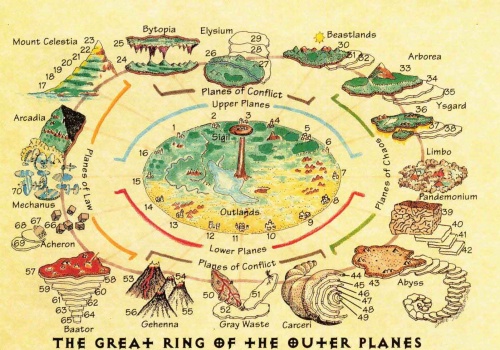
The 5e alignment system is a useful shorthand and a misleading trap. The Outer Planes as presented in the 2014 Player’s Handbook and Dungeon Master’s Guide only make the alignment system’s problems worse. The perfect overlap between alignments and planes—and the total lack of alternative Outer Planes—reinforces the alignment system’s worst inclinations: easy stereotyping, reductionist thinking, and a restriction of creative possibilities.

So what the heck are you supposed to do?

Continue reading

No more bland-aids: make your Clerics interesting

Hot take: clerics in D&D 5e feel like the blandest superheroes. Without a clear relationship with a greater power or a faith, it’s easy for them to float in the narrative void like a cornucopia of bandaids. The solution lies in placing more expectations on them, constraining them, and giving them a deeper connection with the story’s world and whatever they serve.

Continue reading

Delicious in Dungeon (Netflix 2024)

Cooking anime meets dungeoneering adventure in Delicious in Dungeon. Based on a manga from Ryoko Kui, this show is focused on…

Continue reading

Game system flavor & optional rules

This is pulled from a conversation I had recently about optional rules.

Rules combine to make systems, and systems create flavor by shaping the permissible and supported space of a game. Any skillful or willful group of players (the storyteller is a player too) can play outside the rules of the game system they’re using—that’s normal!—but that play isn’t supported by the system, and it isn’t part of the flavor the system creates.

Optional rules are opportunities…

Continue reading

5e is wrong about Charisma

Hot take: D&D 5e gets Charisma dead wrong. 5e only acknowledges a tiny slice of the greater whole: Charisma isn’t about being likable, it’s about being compelling. It’s about being a metaphysical Mack truck on a highway full of smart cars.

Continue reading

D&D & Disease (in 5e)

There are a lot of topics that D&D isn’t ready-made to explore. As best as I can tell, disease (chronic or acute) is one of them.

This line of thought came up for me while talking with my sib about dangerous encounters in a weird fantasy / sci-fi / horror adventure campaign I’m running for some friends. It’s a roughly post-apocalyptic setting, based in The Hub, in which the apocalypse(s) in question took place a variable amount of time ago and in different fashions, depending on where the PCs explore. Some of the perils the PCs face include radiological disasters, and radioactive environments or threats.

My sib, naturally, asked what I’d done on the topic of cancer.

Continue reading

Taking PCs’ Stuff: better D&D via Apocalypse World

This post is primarily about D&D’s 5th edition (5e), though it is more broadly applicable. If you don’t know anything about roleplaying games, you might want to read this article first.

This post looks to Apocalypse World (AW) for inspiration on when to take away, use up, or activate the downsides of PCs’ stuff in 5e. Some of these ideas are already present (or suggested) in 5e, but I’ve frequently forgotten to use them. My hope is that this thought-jumble will remind me to use them in the future, and that my ponderings can be useful to other people as well.

Some games are better served by *not* using these ideas. They create a specific tone, more consistent with gritty explorers and dungeon delvers rather than high-powered fantasy adventure or flashy social intrigue.

Lastly, I think it’s important to implement these ideas from the outset, or to introduce them gradually and explicitly. Using these ideas changes the way the PCs’ world works, and might not meet the players’ assumptions. It’s rude to pull the rug out from under the players by making changes suddenly and without warning. I’d want my players’ buy-in before incorporating these ideas into my game, whether that means setting the game’s tone at the start or getting the players’ agreement to them mid-campaign.

With that out of the way… when should we take away the player characters’ (PCs’) stuff?

Continue reading

World Building: Making The Outer Planes Better

500px-Outer_planes

Once again, I find myself investigating the cosmological background of the setting I’ve most recently created.  I was reading through the Dungeon Master’s Guide again, reading the section on planes near the beginning, and I’m in that usual place: somewhere between excited and miffed.  Fortunately, it’s easy enough to change the things that haven’t excited me.

I’m comfortable, for the most part, with the material the DMG offers on things like the Astral and Ethereal planes.  I’m more okay with the DMG’s ideas for the Shadowfell, the Feywild, and the various elemental planes.  I’m not very happy about their ideas for the Outer Planes.  I have some rewriting to do; let me tell you why.

Continue reading