How to make deep NPCs

Are you tempted to make every NPC in your game a deep and complex character?

Don’t.

I love creating and playing NPCs in my games, and it comes easily to me. Part of this is because I’ve done improv theater—lots of improv theater. But mostly it’s because I use a few basic guidelines when I’m coming up with NPCs.

Since I apparently haven’t written anything about making or running NPCs since that article about naming them from over a decade ago, I figure this post is overdue.

Continue reading →

Building Consent (in RPGs)

Consent is vitally important to RPGs (especially horror RPGs), yet is often taken for granted. Often, consent’s building blocks—trust, plus shared social expectations, desires, and goals—are only analyzed after something has gone wrong and the illusion of agreement is broken. I don’t think anyone needs to constantly check for consent at every new moment in their games, but you can save yourself some anguish if you establish those building blocks before playing.

Why do I think consent is so important in RPGs?

Continue reading →

The Social Skills of Storytelling

I write a lot on this blog about the social skills involved in being a storyteller, because I think many of our RPG books ignore the topic. What’s more, many RPG-related blogs and YouTube channels that I admire share advice about the mechanics and structure of RPG systems… but don’t cover the social dynamics. It seems like a collective blindspot. We assume that people will know what they’re doing, or that they’ll muddle along well enough.

Some of this has changed since I started running TTRPGs about 30 years ago. Many RPG books now include the basics of safety mechanics like lines and veils, the X-card, etc. But there isn’t much on how to find consensus or foster buy-in amongst your players. You have to learn the tricky art of building agreement and engagement in your own gaming group with few pointers and little advice.

On the one hand, I get it. I think the arguments run something like the following:

There’s so much variation in social expectations between gaming groups that no system could truly be one-size-fits-all. Those interpersonal connections are outside the scope of a roleplaying game. People should figure out what works for them, and do that.

But on the other hand, those arguments are an avoidant pile of crap.

Continue reading →

Game system flavor & optional rules

This is pulled from a conversation I had recently about optional rules.

Rules combine to make systems, and systems create flavor by shaping the permissible and supported space of a game. Any skillful or willful group of players (the storyteller is a player too) can play outside the rules of the game system they’re using—that’s normal!—but that play isn’t supported by the system, and it isn’t part of the flavor the system creates.

Optional rules are opportunities…

Continue reading →

Setting Expectations for Rulings in RPGs, Quick Thoughts

Somehow, despite reading hundreds of thousands of words on how to run roleplaying games since the age of twelve, I don’t clearly remember any RPG book giving me this advice:

Explicitly set expectations for your group around how you, the storyteller, will adjudicate rolls, rulings, and mechanical resolutions.

It’s totally possible that I simply glossed over this advice when I did read it. But it’s important enough advice that I’m going to devote more words to it here.

Setting expectations explicitly is helpful because Continue reading →

Milestones, XP Rewards, & Training Your Players, Longer Thoughts

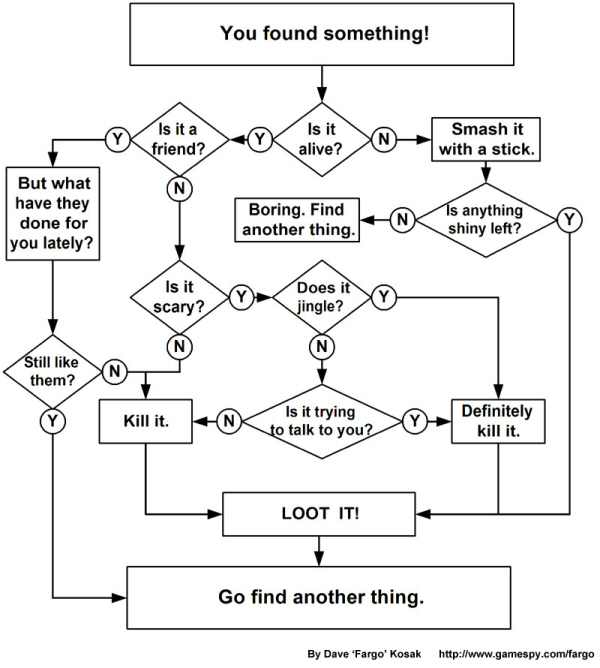
MurderHoboRPG_flowchart

The flowchart of the “murder hobo.”

Game systems, role-playing game systems, are a set of constraints on cooperative imaginative play that are designed to facilitate making up stories together. The constraints they impose create boundaries around the kinds of stories that you can tell within those game systems. This doesn’t make “resistant play” impossible (using resistant play as one might use the term resistant reading), but any system will tend to make a particular kind of play or story experience easier to support than others.

I’ve discussed related thoughts previously, in the context of “flavor.”

But what about experience points, or character advancement?

What about the game’s systems for rewarding players?

Continue reading →

Game Analysis: Dragon Warrior Monsters

Zeeblee

Pokemon X/Y comes out tomorrow.  So today I am going to talk about my favorite monster collecting game.  No, it’s not Pokemon.  In fact, my favorite game in the “collect, raise, and battle” genre is a spinoff of the well-known series Dragon Warrior/Dragon Quest.  The game is Dragon Warrior Monsters (DWM), and while I have not played it through as many times as I have the original Pokemon, I have loved it a great deal more, and spent more energy on it.  It is rare for me to actually write stuff down in a notebook for a game, but for DWM I found myself recording my findings in a notebook for future use.  This is due to its unique take on how you collect and battle your little monster minions, even if you raise them just like most other RPGs (yay grinding!)

The story for the first game (yes!  There are more than one!) begins with your sister getting kidnapped by a strange monster.  Immediately after another monster shows up and offers to help you get your sister back.  He takes you to another world and introduces you to a king.  Apparently there is a tournament soon, and the prize for winning is a wish.  Before you can participate you must train up and qualify, and so begins your journey (which includes other stories as well).  I am honestly terrible at plot-synopses because I don’t like to give anything at all away (I believe part of the joy of a story is going into it completely blind).  So as per usual I am going to focus my reviews on mechanics.

Continue reading →

RPG Character Progression

Zeeblee

Reading the title you may be thinking that I am going to talk about how characters evolve in a narrative in roleplaying games, but if you remember last week’s article you may note the subtle queue in my use of RPG instead of “roleplaying game.”  That’s right; today I am going to talk about different styles of stat/ability progression in RPGs along with minor discussion on the role of progression in narrative.

Continue reading →

“Roleplaying” Games and the Misused RPG Label

Zeeblee

I have written a few reviews for digital roleplaying games (RPGs), but in many cases I find the label is completely inappropriate.  When I think of a “roleplaying” game, I think of a game in which I take control and can make important narrative choices.  But most digital RPGs don’t let you make narrative choices at all.  For that reason I would say that the label of RPG has come to be associated with a mechanic which is common to most RPGs, but isn’t the attribute that makes them RPGs.  The mechanic in question is that of leveling up, and I hate it*.

Continue reading →

Monsterhearts: taking a peek under the ribcage

title-postcard

Monsterhearts sells itself as “the messy lives of teenage monsters.”  But the truth is that the monstrous nature of the PCs in any game of Monsterhearts really just serves as a reminder of the alienation, discomfort, and feeling of mislabeled or misunderstood powerlessness that gnawed at so many of us when we were teenagers.  And maybe as adults as well.  Furthermore, themes which have filled classic literature for ages rear their heads again and again in this game; you don’t have to have ever experienced any of them yourself in order to be fascinated by and indulge yourself in them.

A quick background: this is an RPG which has grown out of the Apocalypse World system created by Vincent Baker.  It takes the sparse elegance of Baker’s ruleset and applies it to a very different type of life.  Read on to find out what makes Monsterhearts different from Apocalypse World, and learn some of what makes it so dynamic and so much fun to play.

Continue reading →