No review for the moment, just an update. I’ve got Sal & Gabi Break the Universe right now, and am looking forward to getting my hands on In The Red soon (which for some reason wasn’t available as an ebook through Libby). My recent book-sprint has slowed down again, just waiting for it to pick back up again. Might have something to do with watching more shows than I usually allow myself to, or giving myself permission to watch them less attentively than I usually try to.
Meanwhile, I’ve been reading Murderbot to my partner and they’ve been loving it. I love rereading it too, though I’d forgotten how difficult some of it is for reading aloud. It turns out that while I think Martha Wells was right to bury some conversations in paragraphs the way that she did, simply because that’s how they fit in Murderbot’s stream of consciousness, it’s a lot harder to read those buried lines aloud without breaking up my reading to clarify what Murderbot says versus what it thinks. This could be easier, if I had thought to come up with a distinct voice for Murderbot’s speech as opposed to its thoughts, but alas I did not.
Besides, that would be odd, right? It’s all Murderbot. It should sound more similar than different.
It’s not all bad though. I did luck into some hilariously good voices by accident, especially while reading ART’s lines.
I’m not sure what next week is going to look like, or whether I’ll be able to post much; I’ve been selected for jury duty, and might be otherwise occupied.
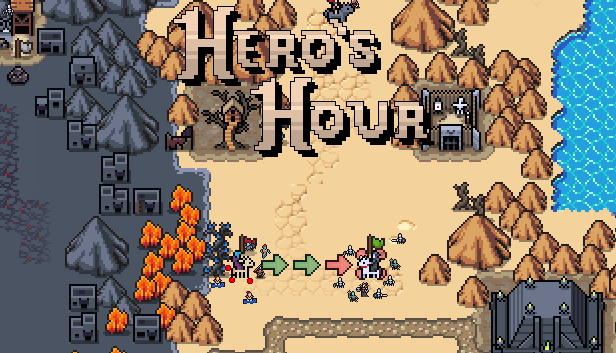
Oh, and on the video game front, following up the Hero’s Hourpost from two weeks back… there’s another game that also obviously wants to follow the path of the old Heroes of Might and Magic games: Songs of Conquest. It’s not available yet, though early access is supposed to start in March. From the little I’ve seen so far, it looks like they’ve focused a larger team with more resources on making fewer factions in a game with more visual polish and greater similarity to HoMM’s old combat mechanics. Hopefully it is also more stable.
Hero’s Hour is so clearly an homage to Heroes of Might and Magic (HoMM), especially HoMM3, that it’s impossible for me to play it without comparing the two. That’s both a strength and a weakness.
I love HoMM 3. I played so many hours of HoMM3 that it’s been etched into my brain in a way that few other games have matched since. I also played a number of other HoMM games—the first two, as well as HoMM4 & 5—and all of that trained me pretty well in the genre those games pioneered (and which few games have matched before or since). Heck, New World Computing, the makers of the original HoMM games, may have actually trained their audience too well given the mixed reception to their changes to the game for HoMM 4.
What I’m trying to say here is that making a sequel to the Heroes of Might and Magic series, even making an homage to the series, isn’t easy. A number of studios have struggled to do just that, most often creating new games that were mediocre imitators rather than improvements to the genre.
A little history, and maybe some perspective.
After New World Computing disbanded, Ubisoft continued publishing sequels from other developers, with a new developer for each subsequent game. Sometimes they even found a new developer for an expansion. I have no idea what that was like for the teams involved, but from an outside perspective that doesn’t seem like a good sign.
I played a little bit of some of those sequels. They were… fine? None of the ones I played went beyond simply feeling okay, none of them delivered quite the same flavor that pulled me into HoMM 3 and kept me playing it for over a decade. Some of them shared similar points of failure with Hero’s Hour.
This isn’t a struggle unique to those trying to recapture the appeal of HoMM. It’s happened with a number of different attempts to recreate the feeling of other 90s classics (like Master of Magic or Master of Orion). The best sequels and homages to those games that I’ve played all rely on finding some way to distinguish themselves, to be new and different and give themselves a way to excel, while still obviously following in the same vein as their predecessors. That seems like a universal rule for sequels, not only with sequels to these games.
But for whatever reason, most games I’ve seen that have tried to follow in HoMM 3’s footsteps haven’t managed to both recapture the feel and distinguish themselves well.
Sadly, I’m not sure that Hero’s Hour does either. Yet.
First, a caveat: I’m writing about an early version of the game (v.1.8.2). It’s available on itch.io, but isn’t out on Steam or GOG yet. I don’t know what will change with the wider release. Presumably some of the issues I mention here will be resolved.
Now. Why do I have to compare Hero’s Hour to HoMM?
The game very obviously wants to be recognized by fans of HoMM. The hero attributes are the same, many mechanics are the same, a number of the factions (and the factions’ units) are either the same or within spitting distance of each other. Tromping around the map and upgrading your town is eerily similar to HoMM3 (more on that later), right down to the names, functions, and visual designs of many map locations. It’s all close enough—until you get to combat—that it’s achingly familiar. Familiar enough that I wouldn’t be surprised by an intellectual property lawsuit (though I don’t know who’d win that).
Combat, and the way in which those familiar hero attributes are used in combat, is where things are totally different. Hero’s Hour uses a real-time-with-pause auto-battle system, one that allows you to give commands to your various units, sling spells, etc. That’s a considerable departure from the hex-grid turn-based strategy of HoMM. I actually like how this change distinguishes the game from the originals. But it’s not especially clear to me how to learn the auto-battler’s systems, and it’s not clear I’ll be able to master it in the same way I did HoMM3’s battles. Like HoMM3, the underlying mechanics are a bit opaque; but 23 years have passed since HoMM3 came out, and I have higher expectations for system design and the presentation of information. Also, I want to feel a little less clumsy in the game’s battles. Maybe that expectation of mine, the idea that I might have finer control of the battle, is the problem here: nothing about the game’s battle aesthetics suggests much fine control would be available, as lots of little units hop around cartoonishly and bump into each other in bloody combat.
It’s cute, really. I wish I felt like I understood it better.
It also is unstable. I expect this to be patched out, but the game has crashed several times for me near the start of a battle. More rarely, it’s crashed at other points during the turn. This is a big problem. The game is informal and straightforward enough to keep me playing for a while, but it’s not addictive enough to pull me back in after a crash (let alone several). The game does have a reliable autosave feature, so I’ve never lost too much progress in one go, but I hope the instability is fixed quickly.
Now, back to the map.
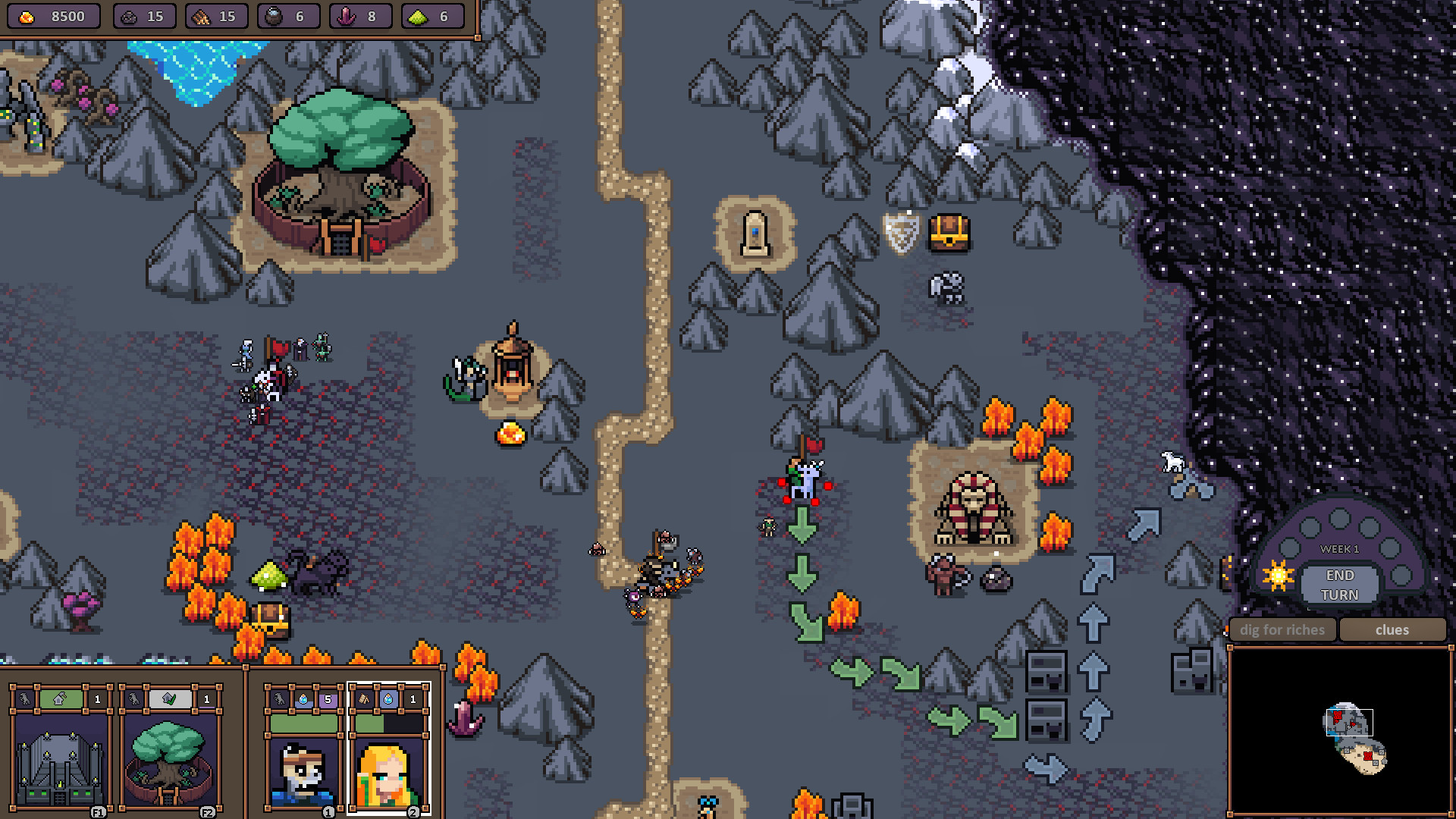
Hero’s Hour’s visual design for its maps is fine, but compare it to the rich textures of the games it’s imitating.
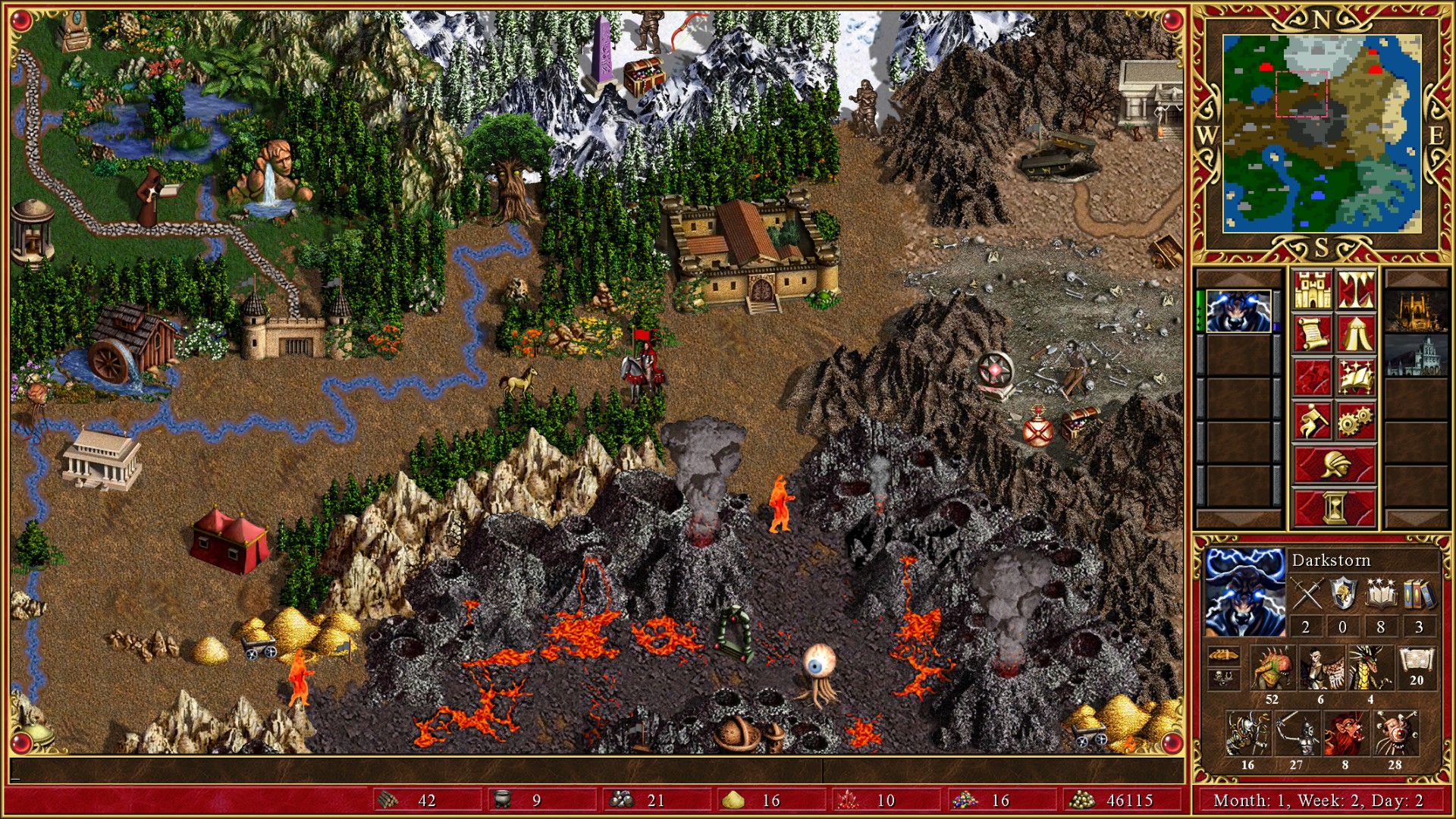
This critique in some ways feels unfair to me, but: the visual design for the map feels lackluster. It’s bland. This is made worse by how obviously this game has been built in the image of the old HoMM games, and how it looks when I compare a screenshot of it with a screen from one of the old games. Hero’s Hour wants to remind players of those games (and does!) but its visual design doesn’t stand up to the visual design (or map design) of HoMM 2&3. HoMM2 had vibrant and inviting color, lots of texture, and map features that engaged the viewer. HoMM3 toned down the color palette very slightly—but it instead added more color variety, and paid even more attention to detail, making the various locations on the map pop. Both titles managed to make very full screens overflowing with tiny details that were still legible to the eye. Hero’s Hour has obviously put time into designing the map locations that players will look for and visit, and has ensured that all the various interactable locations and items are legible as such, but by comparison the background (which takes up most of the screen, and which players spend almost all their time looking at) feels neglected.
HoMM 2 looks lush and vibrant by comparison
And compare HoMM 3’s richly textured volcanic terrain to the detail available in Hero’s Hour
That critique feels unfair to me because I know there’s a solo developer (presumably with limited support from contractors) behind this project. For comparison, even at its smallest I believe New World Computing had three people. Yet while I know it’s a stretch to ask for more and better art—and better overall visual design—I do want more. I want varied texture for the backgrounds. I want the edges of the current texture swatches to be less blocky and more organic. I suspect that if this game’s map backgrounds received a little more attention—got a little more texture, more saturated colors, more places for the eye to explore—that would go a long way. I don’t expect this solo developer to outdo (or even match) HoMM 3’s visuals, but I really want a little more visual appeal.
And it’s clear that the dev knows how to do this! The Town screen is an excellent example. It’s detailed, colorful, and has lots of changing elements that develop as you build new structures (all hallmarks of the HoMM games). It’s obviously received plenty of attention. But this means that the dramatic difference in visual appeal between those Town screens and the map that I spend almost all my time looking at is even harder to ignore.
There’s another side to the maps which feels odd: area layout, map design, and initial expansion. This feels especially odd given how closely the “riding around on the map gathering resources and visiting locations” experience matches the old HoMM experience. Maybe this would feel different to me if I had better mastery of the battles, but early expansion in Hero’s Hour (with default settings) is harder and slower than I remember it being in HoMM3. The neutral armies guarding the ever-vital elements of the resource economy are a hair tougher, more wall than speed bump. And those guarded mines are spread further apart… indeed, it feels like the whole map is stretched just a bit wider than the old games. If this felt more deliberate, and if the game gave me more opportunities to *do* things while building up my army to conquer basic resource generators, I think it might feel different. As it is, I feel like I’ve spent more time wandering back and forth picking up minor collectibles and twiddling my thumbs than I did in the old games—which is saying something.
I suspect this comes down to random map generation.
Random map generation is neither easy nor simple. I’m not surprised that Hero’s Hour’s map generator is creating maps that feel less well-tuned than the custom made maps of HoMM3. That seems unavoidable, without a preposterously long development time. And playing Hero’s Hour gave me newfound appreciation for how finely the old HoMM team had honed their map-making skills. But it also makes me wonder whether this game would be better off with hand-made maps, at least at first. So much of the game is spent roaming around them, it matters when they don’t feel rewarding.
Unfortunately, the combination of visual design, less well-tuned maps, and slightly-clumsy battles leaves this game feeling a little more like an idle game and a little less like a deep and engaging strategy game. I think that’s misleading, because I suspect that approaching it more like an idle game will make it very hard to win. What’s more, I can see that there *are* deeper strategic options available, even if I haven’t yet learned how to really shine in the game’s battles so that I can reach them.
And I want to reach them. I love the genre, and I do still enjoy the game. I’ll probably play more again today, and will no doubt check in again as it is updated. But as the game stands right now, it’s not going to pull me in and feel rewarding for hours upon hours, unlike the games it’s so obviously trying to imitate. I want Hero’s Hour to do better, because I love those old games and I want more people to see how good they could be. And I want Hero’s Hour to do better because it’s already so close, it’s almost there. Good luck, dev(s).
When I’m building my own one-shot scenarios, I focus particularly on draws and dangers.
Draws are anything that compel people to be somewhere, preferably of their own volition. I want my players, and their characters (the PCs), to *want* to be where they are. I write about this in Be Hungry, a post about making characters, but here I’m thinking of it from the storyteller’s perspective. I want players to feel engaged, for their characters to actively pursue things in the course of play. If they don’t want to be there (player or PC), they have few reasons to stay involved with anything in a scenario. It’s possible to trap characters in a situation they don’t want to be in, but that’s usually more stressful for players. In fact, it’s so uncomfortable that it’s a frequent trope of horror stories. More on that later.
Dangers are just that; a danger is anything that might threaten the well-being of a character, or which presents a potentially harmful obstacle between a character and what they desire. A danger’s potential harm could operate on any of several levels: physical peril, social or emotional threat, or jeopardizing other things a character values. The severity of the danger is critical, and needs to be calibrated against both the draws of the scenario and the other dangers present.
Dangers must be calibrated against each other because they shape how PCs react to the world around them. If a danger is sufficiently scary, PCs will do whatever they can to avoid it. This could include facing other dangers which seem less scary, or simply turning tail and fleeing.
Dangers must also be calibrated against the scenario’s draws, because those dangers may scare off PCs or cause them to despair. As a concrete example, if PCs seek a unique treasure but discover that it lies on the far side of a vast pit full of demons, they may decide that the treasure isn’t worth the trouble. If there’s a secret route to the treasure and the PCs don’t find it, the PCs will probably just shrug and move on, marking that treasure as something to come back for later. This is perfectly normal and fine in most games, and such juxtapositions of draws and dangers have their place in stories, but it’s not going to deliver a triumphant story experience in that game session.
“We came, we saw, we turned around and went home because demons are scary.” As a story, it’s a little anticlimactic. Keep in mind, because this post is focused on one-shots, I’m not as interested in foreshadowing large challenges for later sessions… which is where that anticlimactic story may have a larger role.
To tell a dramatic and triumphant story—a frequent goal of one-shot scenarios—PCs should engage with dangers, resolve them, and reach the draw they sought. Ideally those dangers are scary enough to unsettle the players and make players feel good about resolving or bypassing them, but not bad enough to convince the PCs to give up and go home. It’s a careful balancing act. And it’s a balancing act that you can build into the scenario from the very beginning, both by making sure that the draws pulling PCs in are sufficiently exciting, and by making sure that the dangers don’t seem that bad at the start.
Notice the “seem” in there. It’s entirely possible to reveal that dangers are worse than the PCs expected part way through a scenario. Revealing that the danger’s threat is worse than previously realized is a very traditional way of increasing the tension of any story. It’s possible to do poorly, or to wear out the trope by doing it too reliably, but when done well it’s delightful.
Finally, one quick note on how horror scenarios work with draws and dangers.
Horror stories, which I mentioned near the beginning when talking about trapping PCs, can be different. Some horror stories thrive on the PCs’ sense of helplessness, their feeling stuck with a danger that is too great for them to defeat unscathed, or to overcome without losing in the process. In these horror scenarios, overwhelming dangers lie between the PCs and whatever the scenario’s draw may be (usually escape, or resolving the danger without overwhelming sacrifice). Classic movie examples could include anything involving being trapped in a space with something hunting you: Alien, any number of serial killer movies, various murder-puzzle movies like the Saw series, etc.
This doesn’t describe all horror stories though, and the topic is big enough that I’m going to leave the rest of it for another time.
I work at a LARP camp. I love the community there, and my coworkers are some of my favorite people. And when it comes to making magic happen, I would be hard pressed to find a better group of collaborators. I think we do an excellent job giving kids both awesome experiences and tools to change their lives for the better.
Obviously, this spring and summer have been a little complicated because of Covid. We run day camps and overnight camps, we have one-day events, we organize games of capture the flag with swords. All those things happen in-person.
But I’m happy to say that Covid hasn’t stopped us. With some quick thinking on the part of our community, we’ve adapted. One of my friends threw together a discord server for our community as soon as the shutdown started (J. Dragon, the creator of indie horror RPG Sleepaway). Folks have stepped up to run games on our server, and there’s a good feeling of warmth and engagement there.
Better yet, we’re running digital camps this summer. I’d been worried about them at first; they clearly won’t be exactly the same as being together in person, and I’d feared that they wouldn’t capture enough of what makes our camps really sing. But after playtesting our first game last weekend, I’m happy to say that I think we’ve got something really cool to offer.
I was right that these digital camps won’t be exactly the same as our in-person ones. That’s inevitable. But our game writers have put together a really cool set of games for this summer, and I’m really excited about them. I’ll be working the first of them, from July 13th to 17th.
I’ve been playing RPGs since before I could read and write. I’ve played more LARPs than I can remember. And I’ve taught improv theater and LARP for years. These games are good.
Part of what has me so excited is that the games know what they are. They know their constraints, and they’ve embraced those constraints instead of trying to pretend they don’t exist. Because of that, the technological interfaces for our first game actually added to immersion instead of feeling like a barrier.
I love it when a game’s systems and fiction fit together and support each other. That’s a big part of what I like about Monsterhearts, for example. But having the underlying means of interacting with the game world be part of the fiction too is even more exciting. It offers the deep immersion that so many ARGs have sought to offer, blurring the lines between fiction and reality in a way that makes the whole experience far better.
Anyway, I’m excited about all of this. If you happen to be of age to be a camper, I suggest you check out the site.
First off, if you’re playing in my Fell Met Sea game please don’t read this yet. It’s 100% full of spoilers for my current thoughts on setting background that you haven’t learned yet. If you’re not playing Fell Met Sea, I’ve put together some ideas about how the previous civilization(s) that preceded my PCs’ present world fell apart. Check out the consequences of sacrificial blood magic!
I posted in February last year about using XP awards to train your players, and the problems of various methods of XP accounting. I mentioned in that post that I would experiment with rewarding players for telling me more explicitly where they wanted to go in their next session. It turns out, that particular group of players never developed the habit of telling me explicitly what their characters’ goals were despite my repeated encouragement.
I also mentioned the reddit thread about Improved 3 Pillar XP, and said that I didn’t want to use it. I didn’t want to use it because it seemed like it would require more accounting than I was interested in doing. But since Covid-19 has moved all my gaming online and I’ve made more quick reference materials for myself in google docs, I decided that I’d try building a spreadsheet to run the Improved 3 Pillar XP calculations for me.
I think the golden moment for me—the moment that convinced me to throw together the basics of the Improved 3 Pillar XP categories in a spreadsheet—was seeing that I could simplify all XP gain into a series of questions at the end of a session. Those questions:
Did the PCs recover any notable treasure?
Did the PCs explore, defend (suggested by my sibs), or takeover an important location?
Did the PCs ally an important NPC, or align them towards PC’s causes / away from foes’?
Did the players interact with each other in character?
Did the PCs circumvent or defeat any foes?
When I shared my quick and dirty first notes with my sibs, they rapidly made a separate interface that I’m actually quite happy with.
Now I have a spreadsheet that will take direct input from me about how much I want to reward my PCs as a proportion of their next level, with input categories spread across exploration, social interaction, and combat. The best part, as far as I’m concerned, is that this is also flexible and easy to expand.
If I want to try adding other categories of behavior that I wish to reward, I can either include those as expanded qualifying cases for the above questions (by changing an existing question) or I can add another question and reward category. As someone who enjoys tinkering with spreadsheets, that isn’t a scary prospect… though I can understand it not being your cup of tea. Ideally, I’ll have all this put together in a good-looking easily-read format at some point. For now though, I’m trying it out and seeing how well it works. Do it bad quickly first, etc.
The first idea I had about expanding this was to try rewarding players for telling me about their characters’ plans and then having the PCs act on those. I realize that this doesn’t necessarily work with PCs who are too in-the-moment to plan ahead, nor does it work as well when the PCs are too busy reacting to every new garbage fire to forge their own path… but I think it could be useful in a more sandbox game, especially one with a more relaxed pace.
If you want to try building your own, I suggest copying all the various tables in the Improved 3 Pillar XP post into a spreadsheet first so that you know what you’re working with. If you’d like to try using what I’ve got so far, tell me so and I’ll look into sharing something that you might be able to use.
Building a setting piecemeal is sometimes difficult, but often fun and rewarding. By playing mad libs with your setting, you’re able to cram together a wild group of ideas that fill out your underlying concepts and give the whole thing its own distinct flavor. My favorite example of this was Continue reading →
Call of Cthulhu—for all it’s other Lovecraft-inherited flaws—has traditionally done a good job of building expectations of death and insanity into the core of the game. Furthermore, it has done this in a way that builds tension for longer campaigns without (usually) compromising the characters central to those campaigns. CoC does this best by blending one-shots with longer campaigns.
D&D can make use of this! I plan to do this in a game I’m starting soon.
The way that Call of Cthulhu usually handles this is by using a one-shot to set the scene and tone of a longer campaign. Characters in those one-shots are sacrificial, and their survival is a surprise rather than a given.
While similar assumptions of character death underlie old school B/X D&D, those assumptions are less present in most 5th edition D&D games that I’ve been in (or run) recently. Many players have more heroic narrative expectations of their characters. But I want to use Call of Cthulhu’s murderous one-shots in a longer D&D game to give the players a better sense of the tensions and threats that await them.
My hope is to let players experience the fates of other characters (who are not their primary campaign ones). By uncovering the setting’s past, through magical archaeology or some other information gathering, I would let them play one-shots as characters other than their PCs. The players would know beforehand some of the conclusions to be reached in the scenes they played out, but they would otherwise be free to play those snapshots however they saw fit, and could have a chance to learn more about the setting in ways that fed into their main PCs’ decision making and views of the world.
Given that I expect to have some inexperienced players, my hopes with this are manifold; I wish to create spaces within the game for my players to come to terms with character death, to give them information about the setting which would otherwise require hefty info dumps, and to let them cut loose and experiment with decision making that doesn’t hamper their narrative goals or visions for their main characters. We’ll see how I do.
Last winter I revisited a game idea I’d had: inspired by Saladin Ahmed’s suggestion to tell a spy story about spies from disadvantaged minor nations during the Cold War, I wanted a game that would push the dilemmas experienced by those intelligence agents to the forefront. How do you achieve your goals when you’re tiny pieces playing a much larger game? How do you make sure your nation isn’t simply eaten and discarded? How do you achieve your own goals, and how do you do all that while holding onto your humanity?
I knew that GURPS and a good storyteller *could* do all that, but I wanted something that felt more like Monsterhearts (more on my love for that game here) with mechanics that pushed those experiences to the forefront. I spent a while jotting down notes and trying to puzzle out how it would work. I came up with the idea of people choosing particular trainings for the characters, each relevant level of which would give them another die for a skill roll. I thought of measuring stress as a clock (Apocalypse World style) to denote the growing burden of keeping your cool while everything around you is going to hell.
And then I bought a copy of Blades in the Dark (and here) and realized that what I wanted had already been developed.
Now, admittedly, I don’t yet know of a BitD hack that does everything I am looking for. I also haven’t dug deep into the pile of BitD hacks out there, either in circulation or in development. But I no longer think I need to design all of this from the ground up. I think Blades in the Dark, with some modification, should work extremely well for what I want.
I still must find some way to reward continued player-player interactions, encouraging some collaboration without assuming that everyone is on the same side all the time. I don’t want to sacrifice the experience of questionable loyalties, self doubt, and second guessing your own judgement—but I also don’t want to make those things so grating or dominant in the game that it’s impossible to play without giving yourself ulcers. Similarly, as long as I’m letting player characters not all be on the same side all the time (or even all be part of the same Crew) I’ll need to find some way to either replace the Turf mechanic or modify it, and some way to alter the underlying Crew dynamic.
Suffice to say, there’s still a lot for me to figure out. But this looks fun, and maybe some of you would like to see it?

 Fistful of Wits