I’ve made a DriveThruRPG storefront for my World Seeds project (see Whimsy’s Throne for details). I’ll link to that after I’ve uploaded my first Seeds. I knew this step was coming, once I had another finished Seed ready for publication. And now I’m dealing with the intricacies of posting content on DriveThruRPG while trying to figure out how to optimize the PDFs I’ve made for general distribution. I don’t want to publish content that immediately breaks when a stranger tries to open it, after all.
Unfortunately for me, I also don’t want to optimize my published content such that the art turns fuzzy and indistinct. This might be an issue.
My next steps are to upload the two World Seeds I have thus far. I’m making one available for free, and one for cash. Then I need to find another artist I like working with. Meanwhile, I’ll keep chugging along: writing more rough location descriptions and expanding existing descriptions into full-fledged Seeds.
My goal with this project has always been to produce a bunch of these things. And I want them to have notably distinct art styles for each Seed, for the most part. If I can have different artists bringing distinct styles (or experimenting with styles that are new to them), that’s perfect. I’m happy to do repeat work with artists, of course—I’ve really enjoyed collaborating with the artists I’ve worked with so far. I look forward to working with them again—I just don’t want the Seeds to be tied to only one style. The more variations, the merrier.
My hope is that I can have a varied body of artwork and styles reminiscent of the huge variety that was present in early 90’s Magic: the Gathering art. That’s what I grew up with. And while some of it was bad, I loved the way I could find so many totally novel art styles in the same game. During the 00’s MtG homogenized their style significantly, allowing some variation between sets but building a unified “house style.” While I can see how that makes sense for a company managing such a large quantity of content (and a company concerned with consistency in its artistic brand), I feel like MtG lost something when they stopped having such significant variation in artistic style from one card to the next. The individuality and experimentation faded away.
Given that I’m trying to build a product that engages people on as many levels as I can, and which appeals to as broad a group as possible, I feel like changing up art from one Seed to the next is my best option. If someone hates one art style, maybe they’ll love a different one and pick up that Seed. The dream would be for people to love and use every World Seed, but I’ll absolutely settle for catching people’s eye with a few different options.
RPGs are magical. They’re incredibly powerful tools for personal exploration, when used intentionally. And they’re some of the best fun I’ve found.
I’ve played many different characters, seeking many different things. I spent a long time playing characters who wanted to control things or be prepared for all eventualities—something I associate with the style of game I played as a kid, and with my fear of failure or character death (heck, even character misfortune). Those traits, and the struggle to optimize or avoid failure, took a long time to unlearn. I still feel their pull.
I suspect that Monsterhearts, with its suggestion that you “drive your character like a stolen car” helped me break out of this mold the most. But it took me a long while to carry that same delight and freedom, and embracing of consequences as part of the game and story, into my games in other systems. Now, years later, the majority of the characters I’m playing these days are closer to that carefree mode. I feel considerably lighter playing those games, and I feel lighter when I am able to bring some of that same openness to the rest of my life.
I appreciate how my awareness of this has shifted, how I’m better able to recognize my preoccupation with not-failing and not-suffering in games and elsewhere. And I appreciate how RPGs give me an opportunity to explore failure and suffering without actually being stuck in those things. That exploration has been therapeutic for me. Giving in to my characters’ heedless pursuit of fulfilling their desires and achieving their (often simple) goals—and accepting the many ways they end up stubbing their toes or bloodying their noses on the way—offers a profound release from the constant clenching struggle of seeking perfection and avoiding failure.
In many ways, this exploration has paralleled my personal struggles with perfectionism, control, and risk avoidance. My characters have served as a means of venturing outside my comfort zone, of exploring what other possibilities I have and what other modes are available for interacting with the world. My characters often take that exploration to the extreme, far beyond anything I’d want to engage with in real life, but they offer a safe place for experiencing what it’s like to live differently than I do. And they offer an avenue for both self-reflection and growth.
Of course, I play my characters for fun. Most of my characters aren’t designed with any of this in mind. And I don’t make my explorations at the expense of other players at the table, or without their engagement in the kinds of characters I play (my friends’ fun matters too). But with a bit of foresight, self-awareness, and reflection I’ve found RPGs to be right up there with meditation (perhaps like meditation’s active counterpart) as a means of uncovering and facing parts of myself, and growing myself in new directions.
Reading The Butchering Art, with its record of snarky arguments in medical journals, gave me an idea.
The setting for my stories about Miska, along with all the various Andre & Jerome stories I have, is a complicated one. It’s big, in-depth, and just enough like our own world that it regularly leaves people guessing when I try to explain it. Perhaps I should try to simplify some of the setting, but… I think the perverse complexity and deep similarities to our own world are what makes the setting engaging and exciting. It’s a what-if, a thought experiment, and a sometimes-grim sometimes-hopeful social commentary.
Part of the similarity is in geography and place names. That’s the thing that trips up folk the most, I think, and the thing I’ve considered rewriting time and again. The world is—mostly—our own. The continents are mostly the continents we would recognize from our own Earth. As such, I have regularly used our own world’s historical names for cities that match up with a city’s location in this setting (e.g. Paris and Marseille). At times, when I’m trying to convey that there’s something distinct from our own world, our own expectations, I change a city’s name (as I’ve done with most bodies of water). But I know that’s confused readers even more, at times.
It doesn’t help that I’m not totally consistent about it, or haven’t always settled on names for some places.
But those shifted names still don’t address the shift in social conventions, or the difference in histories. Explaining why I’m using some of our own world’s city names doesn’t give a reader any understanding of the detailed history of this alternate Earth. In some ways, I think it actually makes understanding the setting harder for readers—which wasn’t my goal at all.
Enter my flash of inspiration.
The snarky medical journal arguments presented in The Butchering Art conveyed so much more than their surface disagreements. They served as a touchstone for the culture of the time, and they contained such startling similarity to modern academic sniping—and comment section flame wars—that I immediately felt like I had a better connection to, a better read on the world depicted by the book.
So I started writing in-setting documents for this world. Some were the stiffly polite and horribly condescending disagreements of people writing to various society papers’ opinion sections. Another was an excerpt from a personal letter between two people involved in city politics and what might be called clandestine activity. Every so often I have another idea and try it out.
With this, I think I’ve finally found the way to give readers a window into the setting. This material can preface some chapters or stories, or serve as introduction to a section of a book. What I’ve written so far feels clunky as an epigraph, but I think this can finally give enough context to ease readers into the world. Better yet, I can showcase in-setting struggles and disagreements, political squabbles, and personal opinions. I can reveal information that some of the characters might know, or comment on at some point. And, I hope, I can do some of the world-building work that would otherwise clog the rest of my story with exposition.
So here, enjoy the first idea that came to me a while back. It won’t be nearly enough on its own to show you all of this setting, but maybe you can enjoy peering in through the cracks.
***
Letter on the latest troubles of the Inner Sea, to the editor of The Parisian, first and finest of the continental ladies’ magazines
Regarding the recent abuse levied against the fine Doctor Gilarien of our daughter-city Marseille, this writer must protest heartily. It is by no means sensible for any to wage too harsh a battle against the natural allies of our fine city, and this is precisely what La Fleur du Sucre proposes to do. Our daughter-city—along with her denizens—is our responsibility to protect and guide, and the true proof of Parisian majesty will be evident in the beauty, grace, intellect and fortitude of her daughters in the face of the dangers of the world. Certainly I would hope that La Fleur du Sucre would not be the type of mother who so admonishes and smothers her children that they never learn to fly from the nest of their own accord. No, what is needed here is not chastising whip-tongue remonstrations, but rather the gentle guidance and support of a mother for her child. We may prune back ill-reason and train the growing limb of intellect to our trellis where we know it will be healthy and bear fruit.
The estimable Doctor Gilarien is entirely correct that our city’s agents operating as they are, along the coast of the Inner Sea, have brought forth suffering amongst the many tribes present there. But the good doctor must recall that these tribes have long allied themselves with the Ones to the East, the very same who sought to maintain “Enlightened” dominion over all of us despite the wishes of the Good Masters. Given these tribes’ warlike disposition and their frequent exercises upon the borders of our allies, it would be insufferable for us to not interrupt their works, lest they grow too numerous and powerful and form once more the armies that they once were. For let us not forget that those selfsame tribes, the ones the good doctor feels such concern for, were once the engines of destruction which drove the burning of Köln, Rotterdam, and even our lovely Paris. Thus it is that one would do well to balance the—admirable, and well-reasoned!—concern for innocent life made more difficult by our own actions, against the cost of allowing such hostile forces to regain their strength and organization to rampage across our continent once again. This writer is entirely certain that the good doctor will agree that the actions of Paris and her agents must, in the greater balance, come out the lighter price to pay.
As to the fine doctor’s points with regards to the treatment of the prisoners of war captured amidst the strife along the Inner Sea, this writer must surrender to their local experience and expertise. It is the doctor’s knowledge of the prisoners’ circumstances which must, clearly, take precedence here, and La Fleur du Sucre would do well to recall that one’s daughters will only grow into their own skills of reason if they are trusted to observe and report their own findings in all earnestness, and assess proper courses of action from there on—with their mother’s guiding hand, of course. Therefore to the doctor this writer suggests that it would be to everyone’s benefit if some documentation could be made of the present circumstances of the prisoners during their transportation. There is no course by which the transportation may be stopped—it would not do to domicile prisoners too near the fighting, nor to leave them anywhere they might escape unsupervised, and as such the verdant gardens of the New Sea must be the best solution—but perhaps the transportation might be made less onerous and perilous to those transported. Certainly there is no need to torture, as the good doctor would have it, those who have surrendered or otherwise been captured. After all, these vanquished foes are not insensate beasts, but merely the doughty and fearsome battle cadre bred and trained from birth to serve in the Enlightened Ones’ armies.
Lastly, this writer must commend the good doctor’s dedication to the ethics of the profession; surely the doctor’s presence in this world is of considerable value to all, and a guiding light for all others of the daughter-city who might seek the health and well-being of their fellows. If this writer lacks any merest atom of knowledge of the arts of medicine, may it nevertheless be that this writer is able to remind the fine doctor of Marseille to think beyond the simpler personal suffering of a vanquished few and to encompass the greater wellbeing of free civilization upon the continent without the dominion of those who once held us all in bondage. It would be a foul sickness indeed were we to squander the freedom granted us by the Good Masters, and fought for by our ancestors, by failing to protect it from the encroachments of those who may wish us ill.
I’ve been watching people play Civ again, as a writing break. It’s less dangerous than letting myself play the game, what with the likelihood of one-more-turning through the rest of the day. But all this Civ-watching is tickling a game idea I’ve had for a few years.
Years ago, there was an article on RockPaperShotgun reviewing a 4X game in which the writer mused on why there weren’t any 3X, or 2X games. For those unfamiliar with the term “4X,“ in this context it stands for “eXplore, eXpand, eXploit, eXterminate”—a series of objectives common to many real-time and turn-based strategy games, considered foundational to turn-based strategy games like Civilization. But that writer’s comments resonated with me. And while there are first-person exploration games and walking simulators (which might count as 1X games), I’m really curious about a map-based game.
Civilization, and games like it, engage me most during the early stages. It’s the exploration that really does it for me. The discovery of new possibilities, the uncovering of new places of interest, and the process of learning how to connect the places you already know with the places you’ve just found. These are similar to the themes and experiences that I love in exploratory RPGs.
By the time that I’ve reached mid-game, the game often feels more stagnant. I can usually run the numbers at that point and have an idea of whether I’ll win or lose, or I know that the focus of the game will shift to the (almost) inevitable grind of fighting some other group. I’ll need to declare war on someone else, or they’ll declare war on me and I’ll need to defend myself. And even there, I can often tell beforehand how those challenges will play out. It doesn’t help that the AI isn’t very good at using its military in most Civ games. This means that the game, which had been exciting and engaging and full of discovery, slows down and fills with busy-work and micromanagement.
I expect some people really like that stuff. Sometimes I find it rewarding too.
But I’d love to see something else. I’d love to see a game that is predominantly about exploration, and about making connections. Maybe it’s about spreading out from one point and building trade networks? Maybe it’s about finding ways to connect things you’ve discovered with your home. I’m honestly not sure, except that I know I want the game to be more about discovery and exploration than about any of the other eXes.
What’s kept me from making this, for the most part, is not having made time for it. That, and the pandemic, which has made playtesting with excited friends more difficult. But I want to try putting together something with index cards, flipping tiles from the top of a deck as you uncover new spaces. There are definite limitations to doing this by hand instead of programming it, but at least it would avoid needing to a) refresh my ancient programming skills to be able to program such a game, and b) figure out how to generate satisfying maps through procedural generation. Instead, I simply need to puzzle through how to make satisfying maps via kludge and fiat with tile placement.
If you do know of something like this, I’d love to hear about it. I’ll be sure to share whatever I discover, when and if I try it myself.
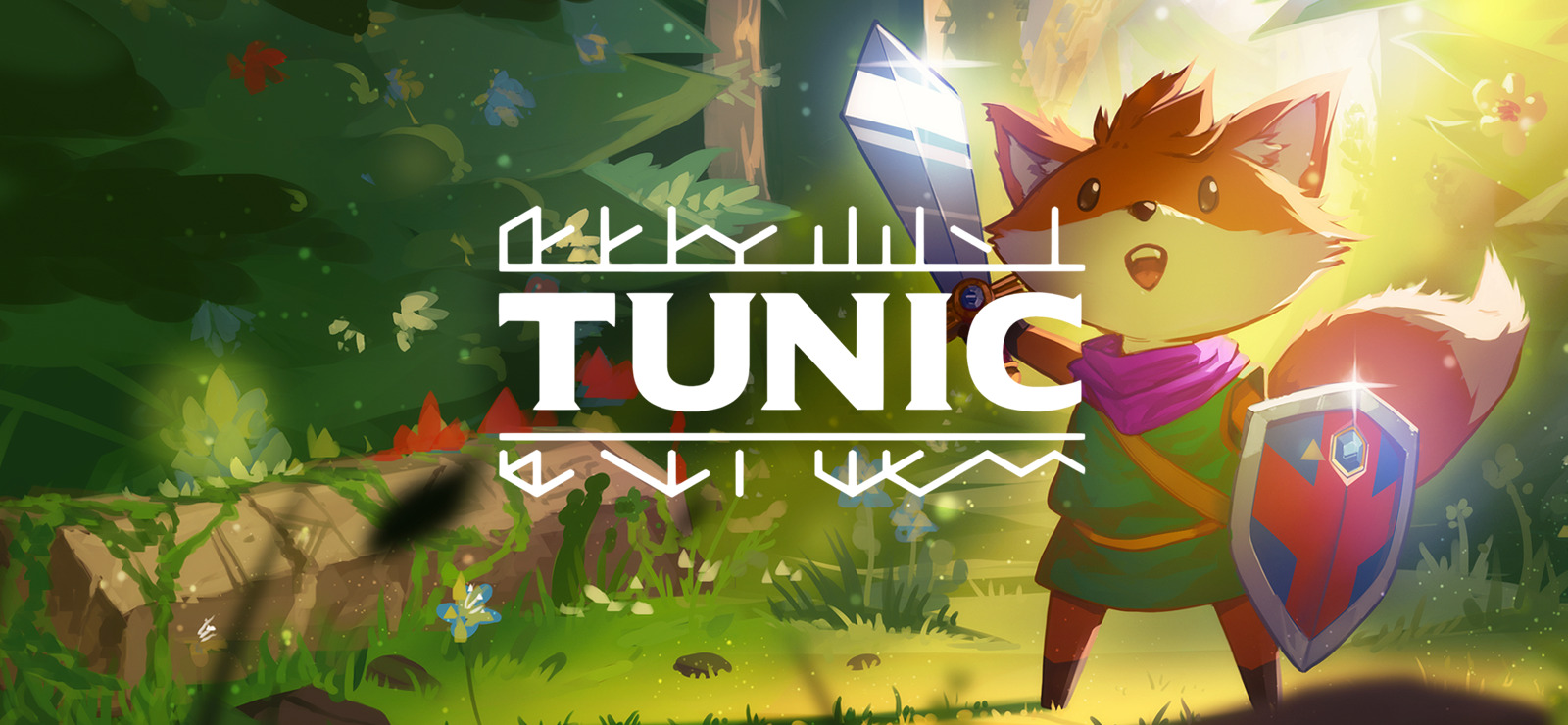
TUNIC is good. It’s great. It has a goofy, simple name that has encouraged Google to serve me both articles about the game and articles of women’s clothing, and it’s drawn me in magnetically over the past two weeks. There have been nights where I’ve had to peel myself away from the computer, and gone to sleep still puzzling over how to get past the latest obstacle I’ve found. It’s worth checking out.
This game has never had a name that, to my mind, properly acknowledged its potential. I first saw it teased at PAX East years ago, when it was still called Secret Legend. From what I can tell, the game has grown significantly since then.
And it’s good.
Other people have already made this quip, but they’re on the right track: TUNIC is a Souls-like by way of Zelda nostalgia. But that’s not all. In many ways, TUNIC reminds me of a less bloodthirsty Hyper Light Drifter (HLD) with more puzzles and more Metroidvania-esque exploration. It’s softer aesthetically, with all its gentle shapes and bright colors, and less challenging in its basic fights. But it still rewards—and requires—mastering its combat-mechanics in order to progress. As is traditional, boss fights are designed with the expectation that you’ll die a number of times. You’ll gradually learn the bosses’ patterns and how they change over the course of the battle, and might find sneaky ways to use those patterns against them.
TUNIC starts you off slowly, a classic ”wild Link” waking on a sandy shore. It introduces its mechanics in a dribble, offering you new equipment and consumables in chests hidden throughout the game—some hidden better than others. It even gives you an in-game manual. But TUNIC requires you to collect every manual page you want to read, and (again like HLD) almost all of its in-game text is in an unfamiliar script.
Just enough of the manual is in English that I haven’t needed to translate the script in order to understand how to do things yet. But nearly the entire “Background Story” page is impossible for me to read, along with other big chunks of the manual. So making a translation is on my to-do list; there are enough pages mostly in TUNIC’s script, enough clues and explanations that I can’t read yet, that I think it is worth it.
Frustrating as this might be, it’s part of what sets TUNIC apart from other similar games for me. It has somehow doled out just enough information to keep me feeling hooked and encouraged, and I haven’t yet spent long enough mashing my head against a wall to despair. Better yet, while there are clues hinted at in the manual, there are also secrets the manual carefully doesn’t explain or mention, which only opens up the feelings of possibility even further.
Given what I heard about the game developers giving their early reviewers a Discord channel where they could share questions and hints about what they’d discovered so far, my hope is to find other people who are playing and compare notes with them. Maybe I’ll do that on the official Discord server; while I’d prefer to confer with friends, the community there looks like it’s doing a decent job of not spoiling things for the most part. And that’s good, because I don’t want spoilers! And I don’t want to spoil anything for another player. I might be willing to tell people that yes, there’s an item that will allow you to do something, or that yes, there’re hints pushing me to investigate in another direction… but I want to find the actual discovery for myself. The few hints I saw on the official server reassure me that I’ve barely scratched the game’s surface, even though I’d thought I was pretty far along.
I guess that makes sense. So far, I’ve just kept finding more things hidden around the world of TUNIC. And every time I discover a new tool or technique, I revisit all the old places I’ve already been and hunt for what I might have missed. So far, I’ve missed a lot! But I’ve also uncovered tremendously cool things, and it’s that feeling of discovery that I love so much. The satisfaction of puzzling out how to do something—how to open a door I’d struggled with or how to sneak my way past it—is what feels so rewarding. I don’t want to ruin that for anyone. And if that’s something you enjoy in a game, I have to recommend this to you.
If you’re able to play it, and if you like Zelda-ish games with many deeper puzzles, and don’t mind an occasional tricky boss battle… damn. Try TUNIC.
Today’s been an odd one. I’ve been productive on other projects, but without a specific book or game lined up to review, I’m at a bit of a loss here.
I’m partway through two books, Teen Killers Club by Lily Sparks, and The Orpheus Plot by Christopher Swiedler. The Orpheus Plot is another middle grade sci-fi book in the same setting as In The Red, this time with slightly more focus on politics and intrigue (a Belter kid wants to join the space navy, which is almost entirely composed of people from Earth, Mars, and the Moon). It does some of the things I’d wanted to see from In The Red, dealing a bit more with the social expectations of people in this setting and how that creates and influences political conflict, so that’s a plus. I’m about halfway through; I’m enjoying it, and I won’t render any verdict yet.
Teen Killers Club caught my attention for being a potential comp title for one of my friend’s YA projects. I’m about a quarter of my way through that one, so I have even less to go on, but at the moment I’d call it a fusion of Holes, Suicide Squad, and the surge in fiction about serial killers from a couple years back. It feels like one-part thriller, one-part mystery, one-part teen camp drama, and it ate a good deal of my time earlier this week and stopped me dead in my tracks in the middle of The Orpheus Project. I’m enjoying it so far.
I’m also rereading Naomi Novik’s socialist-Harry-Potter-but-different The Last Graduate, this time out loud to my partner. They’ve been loving these books (they insisted that I start this one the day after I finished reading the first book, A Deadly Education, to them). That’s good, because I love them too. But I’m not able to read multiple chapters a day because by the time I start reading it’s usually already late. So there’s been an amusing and agonizing dance of trying to find places where I can stop each evening that will both keep them hooked and give them enough breathing room to actually be okay with stopping. The first has been much easier than the second.
Edit: I realized while writing this that I never reviewed The Last Graduate here. I’ll have to rectify that.
I, like several friends of mine, have picked up Vampire Survivors. It’s not an especially complex game, but it does a stunningly good job of catching my attention and holding it. Compulsive. That’s what I’d call it. Usually that’s not a quality I want in a game, but I used it to distract myself from some unwanted thoughts earlier today and that seemed to work pretty well. Maybe not the healthiest solution, but quick and effective at the time.
With a little luck, next week I’ll have finished one of those books and be ready to share my thoughts on it with you.
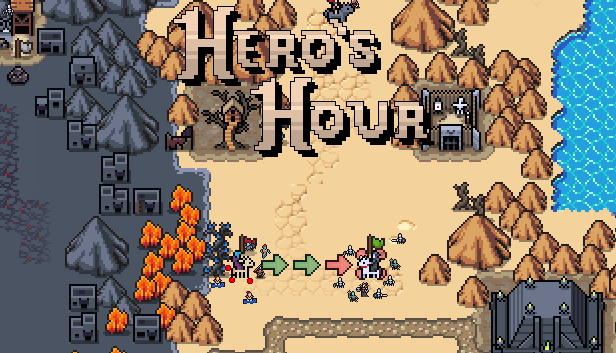
Hero’s Hour, which I wrote about before, is out now in a full release. The game still feels like the same casual-ish Heroes-lite offering I mentioned before. But with its stability improvements in the release build, I can finally play the game without multiple crashes in one sitting. It turns out that’s enough to change my feelings on the game.
The visuals haven’t changed. The maps still feel a little bland, but there’s significant variation in visual appeal between different biomes and it seems like I was mostly playing on the ugliest possible options last time. The units aren’t as detailed or lush as HoMM 3’s units, but their cute lo-fi pixel art design matches their slightly cartoony movement and attack or death animations. It all gels to match the aesthetic, for the most part, and does a decent job.
The map generation and layout also doesn’t seem to have changed. But as one might expect from procedural generation, its quality varies: sometimes the spacing I complained about previously is an issue, sometimes it isn’t, and mostly it feels right enough. However, I admit that the variation is something I never saw HoMM 3 manage well, and it does help keep things interesting. Hero’s Hour deserves credit for that. It also helps, no doubt, that I’ve changed strategies and picked up an early extra hero or two to cover more ground and to augment and reinforce my main army faster (old HoMM strategies I’d nearly forgotten).
Also, I think I’ve found the ‘deeper strategy’ I’d glimpsed before. It’s not what I’d expected. Hero’s Hour gives every faction unique mechanics, and every hero a unique arrangement of common skills, without (apparently) trying to balance any of them. I generally like games where every faction can do weird cool stuff, and I’m okay with that imbalance. But this means the most reliable path to victory (vs the AI) is to find and exploit combos of skills and faction units, and then hammer that combo relentlessly. Changes in strategy are rarely necessary when facing the AI. Some heroes seem strictly worse than others, whether through weaker or slower-starting combos, but counter-combos are also available sometimes. This creates a messier-than rock-paper-scissors dynamic, which I think could shine in a multiplayer setting. Sadly the game only currently offers multiplayer via hotseat—classic HoMM—and the dev apparently isn’t certain how to implement other multiplayer options.
What’s my final take?
In context, this game is extremely impressive. It’s predominantly one person’s project, with help from a few other contractors. Now that it’s more stable, I’m able to enjoy the HoMM-esque feel without interruption. As I said above, it turns out that’s enough to let me enjoy the HoMM homage without fixating on the minor shortcomings. I can just relax and have fun.
And your mileage may vary! Some folks like the game’s aesthetic more than I do, including the map’s visuals. Plus, there are enough weird interactions between different units and their abilities that the game can totally surprise me; that’s both good and bad, but it leaves enough intriguing wrinkles to draw and hold my interest for a bit. And at least in Hero’s Hour I can puzzle through why what was supposedly an easy fight was actually hard. This game does a far better job explaining unit and hero abilities than HoMM 3 did, where most unit abilities were opaque and the path to victory was generally predictable.
I’ve seen precious few games recreate the HoMM experience any time recently (though I’m still watching Songs of Conquest) and if you want to experience HoMM again, this is one of the few options that can deliver that. Playing Hero’s Hour is fun. The game knows what it’s doing. Plus, there’s a free demo, which is a big plus.
No review for the moment, just an update. I’ve got Sal & Gabi Break the Universe right now, and am looking forward to getting my hands on In The Red soon (which for some reason wasn’t available as an ebook through Libby). My recent book-sprint has slowed down again, just waiting for it to pick back up again. Might have something to do with watching more shows than I usually allow myself to, or giving myself permission to watch them less attentively than I usually try to.
Meanwhile, I’ve been reading Murderbot to my partner and they’ve been loving it. I love rereading it too, though I’d forgotten how difficult some of it is for reading aloud. It turns out that while I think Martha Wells was right to bury some conversations in paragraphs the way that she did, simply because that’s how they fit in Murderbot’s stream of consciousness, it’s a lot harder to read those buried lines aloud without breaking up my reading to clarify what Murderbot says versus what it thinks. This could be easier, if I had thought to come up with a distinct voice for Murderbot’s speech as opposed to its thoughts, but alas I did not.
Besides, that would be odd, right? It’s all Murderbot. It should sound more similar than different.
It’s not all bad though. I did luck into some hilariously good voices by accident, especially while reading ART’s lines.
I’m not sure what next week is going to look like, or whether I’ll be able to post much; I’ve been selected for jury duty, and might be otherwise occupied.
Oh, and on the video game front, following up the Hero’s Hourpost from two weeks back… there’s another game that also obviously wants to follow the path of the old Heroes of Might and Magic games: Songs of Conquest. It’s not available yet, though early access is supposed to start in March. From the little I’ve seen so far, it looks like they’ve focused a larger team with more resources on making fewer factions in a game with more visual polish and greater similarity to HoMM’s old combat mechanics. Hopefully it is also more stable.
Hero’s Hour is so clearly an homage to Heroes of Might and Magic (HoMM), especially HoMM3, that it’s impossible for me to play it without comparing the two. That’s both a strength and a weakness.
I love HoMM 3. I played so many hours of HoMM3 that it’s been etched into my brain in a way that few other games have matched since. I also played a number of other HoMM games—the first two, as well as HoMM4 & 5—and all of that trained me pretty well in the genre those games pioneered (and which few games have matched before or since). Heck, New World Computing, the makers of the original HoMM games, may have actually trained their audience too well given the mixed reception to their changes to the game for HoMM 4.
What I’m trying to say here is that making a sequel to the Heroes of Might and Magic series, even making an homage to the series, isn’t easy. A number of studios have struggled to do just that, most often creating new games that were mediocre imitators rather than improvements to the genre.
A little history, and maybe some perspective.
After New World Computing disbanded, Ubisoft continued publishing sequels from other developers, with a new developer for each subsequent game. Sometimes they even found a new developer for an expansion. I have no idea what that was like for the teams involved, but from an outside perspective that doesn’t seem like a good sign.
I played a little bit of some of those sequels. They were… fine? None of the ones I played went beyond simply feeling okay, none of them delivered quite the same flavor that pulled me into HoMM 3 and kept me playing it for over a decade. Some of them shared similar points of failure with Hero’s Hour.
This isn’t a struggle unique to those trying to recapture the appeal of HoMM. It’s happened with a number of different attempts to recreate the feeling of other 90s classics (like Master of Magic or Master of Orion). The best sequels and homages to those games that I’ve played all rely on finding some way to distinguish themselves, to be new and different and give themselves a way to excel, while still obviously following in the same vein as their predecessors. That seems like a universal rule for sequels, not only with sequels to these games.
But for whatever reason, most games I’ve seen that have tried to follow in HoMM 3’s footsteps haven’t managed to both recapture the feel and distinguish themselves well.
Sadly, I’m not sure that Hero’s Hour does either. Yet.
First, a caveat: I’m writing about an early version of the game (v.1.8.2). It’s available on itch.io, but isn’t out on Steam or GOG yet. I don’t know what will change with the wider release. Presumably some of the issues I mention here will be resolved.
Now. Why do I have to compare Hero’s Hour to HoMM?
The game very obviously wants to be recognized by fans of HoMM. The hero attributes are the same, many mechanics are the same, a number of the factions (and the factions’ units) are either the same or within spitting distance of each other. Tromping around the map and upgrading your town is eerily similar to HoMM3 (more on that later), right down to the names, functions, and visual designs of many map locations. It’s all close enough—until you get to combat—that it’s achingly familiar. Familiar enough that I wouldn’t be surprised by an intellectual property lawsuit (though I don’t know who’d win that).
Combat, and the way in which those familiar hero attributes are used in combat, is where things are totally different. Hero’s Hour uses a real-time-with-pause auto-battle system, one that allows you to give commands to your various units, sling spells, etc. That’s a considerable departure from the hex-grid turn-based strategy of HoMM. I actually like how this change distinguishes the game from the originals. But it’s not especially clear to me how to learn the auto-battler’s systems, and it’s not clear I’ll be able to master it in the same way I did HoMM3’s battles. Like HoMM3, the underlying mechanics are a bit opaque; but 23 years have passed since HoMM3 came out, and I have higher expectations for system design and the presentation of information. Also, I want to feel a little less clumsy in the game’s battles. Maybe that expectation of mine, the idea that I might have finer control of the battle, is the problem here: nothing about the game’s battle aesthetics suggests much fine control would be available, as lots of little units hop around cartoonishly and bump into each other in bloody combat.
It’s cute, really. I wish I felt like I understood it better.
It also is unstable. I expect this to be patched out, but the game has crashed several times for me near the start of a battle. More rarely, it’s crashed at other points during the turn. This is a big problem. The game is informal and straightforward enough to keep me playing for a while, but it’s not addictive enough to pull me back in after a crash (let alone several). The game does have a reliable autosave feature, so I’ve never lost too much progress in one go, but I hope the instability is fixed quickly.
Now, back to the map.
Hero’s Hour’s visual design for its maps is fine, but compare it to the rich textures of the games it’s imitating.
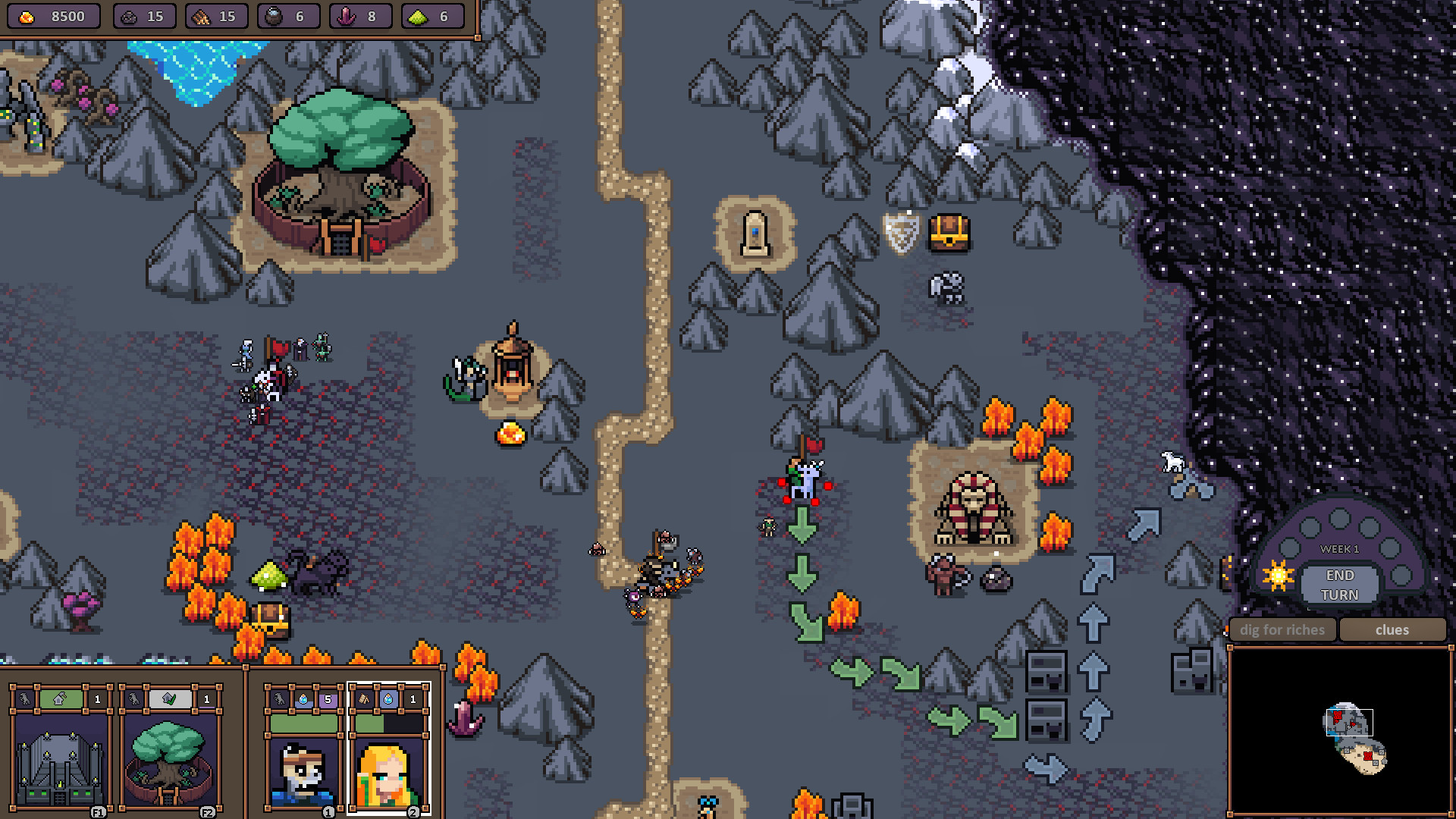
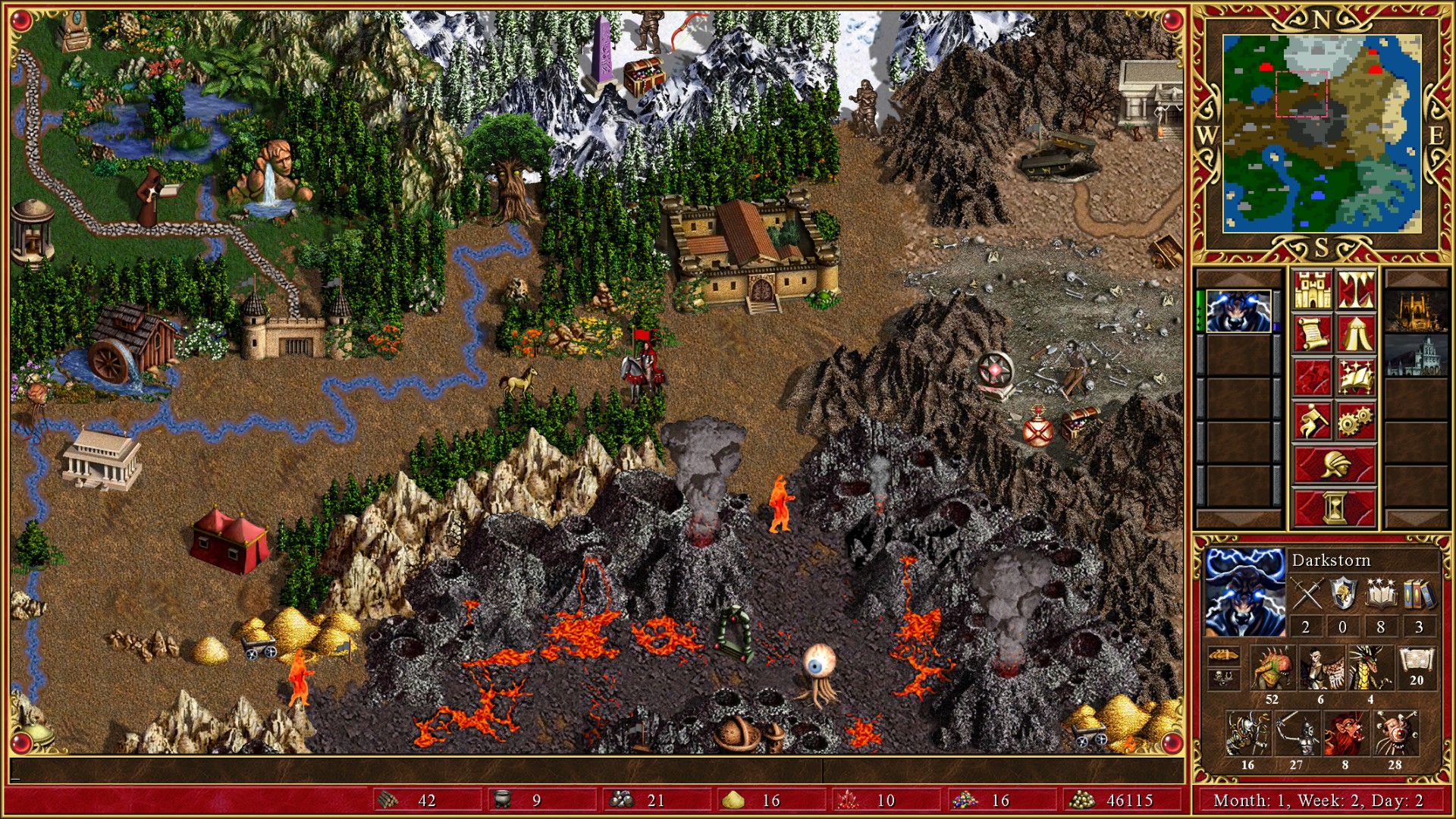
This critique in some ways feels unfair to me, but: the visual design for the map feels lackluster. It’s bland. This is made worse by how obviously this game has been built in the image of the old HoMM games, and how it looks when I compare a screenshot of it with a screen from one of the old games. Hero’s Hour wants to remind players of those games (and does!) but its visual design doesn’t stand up to the visual design (or map design) of HoMM 2&3. HoMM2 had vibrant and inviting color, lots of texture, and map features that engaged the viewer. HoMM3 toned down the color palette very slightly—but it instead added more color variety, and paid even more attention to detail, making the various locations on the map pop. Both titles managed to make very full screens overflowing with tiny details that were still legible to the eye. Hero’s Hour has obviously put time into designing the map locations that players will look for and visit, and has ensured that all the various interactable locations and items are legible as such, but by comparison the background (which takes up most of the screen, and which players spend almost all their time looking at) feels neglected.
HoMM 2 looks lush and vibrant by comparison
And compare HoMM 3’s richly textured volcanic terrain to the detail available in Hero’s Hour
That critique feels unfair to me because I know there’s a solo developer (presumably with limited support from contractors) behind this project. For comparison, even at its smallest I believe New World Computing had three people. Yet while I know it’s a stretch to ask for more and better art—and better overall visual design—I do want more. I want varied texture for the backgrounds. I want the edges of the current texture swatches to be less blocky and more organic. I suspect that if this game’s map backgrounds received a little more attention—got a little more texture, more saturated colors, more places for the eye to explore—that would go a long way. I don’t expect this solo developer to outdo (or even match) HoMM 3’s visuals, but I really want a little more visual appeal.
And it’s clear that the dev knows how to do this! The Town screen is an excellent example. It’s detailed, colorful, and has lots of changing elements that develop as you build new structures (all hallmarks of the HoMM games). It’s obviously received plenty of attention. But this means that the dramatic difference in visual appeal between those Town screens and the map that I spend almost all my time looking at is even harder to ignore.
There’s another side to the maps which feels odd: area layout, map design, and initial expansion. This feels especially odd given how closely the “riding around on the map gathering resources and visiting locations” experience matches the old HoMM experience. Maybe this would feel different to me if I had better mastery of the battles, but early expansion in Hero’s Hour (with default settings) is harder and slower than I remember it being in HoMM3. The neutral armies guarding the ever-vital elements of the resource economy are a hair tougher, more wall than speed bump. And those guarded mines are spread further apart… indeed, it feels like the whole map is stretched just a bit wider than the old games. If this felt more deliberate, and if the game gave me more opportunities to *do* things while building up my army to conquer basic resource generators, I think it might feel different. As it is, I feel like I’ve spent more time wandering back and forth picking up minor collectibles and twiddling my thumbs than I did in the old games—which is saying something.
I suspect this comes down to random map generation.
Random map generation is neither easy nor simple. I’m not surprised that Hero’s Hour’s map generator is creating maps that feel less well-tuned than the custom made maps of HoMM3. That seems unavoidable, without a preposterously long development time. And playing Hero’s Hour gave me newfound appreciation for how finely the old HoMM team had honed their map-making skills. But it also makes me wonder whether this game would be better off with hand-made maps, at least at first. So much of the game is spent roaming around them, it matters when they don’t feel rewarding.
Unfortunately, the combination of visual design, less well-tuned maps, and slightly-clumsy battles leaves this game feeling a little more like an idle game and a little less like a deep and engaging strategy game. I think that’s misleading, because I suspect that approaching it more like an idle game will make it very hard to win. What’s more, I can see that there *are* deeper strategic options available, even if I haven’t yet learned how to really shine in the game’s battles so that I can reach them.
And I want to reach them. I love the genre, and I do still enjoy the game. I’ll probably play more again today, and will no doubt check in again as it is updated. But as the game stands right now, it’s not going to pull me in and feel rewarding for hours upon hours, unlike the games it’s so obviously trying to imitate. I want Hero’s Hour to do better, because I love those old games and I want more people to see how good they could be. And I want Hero’s Hour to do better because it’s already so close, it’s almost there. Good luck, dev(s).
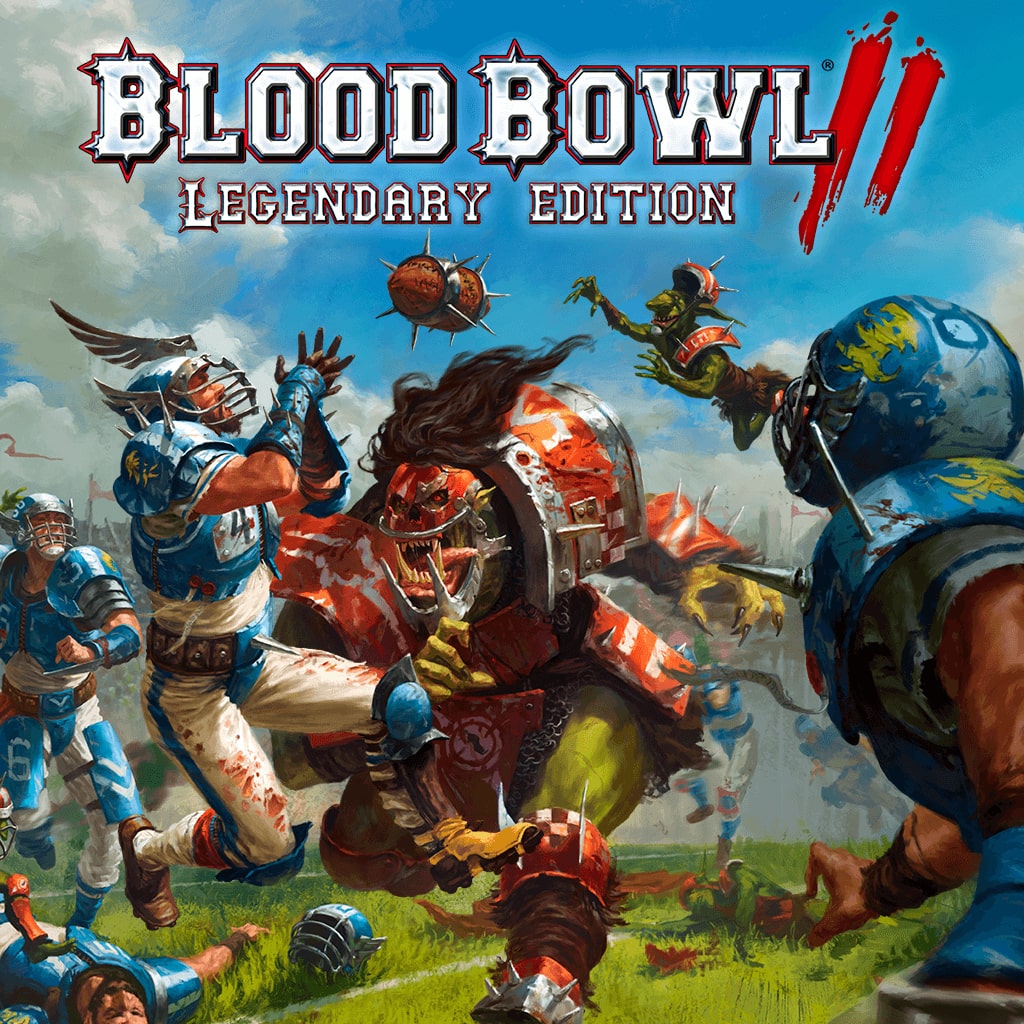
This is not a recommendation, this is just me musing on a game that I’ve been enjoying with my friends for the past… COVID, really. We started playing together in the spring of 2020, when we realized that we weren’t likely to see each other for a long while. I’d never played Blood Bowl before, though I remembered seeing a couple painted minis for it when I was a little kid.
I thought those looked cool, like pretty much everything else that my older sibs touched.
Normally, my friends and I would all see each other in the summer while we worked at LARP camp. We’re also quite close, emotionally speaking; being able to talk to them regularly was (is!) sanative and restorative for me. Given that I’m bad at staying in touch with anyone I don’t see regularly or intentionally schedule time with, playing a semi-weekly fake sports match in a league with my friends was pretty ideal.
The game, however, was not easy to love. Blood Bowl is a satirical mashup of soccer hooliganry, American football, and rugby, and it’s about as violent as it is tongue-in-cheek. It’s also a troublesome beast, full of non-obvious rules and capricious randomness. You can absolutely play an excellent game and still lose because you were sufficiently unlucky with your dice. And you can win a game with a mere tactical victory, while most of your team lies broken and bleeding on the pitch.
In a strange way, I think Blood Bowl was a very appropriate game for me to start playing during the early stages of a pandemic. You have to learn equanimity to play well, or at least learn to recognize when you’ve lost that balance. You can only play your best, try to control what you can, and understand that there’s always something that simply isn’t up to you. In that way, it was quite good at teaching me to let go of trying to control absolutely everything.
Useful, given the world’s circumstances.
For a long time, perhaps over a year of playing the game, I wasn’t even interested in playing with anyone besides my friends. No matter how much fun I had playing, it was often still stressful. And the thought of playing with anyone I wasn’t close friends with—anyone I wasn’t LARP-camp friends with—had very little appeal. A lot of the joy I got from the game came from naming my team and players after good bits, things that I could play to the hilt and which I and my friends could laugh about. It helped that some of my fellow players were into pro-wrestling and convinced us all to indulge in the kayfabe and the creation of faces and heels for our league.
But I think I’ve finally turned a corner. I can’t say I’m likely to start playing games with randoms on the internet, but I’ve finally reached a point where the game feels more rewarding and less stressful. Maybe that’s from growing skill and familiarity, maybe it’s a shift in mental health and brain weather, or maybe it’s something else. Suffice to say, I do actually enjoy the game these days. I don’t only engage with it as a way of maintaining regular contact with my friends (though that is still something I treasure).
For myself, I’m looking forward to more seasons of Blood Bowl to come. And I can’t wait to see whether the Skraghaven Squigbitas can take down that uppity bunch of varsity kids, the Kronar High Neandertals. I plan to watch, and heckle, and root for my friends this Saturday while we find out what wildly improbable inanity will happen this time.
I think I finally understand what people love about rooting for their teams in real life sports. I won’t say that you should try the game, or that you’d enjoy it, but… you might?


 Fistful of Wits